What specs matter when you choose a heater for your tank?
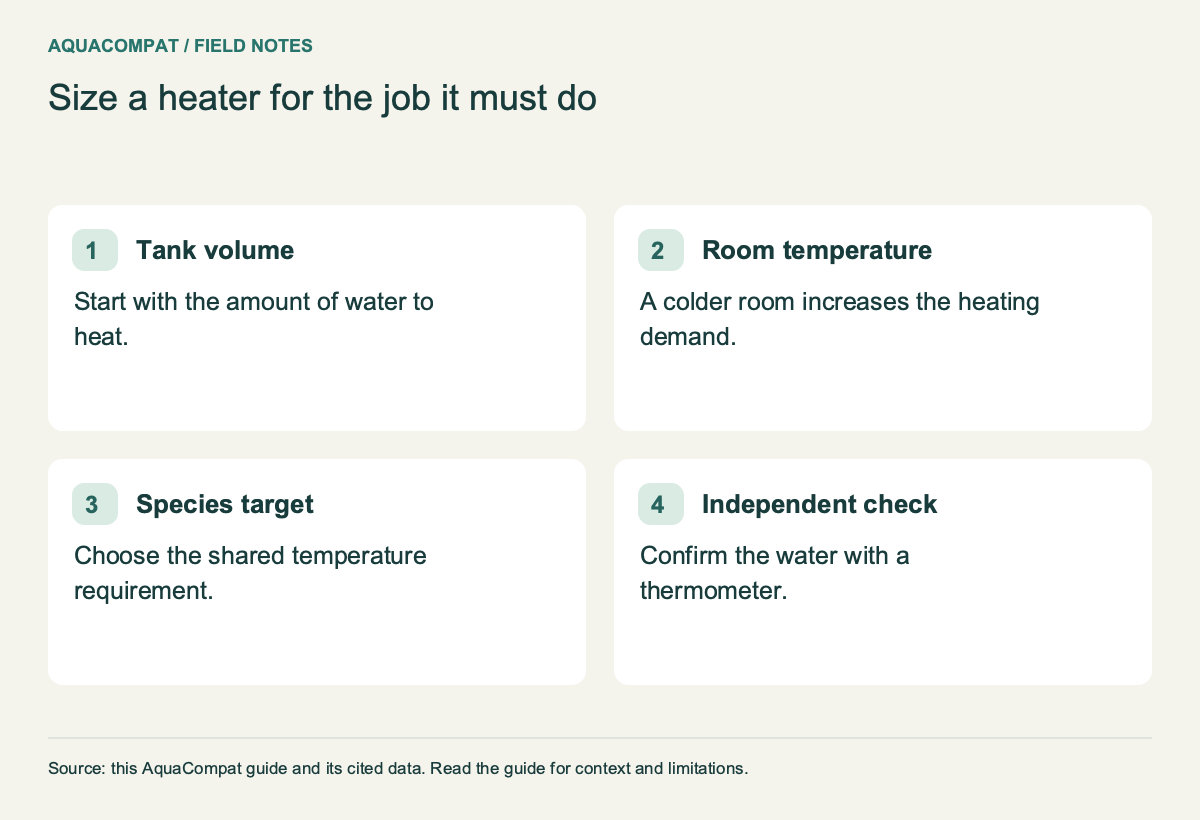
Four specs decide whether a heater suits a tank: wattage against water volume, how the thermostat controls temperature, what protects the fish if something goes wrong, and whether the heater physically fits. Price and brand matter far less than these.
Wattage against volume
Wattage sets how quickly a heater can lift the water above room temperature. Hobby sizing rules put the need at about 5 W/gal to hold water around 10 °F above the room, or 1 W/L in a normally heated room. Aquarium Co-Op and All Pond Solutions publish these figures; no university extension source sets a figure, so treat them as starting points, not limits. A cold basement or an uncovered tank needs more.
Thermostat type and accuracy
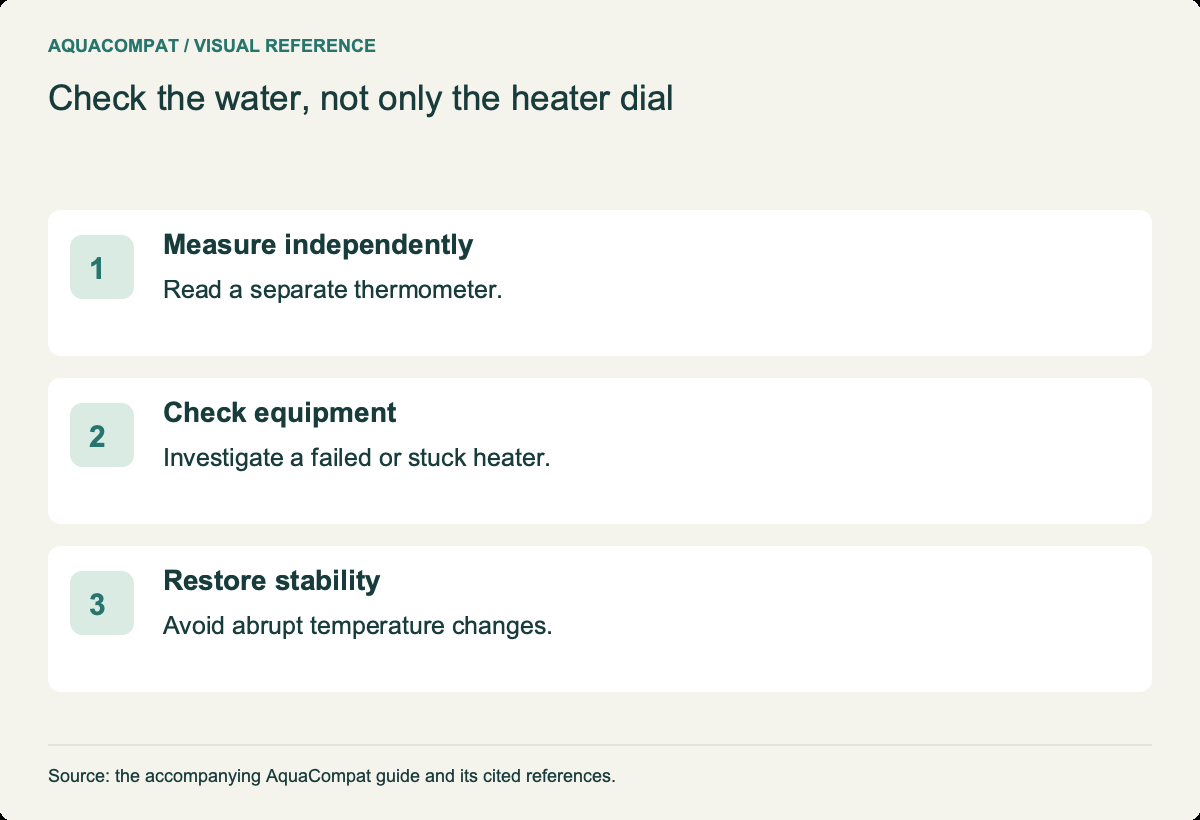
A thermostat is the switch that turns the element on and off. Electronic models such as the Fluval E series use a microprocessor and, per Fluval, two temperature sensors, and they show the water temperature on a display. Dial models such as the Eheim Jager rely on a calibrated thermostat; Eheim publishes a control accuracy of ±0.5 °C and lets you recalibrate the dial against a thermometer. Whatever the type, check it against a separate aquarium thermometer for the first week.
Protection when things go wrong
The most common failure is a heater left running out of water during a water change. Eheim lists a dry-run shutoff on the Jager, and Hydor describes the Theo’s PTC element as self-limiting so it stops on abnormal operation. Fluval does not publish an automatic shutoff for the E or M series, so the safe habit is to unplug any heater before lowering the water level.
Physical fit
A heater must sit below the waterline along its working length. The Fluval E100 measures 298 x 50 x 28 mm (H x L x W), the Jager 100 W is 12.2 in long, and the Hydor Theo 50 W is 7 in. Measure your tank’s water depth before buying, especially for low nano and rimless tanks.
How many watts does a 5, 10, 20, 29, 40, 55 or 75-gallon tank need?
Multiply the tank’s volume by the sizing rule, then pick the next heater size up. The table applies both published rules so you can see the spread; the lower figure suits a warm, lidded room and the higher one a cooler room or an open-top tank.
| Tank size | Volume | At 1 W per litre | At 5 W per gallon | Heater size to look for |
|---|---|---|---|---|
| 5 gal | 19 L | 19 W | 25 W | 25–50 W |
| 10 gal | 38 L | 38 W | 50 W | 50 W |
| 20 gal | 76 L | 76 W | 100 W | 100 W |
| 29 gal | 110 L | 110 W | 145 W | 150 W, or 2 × 75 W |
| 40 gal | 151 L | 151 W | 200 W | 200 W, or 2 × 100 W |
| 55 gal | 208 L | 208 W | 275 W | 300 W, or 2 × 150 W |
| 75 gal | 284 L | 284 W | 375 W | 2 × 200 W |
Which heater suits which tank size?
Manufacturers rate the same wattage differently, so compare the published tank range, not just the watts. Fluval rates its 100-watt E100 for tanks up to 30 US gal / 120 L, while Eheim rates its 100-watt Jager for 100–150 L (26–40 US gal). Neither rating is wrong: they assume different room temperatures. In a cool room, buy from the lower end of the published range.
| Heater | Watts | Rated tank | Thermostat | Run-dry protection | Length |
|---|---|---|---|---|---|
| Hydor Theo 50 W | 50 W | 20–50 L / 5–14 US gal | Graduated dial, PTC element | Self-limiting PTC element | 7 in |
| Fluval E100 | 100 W | up to 30 US gal / 120 L | Electronic, LCD readout | Not published | 298 mm |
| Eheim Jager 100 W | 100 W | 26–40 US gal | Calibrated dial, ±0.5 °C | Yes, dry-run shutoff | 12.2 in |
| Fluval M150 | 150 W | up to 45 US gal / 150 L | Calibrated dial | Not published | 33 cm |
| Eheim Jager 150 W | 150 W | 53–79 US gal | Calibrated dial, ±0.5 °C | Yes, dry-run shutoff | 13.4 in |
| Fluval E300 | 300 W | up to 100 US gal / 375 L | Electronic, LCD readout | Not published | 35.5 cm |
Heaters matched to tank size
Each heater below was chosen for a size band, using the published ratings and features above. None of them was bench-tested by AquaCompat; the notes explain the trade-offs that the specifications reveal.
As an Amazon Associate I earn from qualifying purchases. Prices change often, so they are not shown here; the button opens the current listing.

Hydor Theo 50 W
- Power
- 50 W
- Rated tank
- 20–50 L / 5–14 US gal
- Setting range
- 20–32 °C
- Protection
- PTC self-limiting; stops automatically on abnormal operation or dry running
Fits: a 5 to 14-gallon betta, shrimp or small community tank; at 7 inches it suits shallow nano tanks and can lie horizontally.
Skip it if: you want a readout on the heater itself; the Theo uses a graduated scale, so pair it with a thermometer.
Check price on Amazon
Fluval E100
- Power
- 100 W
- Rated tank
- up to 30 US gal / 120 L
- Setting steps
- 0.5 °
- Display
- LCD with VueTech colour alert
Fits: a 20-gallon community or planted tank where you want to read the temperature at a glance; the display changes colour when water drifts from the set point.
Skip it if: your tank is shorter than about 12 inches of water depth, or you need a published run-dry shutoff.
Check price on Amazon
Eheim Jager 100 W
- Power
- 100 W
- Rated tank
- 26–40 US gal
- Accuracy
- ±0.5 °C
- Protection
- yes, dry-run shut-off (Thermo Safety Control)
Fits: a 29-gallon tank in a heated room; the dry-run shutoff and recalibration dial suit owners who set it once and check it weekly.
Skip it if: you keep the tank in a cold room; at 100 watts it sits below the 5 W per gallon rule for 29 gallons.
Check price on Amazon
Fluval M150
- Power
- 150 W
- Rated tank
- up to 45 US gal / 150 L
- Construction
- shock-resistant borosilicate glass, mirrored finish, ceramic heat sink
Fits: a 29 to 40-gallon tank where a slim, mirrored heater is less visible against the background.
Skip it if: you rely on the heater to protect itself during water changes; Fluval does not publish a run-dry shutoff.
Check price on Amazon
Eheim Jager 150 W
- Power
- 150 W
- Rated tank
- 53–79 US gal
- Accuracy
- ±0.5 °C
- Length
- 13.4 in
Fits: a 55-gallon community tank, or a pair at each end of a 75-gallon tank to share the load.
Skip it if: your tank is under 20 inches tall; at 13.4 inches the heater needs deep water.
Check price on Amazon
Fluval E300
- Power
- 300 W
- Rated tank
- up to 100 US gal / 375 L
- Setting steps
- 0.5 °
- Display
- LCD with VueTech colour alert
Fits: a single-heater setup on a 55 to 75-gallon tank, with the readout visible from the front.
Skip it if: you prefer two smaller heaters for redundancy on a large tank.
Check price on AmazonHow did we choose these heaters?
Every heater here was chosen by comparing manufacturer specifications against the sizing rules above. We did not test them in our own tanks, so the notes report what each maker publishes and what that means in practice. The criteria, in order of weight, were a rated tank range that matches a common tank size, a published safety feature (run-dry protection or a self-limiting element), a way to set or read the temperature precisely, and availability from US retailers. Each listing is matched to the exact model and wattage named on the manufacturer’s page; bundles and third-party replacements were excluded. Prices are left out because they change daily. Our full research method is on the methodology page.
Two heaters were left off. The Cobalt Neo-Therm we planned to include had no current US listing matching its model, and the Fluval E200 listing named a different wattage in its title, so neither could be linked with confidence.
What temperature should the heater hold?
Set the heater to the range your fish share, not a generic number. Merck’s veterinary guidance puts tropical fish near 77 °F, and most community species fall inside that. Individual species differ, though: neon tetras are listed at 70–77 °F (21–25 °C), betta fish at 72–86 °F (22–30 °C), and discus need warmer water at 79–86 °F (26–30 °C). When two species share a tank, set the heater inside the overlap; the aquarium temperature guide lists the ranges side by side.
Goldfish are the main exception. They are temperate fish with an optimum of 65–75 °F, so most goldfish tanks in a heated home need no heater at all.
If you are setting up a small tank from scratch, the 10-gallon community setup pairs a 50-watt heater with a matching filter and stocking list, and betta keepers can check which fish share a heated tank in the betta tank mates guide. Heater checks belong on the weekly list in the aquarium maintenance schedule.
Is one big heater or two smaller ones better for a large tank?
Two smaller heaters are the safer choice for tanks of 55 gallons and up. Splitting the wattage means a heater that fails off leaves the other still working, and a heater that sticks on has only half the power to overheat the tank. Placing one at each end also evens out the temperature in a long tank. The table above shows a pair of heaters at every size where that split is practical, such as two Eheim Jager 150 W units for a 75-gallon tank.
What should you do when a heater fails?
A heater fails in one of two ways: it stops heating, or it sticks on. Either way, the temperature should be brought back slowly. The Merck Veterinary Manual limits temperature change during handling to about 1 °F or °C per hour, because faster swings stress fish.
- Water too cold: replace or add a heater and let it raise the temperature over several hours rather than adding hot water.
- Water too warm: unplug the heater, increase surface movement for oxygen, and float sealed bags of tank-temperature water to bring it down gradually.
Once the cause is fixed, check ammonia and nitrite over the next few days, since stressed fish and filter bacteria both react to temperature shocks.
Questions people ask
Can a heater be too big for a tank?
A heater rated well above your tank’s volume heats faster but is not dangerous if its thermostat works. The risk appears only if the thermostat sticks on: a 300-watt heater in a 10-gallon tank could overheat the water quickly. Matching the rated range keeps the worst case small.
Where should the heater go in the tank?
Place it where water moves past it, usually near the filter outlet or intake, so warm water spreads instead of pooling. Keep it fully below the waterline for its marked minimum depth and away from substrate, which can crack glass heaters as they warm.
Do I need a heater for a betta?
Yes, in almost every home. Bettas are tropical fish listed at 72–86 °F (22–30 °C), which is warmer than most rooms. A 5 to 10-gallon betta tank needs about a 25 to 50-watt heater, such as the Hydor Theo 50 W.
How long should I wait before adding fish to a newly heated tank?
Let the heater hold a steady temperature for at least 24 hours and confirm it with a thermometer before adding fish. If the tank is new, the nitrogen cycle also has to finish first; see the fishless cycling steps.
Sources 27 documents from 16 publishers
- All Pond Solutions (allpondsolutions.co.uk): “Aquarium Heater Buying Guide”
- Amazon (amazon.com): “Hydor Theo Shatterproof Aquarium Heater, 50-Watt (B00061UQ6G)”; “Fluval E 100 Watt Electronic Heater (B001VMWT4Q)”; “EHEIM Jager Aquarium Thermostat Heater 100W (B003SNU1I2)”; “Fluval M 150-Watt Submersible Aquarium Heater (B0027VONH6)”; “EHEIM Jager Aquarium Thermostat Heater 150W (B003M7P9YU)”; “Fluval E 300 Watt Electronic Heater (B001VMSK0I)”
- Aquarium Co-Op (aquariumcoop.com): “How to Choose the Right Aquarium Heater”
- Aquasabi (aquasabi.de): “Fluval E-Serie Aquarium Heater E100”
- Bulk Reef Supply (retailer) (bulkreefsupply.com): “EHEIM Jager TruTemp Aquarium Heater”
- EHEIM (eheim.com): “EHEIM thermocontrol 100”; “EHEIM thermocontrol 150”
- FishBase (fishbase.se): “Symphysodon aequifasciatus, Blue discus: species summary”
- Fluval (Rolf C. Hagen) (fluvalaquatics.com): “E100 Electronic Heater, 100W, up to 30 US Gal / 120 L”; “M150 Submersible Heater, 150W, up to 45 US Gal / 150 L”; “E300 Electronic Heater, 300W, up to 100 US Gal / 375 L”
- Gardensite (retailer) (gardensite.co.uk): “Hydor Theo 50W Aquarium Heater”
- Hydor (hydor.com): “THEO”
- Maidenhead Aquatics (fishkeeper.co.uk species data sheet) (fishkeeper.co.uk): “Neon Tetra data sheet”
- Merck Veterinary Manual (merckvetmanual.com): “Special Considerations for Fish (pet owner version)”; “Environmental Diseases of Aquatic Animals in Aquatic Systems (Francis-Floyd, Yanong, Petty)”
- Reef Supplies (retailer) (reefsupplies.ca): “Fluval M150 Submersible Heater - 150W”
- Seriously Fish (seriouslyfish.com): “Paracheirodon innesi (Neon Tetra)”; “Betta splendens”; “Symphysodon aequifasciatus”
- Southern Regional Aquaculture Center (srac.msstate.edu): “SRAC 7201: Species Profile: Koi and Goldfish (Watson, Hill, Pouder)”
- UF/IFAS EDIS (ask.ifas.ufl.edu): “Evolution, Culture, and Care for Betta splendens (FA212)”
All sources accessed . Every number on this page comes from these documents.