- Temperature overlap
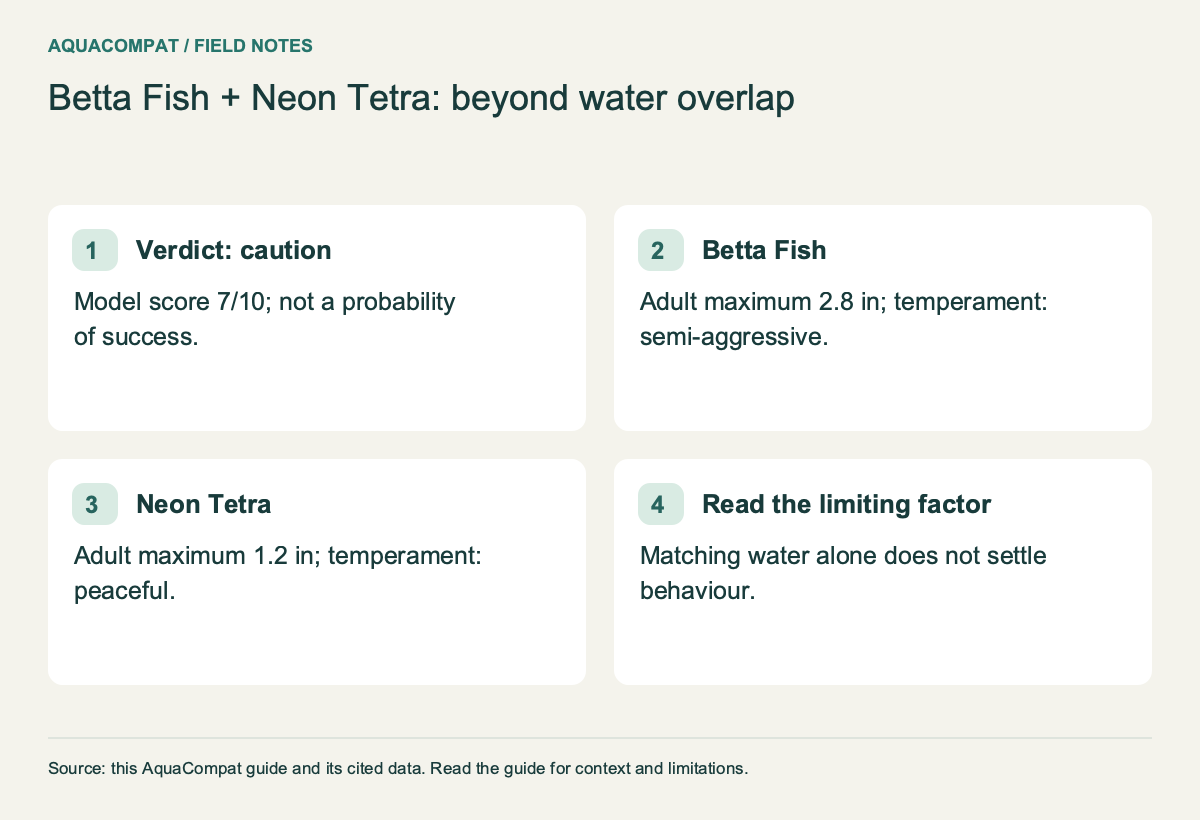
- 7/10
- pH overlap
- 8/10
- Hardness overlap
- 10/10
- Temperament
- 6/10
- Size and predation
- 8/10
- Swim level
- 10/10
- Smallest tank together
- 29 US gal (110 L)
Scores come from published water ranges, adult size, temperament and swim level. How the score works.
Where do bettas and neon tetras overlap in water parameters?
Bettas and neon tetras overlap at 72–77 °F (22–25 °C), pH 6.0–7.5 and a general hardness of 1–12 dGH. The pH and hardness bands are generous, but the temperature band is the narrowest of the three and is the main reason this pairing does not score higher. The betta alone is listed at 72–86 °F (22–30 °C), pH 6.0–8.0 and 1–15 dGH. The neon tetra alone is listed at 70–77 °F (21–25 °C), pH 5.0–7.5 and 1–12 dGH.
Read the bars below from left to right. The betta’s temperature bar starts a little above the neon’s and runs far past it, so the shared band is cut off on the warm side by the neon tetra. On pH and hardness the neon’s bar is the wider one at the soft, acidic end, while the betta’s extends further toward hard, alkaline water; their middle stretch is where both overlap.
Which temperature suits both a betta and neon tetras?
A betta and neon tetra tank should sit in the lower-middle of the betta’s range, which is also the upper half of the neon’s. The published figures explain why. Seriously Fish lists neons at 70–77 °F (21–25 °C), and the Maidenhead Aquatics data sheet and FishBase stretch only a degree or two warmer. For bettas, Seriously Fish gives 72–86 °F (22–30 °C), FishBase records a wild habitat that starts warmer still, and Aquarium Co-Op suggests a setting of about 80 °F. That Co-Op setting is above every neon figure in our sources.
The heater therefore has to be set for the neons rather than for the betta. Merck’s veterinary guidance gives a general tropical target near 77 °F, and for this pair that generic target already lands at the neon’s upper limit, with no margin for a warm summer room. A setting toward the middle of the shared band leaves room in both directions. The guide to aquarium temperature ranges by species lists both fish beside every other species we cover, and a heater sized for the tank, as explained in the guide to aquarium heaters by tank size, holds that setting more steadily than an undersized one.
Do pH and hardness limit this pairing?
Neither pH nor hardness limits a betta and neon tetra tank kept with ordinary domestic fish. The neon comes from acidic blackwater and clearwater streams of the upper Amazon, according to Seriously Fish and FishBase, and Seriously Fish gives it a pH floor of 4.0. Domestic bettas sit higher: Seriously Fish lists pH 6.0–8.0 overall but notes that wild-collected bettas prefer 5.0–7.0. Both species therefore manage in soft, slightly acidic to neutral water, which is the middle of the shared band. The guide to aquarium pH ranges and how to change them explains how to move pH safely if your tap water sits outside it, and the explainer on general and carbonate hardness covers the hardness side.
Will a betta attack neon tetras?
A betta may chase neon tetras, but the published sources describe it mainly attacking a different kind of fish. Seriously Fish states that a male betta may treat fish with trailing fins or a betta-like body shape as rivals, and no source in our data puts the neon tetra in either group. The betta is still recorded as semi-aggressive, and Seriously Fish calls it unsuitable for a standard community tank, so a calm outcome cannot be promised.
Behaviour varies from one betta to the next. The care sources behind our betta data note that some individuals tolerate peaceful nano fish in planted tanks, while others go after anything that moves through their space. Seriously Fish also observes that ornamental strains appear more aggressive than wild Betta populations. The neon tetra is the calm side of the pairing: Seriously Fish describes it as generally peaceful, and Maidenhead Aquatics notes only that males hold small, discreet territories, as many tetras do.
Is a neon tetra small enough to be eaten?
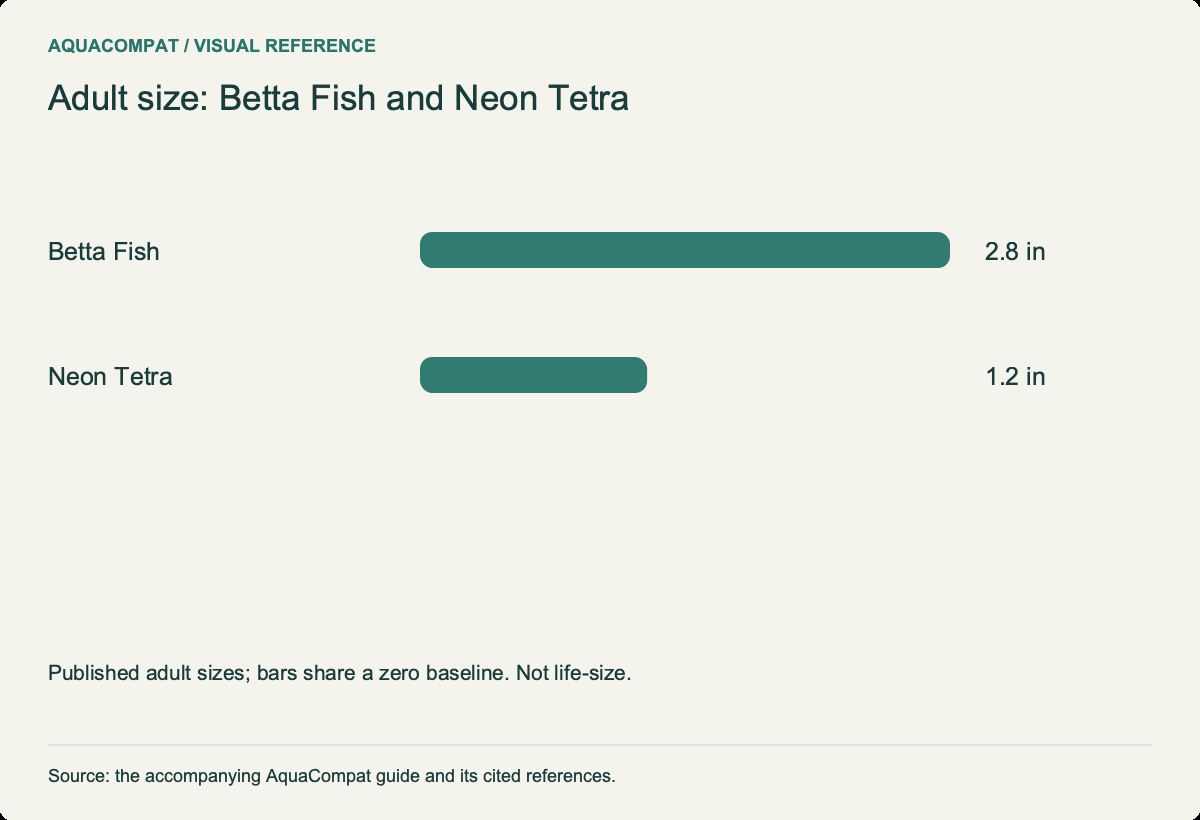
An adult neon tetra is too large for the betta’s predation risk in our data, which is why the size factor scores well. The neon reaches 1.2 in (3 cm) against the betta’s 2.8 in (7.1 cm). Maidenhead Aquatics warns that only very tiny tank mates may be mistaken for a snack. The contrast is the Endler’s livebearer, which tops out at 1 in (2.5 cm) and fails our size check with a betta, scoring 3/10. Neon eggs and newly hatched fry are another matter, but Seriously Fish says breeding neons needs a dedicated tank anyway.
Do they use different parts of the tank?
Bettas and neons mostly occupy different layers, which helps. Aquarium Co-Op says bettas prefer the upper third of the tank, and it places tetras in the middle level as a group. The neon’s placement comes from that group statement rather than a neon-specific source, but it is consistent with a school that cruises below a betta patrolling near the surface.
What tank size do a betta and neon tetras need?
A betta and neon tetras need at least 29 US gal (110 L) together in our data, almost three times the betta’s own figure. The betta alone needs 10 US gal (38 L), based on Seriously Fish’s 45 × 30 cm footprint. The neon school is what raises the total: Seriously Fish gives neons a 60 × 30 cm base, which our data rounds to 15 US gal (57 L), and FishBase also calls for an aquarium at least 60 cm long. Our method takes the larger of the two single-species figures, adds a margin because the betta is semi-aggressive, and rounds up to the next common tank size.
The length matters as much as the volume. A school of neons needs horizontal swimming room, and a longer tank also gives the school space to stay away from the betta. Long-finned bettas cannot swim well in strong currents, per Aquarium Co-Op, so the filter should be sized for the larger tank but kept gentle at the surface.
A 10-gallon tank is too small for this pairing, even though it suits a betta alone; it is below the neon’s own minimum before the betta is added. The guide to fish for a 10-gallon community tank lists species that do fit at that size, and the stocking calculator for aquariums checks a betta, a neon school and any bottom dwellers against your actual volume.
Can bettas and neon tetras eat the same food?
Bettas and neon tetras can share most frozen and live foods, though their diets lean in different directions. The betta is a carnivore: FishBase lists zooplankton and insect larvae in its wild diet. Seriously Fish adds that bettas accept dried foods but benefit from daphnia, brine shrimp and bloodworm. The neon is an omnivore, and FishBase lists worms, small insects, crustaceans and plant matter in the wild. Seriously Fish recommends dried foods for neons alongside live and frozen bloodworm and daphnia.
Daphnia and bloodworm appear on both species’ lists, so they make a sensible shared feed. A small flake or micro pellet for the neons and a betta pellet can be offered together. Because the betta feeds near the surface and the school sits lower, watch that food reaches the neons before the betta takes all of it, and that the betta is not chasing the school away from the food.
How many neon tetras should live with one betta?
Keep one betta with a school of at least 8 neon tetras. That figure follows Seriously Fish, which advises at least 8–10. Other sources set the floor lower: FishBase says groups of five or more, and Aquarium Co-Op calls six the bare minimum. We use the Seriously Fish figure because a fuller school is the more cautious choice when a semi-aggressive fish shares the tank. The betta count is fixed at 1, since Seriously Fish and Aquarium Co-Op both say males cannot share a tank.
Why does stock quality matter for neons?
Choose neons carefully, because Seriously Fish reports that defects and ill-health are widespread in commercially farmed stock. Neon tetra disease is the best-known example, and the sources disagree on its cause: Seriously Fish attributes it to a microsporidian parasite, while Aquarium Co-Op describes a mycobacterium. Both say it is effectively incurable. For that reason, buy active, healthy-looking fish and avoid tanks in the shop where any neon looks unwell.
Will the neons outlive the betta?
They may. FishBase gives the betta a maximum reported age of up to 2 years, while the Practical Fishkeeping longevity table lists neons at up to 10 years, based on owner reports. Over the life of the tank, the neon school is likely to be the longer-term resident, so it is worth choosing a setup that suits the neons first.
Is any tropical temperature safe for both fish?
No. A common assumption is that all tropical fish share one temperature, so a betta and neon tetras can live at whatever a tropical heater is preset to. The published ranges show otherwise. Hobby references collected in our temperature data put most tropical community fish around 75–80 °F, and part of that span is warmer than the neon’s listed maximum. A heater set toward the warm end of the hobby range for the betta’s comfort would sit outside the range Seriously Fish gives for neons.
The safer approach is to start from the species, not from the label. Look up both ranges, find the band they share, and set the heater inside it. For this pair that band is 72–77 °F (22–25 °C), and every other choice in the tank follows from it.
What goes wrong when a betta and neon tetras share a tank?
When this pairing fails, the cause is usually the setup rather than a single bad fish. Four problems recur in the published data, listed here from most to least likely to apply.
- Water kept too warm for the neons. A heater set for the betta’s preferred warmth puts the school above its listed range.
- A school that is too small. Fewer neons than the 8 Seriously Fish advises leaves each fish more exposed in a tank with a betta.
- A tank that is too small. Below 29 US gal (110 L) there is less room for the school to keep its distance.
- A betta that chases. Individual bettas vary, and a betta that harasses the school will not change its behaviour.
The first three can be fixed by adjusting the heater, adding neons or moving to a larger tank. The fourth can only be fixed by separating the fish. Other betta pairings fail for different reasons. With guppies the trigger is the guppy’s trailing fins rather than temperature, as the page on keeping bettas with guppies explains. Goldfish sit at the far end: the page on keeping bettas with goldfish covers a pairing with no shared temperature at all, where even the narrow band discussed here does not exist.
Which schooling fish suit a betta better than neon tetras?
Schooling fish that tolerate warmer water score higher with a betta than neon tetras do, because they widen the shared temperature band. The options below each improve on the neon’s band or score.
- Cardinal Tetra: 7/10, sharing 73–84 °F (23–29 °C). Seriously Fish and Aquarium Co-Op agree on a warmer range than the neon’s, and our cardinal data describes it as a very peaceful schooling fish that does not bother other species.
- Harlequin Rasbora: 7/10, sharing 72–79 °F (22–26 °C). Aquarium Co-Op recommends harlequins as betta tank mates and says they coexist with bettas and tetras.
- Kuhli Loach: 7/10, sharing 74–79 °F (23–26 °C). A bottom-dwelling, nocturnal group fish that stays well below the betta’s level, per Seriously Fish and Aquarium Co-Op.
All three need the same 29 US gal (110 L) with a betta as neons do, so the switch changes the temperature margin, not the tank size. The harlequin is one of three small rasboras compared in the harlequin, chili and galaxy rasbora comparison. The full ranked list of fish that live with bettas shows every species we cover with its score.
If you would rather keep neons without a betta, they pair better with other peaceful fish: corydoras score 10/10 with neons and harlequins 9/10. Any other combination can be scored in the compatibility checker, and the index of all compatibility guides lists every pair we have written up.
Questions people ask
Can a betta live with neon tetras in a 10-gallon tank?
Not by the published figures. A 10-gallon tank meets the betta’s own minimum of 10 US gal (38 L) but is below the neon tetra’s 15 US gal (57 L), which comes from Seriously Fish’s 60 cm tank length. With a betta added, our data puts the pair at 29 US gal (110 L). In a 10-gallon tank, a betta alone or with a snail is the more realistic plan.
What temperature should a betta and neon tetra tank be?
Keep it inside the shared band of 72–77 °F (22–25 °C), ideally toward the middle rather than the warm edge. The neon tetra’s listed maximum sets the upper limit, so a heater set for the betta alone, such as the roughly 80 °F Aquarium Co-Op suggests, would be too warm for the school. Check the setting with a separate thermometer.
Do neon tetras nip betta fins?
The sources in our data do not say either way. Seriously Fish describes the neon tetra as generally peaceful, and none of the reputable care sheets we consulted addresses fin-nipping by neons. If a betta’s fins show damage in a mixed tank, look at the other tank mates and at water quality before blaming the neons, and watch the tank at feeding time.
Are cardinal tetras a better choice than neons with a betta?
In our data, yes. Cardinal tetras score 7/10 with a betta against the neon’s 7/10, mainly because their range runs warmer at 73–84 °F (23–29 °C). That gives a shared band of 73–84 °F (23–29 °C). The betta’s behaviour is still the same unknown with either tetra.
Should I add the betta or the neon tetras first?
None of the sources in our data tests the order of introduction, so there is no evidence-based answer. What the sources do support is the setup: a tank of at least 29 US gal (110 L), a full school of 8 or more healthy neons, and a heater set inside the shared temperature band before any fish go in.
Sources 41 documents from 11 publishers
- All Pond Solutions (allpondsolutions.co.uk): “Aquarium Heater Buying Guide”
- Aquarium Co-Op (aquariumcoop.com): “Betta Fish Care Guide”; “What Is Neon Tetra Disease and How Can It Be Prevented?”; “Neon and Cardinal Tetras: Beginner Schooling Fish”; “Top 5 Dither Fish to Help Shy or Aggressive Fish in Freshwater Tanks”; “Care Guide for Dwarf Gouramis”; “10 Best Top-Dwelling Fish for Your Freshwater Community Aquarium”; “Endler's Livebearer Care Guide”; “How to Choose the Right Aquarium Heater”; “Care Guide for Cardinal Tetras”; “Care Guide for Harlequin Rasboras and Lambchop Rasboras”; “Care Guide for Kuhli Loaches”; “Top 10 Betta Fish Tank Mates”; “Care Guide for Cory Catfish”
- FishBase (fishbase.se): “Betta splendens, Siamese fighting fish: species summary”; “Paracheirodon innesi summary page”; “Poecilia wingei, Endlers guppy: species summary”; “Trigonostigma heteromorpha summary page”; “Paracheirodon axelrodi summary (Bayesian length-weight estimate)”; “Pangio kuhlii summary (Bayesian length-weight estimate)”; “Osteogaster aenea, Bronze corydoras”
- Maidenhead Aquatics (fishkeeper.co.uk species data sheet) (fishkeeper.co.uk): “Neon Tetra data sheet”; “Siamese Fighting Fish/Betta data sheet”; “Harlequin Rasbora data sheet”
- Merck Veterinary Manual (merckvetmanual.com): “Special Considerations for Fish (pet owner version)”
- PlanetCatfish (via Internet Archive snapshot, 2025) (web.archive.org): “Osteogaster aenea (Bronze Cory) Cat-eLog data sheet”
- Practical Fishkeeping (practicalfishkeeping.co.uk): “How long will my fish live?”; “Quick guide to livebearers”; “A guide to the small rasboras from the genus Trigonostigma”; “Cardinal tetra, Paracheirodon axelrodi”; “What can I keep in my hard water aquarium?”
- Seriously Fish (seriouslyfish.com): “Betta splendens”; “Paracheirodon innesi (Neon Tetra)”; “Poecilia wingei”; “Paracheirodon axelrodi (Cardinal Tetra)”; “Trigonostigma heteromorpha (Harlequin)”; “Pangio semicincta ('Kuhli' Loach)”; “Osteogaster aenea (Bronze Cory)”
- Shrimp and Snail Breeder (aquariumbreeder.com): “Cherry shrimp in a community tank: how to make it successful”
- Tropical Fish Hobbyist Magazine (tfhmagazine.com): “Betta splendens”
- UF/IFAS EDIS (ask.ifas.ufl.edu): “Evolution, Culture, and Care for Betta splendens (FA212)”
All sources accessed . Every number on this page comes from these documents.