What makes a good tank mate for African cichlids?
A good African cichlid tank mate shares hard, alkaline water, matches the cichlid’s level of aggression and does not need a different diet. The three African cichlids in our fact base all come from Lake Malawi: the yellow lab (Labidochromis caeruleus) and the kenyi (Maylandia lombardoi) are mbuna, rock-dwelling cichlids, while the peacock cichlid (Aulonocara spp. (reference species: Aulonocara stuartgranti)) lives over sand and open water. Four criteria follow from the published data on them.
- Hard, alkaline water. All three need roughly 10–25 dGH of general hardness. A fish from soft, acidic water shares no pH band with them, however calm it is.
- Matched aggression. Seriously Fish calls the kenyi one of the most aggressive mbuna and describes peacocks as relatively peaceful. Pairing a bully with a mild species is the most common failure in mixed Malawi tanks.
- A compatible diet. Kenyi graze algae and need mostly vegetable food, while peacocks hunt invertebrates in the sand. The section on mbuna and peacocks below explains why that matters.
- No look-alikes. Males of all three attack fish with similar colours and patterns, according to Seriously Fish and Maidenhead Aquatics.
The matrix below applies those criteria to every pairing we hold data for. For other groups, the tank mates by species index lists each hub, and the species compatibility checker scores any two species from the same records.
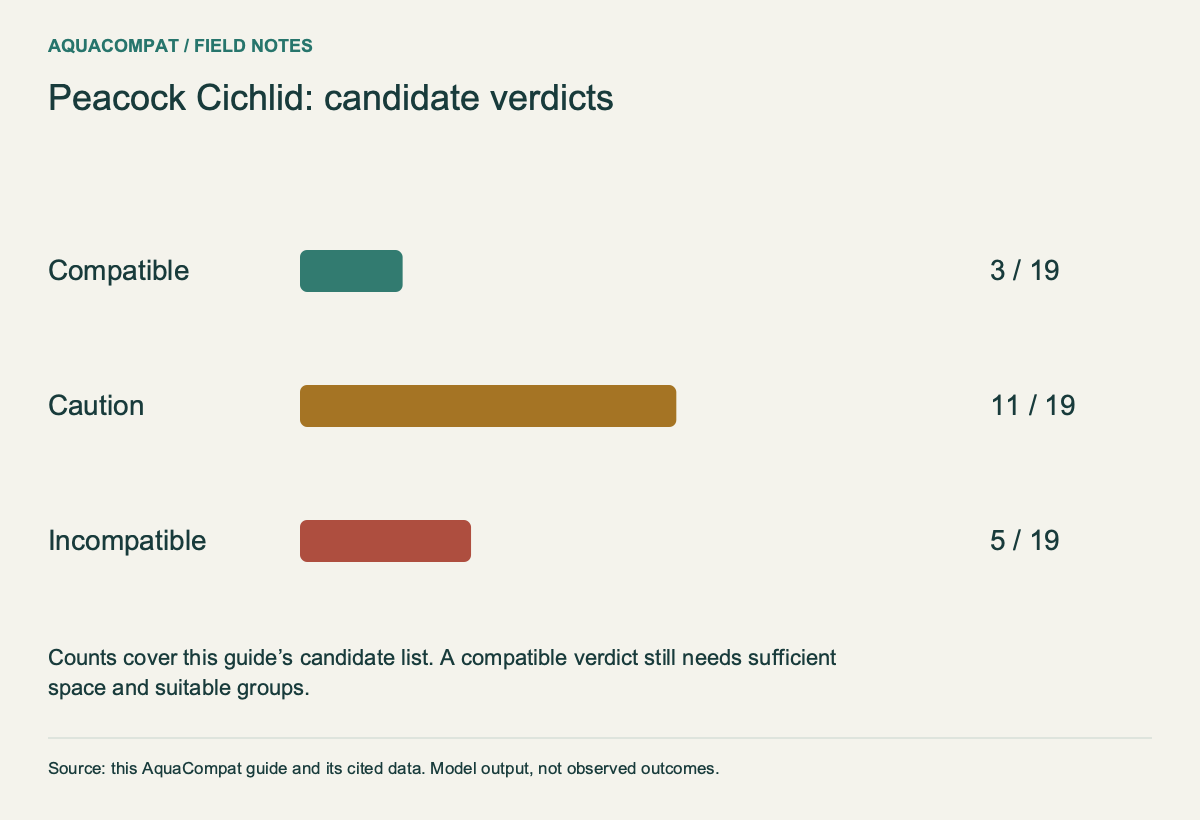
| Species | Yellow lab | Kenyi | Peacock cichlid |
|---|---|---|---|
| Yellow Lab | Same species | caution (7/10) | caution (7/10) |
| Kenyi Cichlid | caution (7/10) | Same species | incompatible (2/10) |
| Peacock Cichlid | caution (7/10) | incompatible (2/10) | Same species |
| Molly | compatible (9/10) | incompatible (3/10) | compatible (9/10) |
| Guppy | compatible (8/10) | incompatible (3/10) | compatible (8/10) |
| Endler's Livebearer | compatible (8/10) | incompatible (3/10) | caution (7/10) |
| Oscar | incompatible (3/10) | caution (7/10) | incompatible (3/10) |
| Angelfish | caution (7/10) | caution (7/10) | caution (7/10) |
| Bristlenose Pleco | incompatible (3/10) | incompatible (3/10) | incompatible (3/10) |
| Corydoras | incompatible (3/10) | incompatible (3/10) | caution (7/10) |
| Neon Tetra | incompatible (3/10) | incompatible (3/10) | caution (5/10) |
| Goldfish | incompatible (3/10) | incompatible (3/10) | incompatible (3/10) |
| Cherry Shrimp | caution (6/10) | incompatible (3/10) | caution (7/10) |
| Nerite Snail | caution (7/10) | incompatible (3/10) | compatible (8/10) |
| Mystery Snail | caution (7/10) | incompatible (3/10) | caution (7/10) |
Can mbuna and peacock cichlids live together?
Only the mildest mbuna can live with peacocks, and the yellow lab is the one the sources name. Seriously Fish advises keeping peacocks away from most mbuna, and its Maylandia lombardoi profile rules peacocks out completely. The two groups differ on three counts: diet, aggression and how they use the tank.
Diet: vegetable grazers against meaty sand-sifters
The kenyi is recorded as a herbivore. FishBase says wild fish brush loose algae from rocks, and Seriously Fish and Maidenhead Aquatics both want a mainly vegetable diet of spirulina, blanched spinach or nori. Maidenhead lists Malawi bloat among the kenyi’s common diseases, and our kenyi data links red meat and protein-rich foods to it. The peacock is a carnivore: Seriously Fish describes a sand-sifting micropredator that needs fine prepared foods plus small live or frozen bloodworm, Artemia and mosquito larvae. Our peacock record notes that a shared tank therefore means a feeding compromise, and Maidenhead’s hybrid peacock sheet does include some vegetable matter. The yellow lab sits between them as an omnivore; Tropical Fish Hobbyist says it feeds mainly on invertebrates, while Seriously Fish wants vegetable matter to be a large part of its diet.
Aggression: who bullies whom
The kenyi is rated aggressive, the peacock and yellow lab semi-aggressive. Seriously Fish says peacocks kept with most mbuna are out-competed and harassed, so the peacock is the victim, not the aggressor. Maidenhead adds that hybrid peacocks crossed with mbuna can be more aggressive than pure Aulonocara.
Why the kenyi and peacock pair is rated incompatible
On paper the kenyi and peacock match well. They share 75–79 °F (24–26 °C) and pH 7.6–8.5, and their fit score on water, size and swimming space is 8/10. The verdict is incompatible anyway, because Seriously Fish’s kenyi profile says peaceful Malawi cichlids such as peacocks and utaka should not be kept with it, and its peacock profile advises avoiding most mbuna. A published behavioural warning outweighs a good water match; the scoring method page explains how such source warnings are applied.
Yellow labs with peacocks
The yellow lab and peacock pairing has a fit score of 9/10 and is rated caution. Tropical Fish Hobbyist says yellow labs can live with peacocks, and Seriously Fish’s A. baenschi page and Maidenhead both name Labidochromis caeruleus as a suitable peaceful mbuna. Our peacock record treats the yellow lab as the main exception, not a sign that mbuna in general are safe, and Seriously Fish notes the yellow lab is still territorial when spawning.
What water parameters do African cichlid tank mates need?
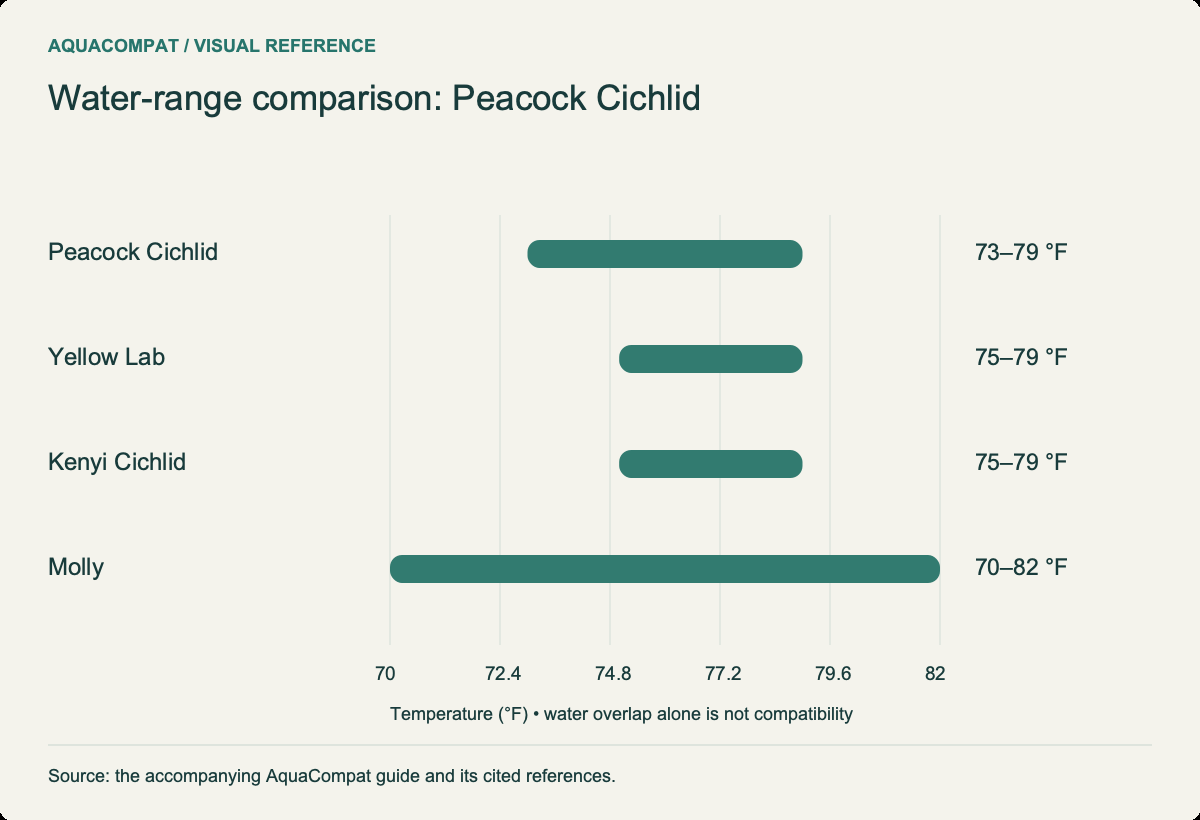
African cichlid tank mates need warm, hard, alkaline water: the three Malawi species share a temperature of 75–79 °F (24–26 °C), a pH of pH 7.7–8.5 and hardness of 10–25 dGH. The figure below shows each range from the published sources and the band all three share.
How hard and alkaline should a Malawi cichlid tank be?
A Malawi cichlid tank should sit in the hard band, with general hardness (GH, the dissolved calcium and magnesium) of about 10–25 dGH. That is far harder than most community tanks. By the German hardness classes (<8.4 soft; 8.4–14 medium; >14 hard dGH (German WRMG 2007)), every Malawi species here needs medium to hard water. Maidenhead Aquatics calls hard water essential for all three.
Temperature
The yellow lab is listed at 75–79 °F (24–26 °C), the kenyi at 75–79 °F (24–26 °C) and the peacock at 73–79 °F (23–26 °C). Seriously Fish allows warmer water for each species than Maidenhead; the ranges shown are the overlap of the two.
pH
The peacock is listed at pH 7.5–8.5, the kenyi at pH 7.6–8.5 and the yellow lab at pH 7.7–8.5. Water with enough carbonate hardness (KH, the buffer that resists acid) tends to hold pH near 7.0–8.3 pH, according to SRAC Publication 464, which is why a stable Malawi tank depends on KH as well as GH. Our guide to GH and KH in aquariums explains the two measures, and the aquarium pH guide covers how pH and buffering interact.
The sources consulted give no KH or TDS ranges for these three cichlids, so we do not set targets for either.
Why don’t community tropical fish mix with African cichlids?
Most community tropical fish come from soft, acidic water and share no pH range with Malawi cichlids. The neon tetra is listed at pH 5.0–7.5 and the cardinal tetra at pH 4.0–7.5; against the yellow lab’s pH 7.7–8.5, the shared pH is no overlap for the neon and no overlap for the cardinal. Corydoras (pH 6.5–7.5) and bristlenose plecos (pH 6.0–7.2) fall short in the same way. A tank kept for one group is outside the other’s published range.
Size and temperament compound the problem. A kenyi reaches 5.9 in (15 cm) and is rated aggressive, while a neon tetra is a small, peaceful schooler. Fish that suit a quiet community, such as those in the guide to choosing fish for a 10-gallon community tank, belong in a separate setup. If you are weighing a cichlid tank against a calmer centrepiece fish, the compatible tank mates for bettas show how differently a soft-water community is stocked.
Livebearers are the exception on water
Mollies, guppies and Endler’s livebearers have published pH ranges that reach into alkaline water, such as pH 7.5–8.5 for the molly, which is why they score well on water against the yellow lab and peacock. The molly shares pH 7.7–8.5 with the yellow lab. None of the cichlid sources in our data discusses keeping livebearers with Malawi cichlids, so treat those verdicts as a water and temperament match only. All three cichlids are recorded as eating dwarf shrimp, and no consulted source says whether they eat small fish; with the kenyi, every livebearer pairing is rated incompatible because of its aggression.
How many African cichlids should you keep, and in what size tank?
Malawi cichlids are kept as harems in large tanks: one male with several females, in a tank of at least 40 US gal (151 L) for yellow labs and 55 US gal (208 L) for peacocks or kenyi. Mixed pairings calculate larger, at 90 US gal (341 L) for yellow labs with peacocks.
- Yellow lab: a group of at least 4, which Seriously Fish describes as one male with three or more females.
- Peacock cichlid: at least 5; Seriously Fish advises one male with 4–6 females, while Maidenhead suggests one or three males with five or more females.
- Kenyi: Seriously Fish and Maidenhead both advise a single male with several females, but neither gives a female count.
Most aquarium species are stocked lightly, but the mbuna advice runs the other way. Practical Fishkeeping warns that lightly stocked mbuna groups, fewer than about 20 fish, tend to be more aggressive, and Maidenhead advises deliberate crowding for both the yellow lab and the kenyi. Crowding spreads aggression across many targets, so it depends on strong filtration and frequent water changes. The stocking calculator estimates how many fish a given tank and filter can carry.
Which species are the best-matched peacock cichlid tank mates?
Ranked on our data, the best-matched peacock cichlid tank mates are hard-water species with mild temperaments. The table ranks every species we hold against the peacock, with the shared temperature and pH and the tank size the pair needs. The kenyi sits near the bottom for the reasons given above.
| Species | Verdict | Score | Shared temperature | Shared pH | Smallest tank |
|---|---|---|---|---|---|
| Molly | compatible | 9/10 | 73–79 °F (23–26 °C) | pH 7.5–8.5 | 90 US gal (341 L) |
| Guppy | compatible | 8/10 | 73–79 °F (23–26 °C) | pH 7.5–8.0 | 90 US gal (341 L) |
| Nerite Snail | compatible | 8/10 | 73–79 °F (23–26 °C) | pH 7.5–8.0 | 90 US gal (341 L) |
| Yellow Lab | caution | 7/10 | 75–79 °F (24–26 °C) | pH 7.7–8.5 | 90 US gal (341 L) |
| Endler's Livebearer | caution | 7/10 | 75–79 °F (24–26 °C) | pH 7.5–8.5 | 90 US gal (341 L) |
| Platy | caution | 7/10 | 73–77 °F (23–25 °C) | pH 7.5–8.2 | 90 US gal (341 L) |
| Mystery Snail | caution | 7/10 | 73–78 °F (23–26 °C) | pH 7.5–8.0 | 90 US gal (341 L) |
| Assassin Snail | caution | 7/10 | 75–79 °F (24–26 °C) | pH 7.5–8.0 | 90 US gal (341 L) |
| Cherry Shrimp | caution | 7/10 | 73–79 °F (23–26 °C) | pH 7.5–8.0 | 90 US gal (341 L) |
| Amano Shrimp | caution | 7/10 | 73–79 °F (23–26 °C) | pH 7.5–7.5 | 90 US gal (341 L) |
| Corydoras | caution | 7/10 | 73–79 °F (23–26 °C) | pH 7.5–7.5 | 90 US gal (341 L) |
| Angelfish | caution | 7/10 | 75–79 °F (24–26 °C) | pH 7.5–8.0 | 90 US gal (341 L) |
| Cardinal Tetra | caution | 6/10 | 73–79 °F (23–26 °C) | pH 7.5–7.5 | 90 US gal (341 L) |
| Neon Tetra | caution | 5/10 | 73–77 °F (23–25 °C) | pH 7.5–7.5 | 90 US gal (341 L) |
| Bristlenose Pleco | incompatible | 3/10 | 73–79 °F (23–26 °C) | no overlap | 90 US gal (341 L) |
| Oscar | incompatible | 3/10 | 74–79 °F (23–26 °C) | pH 7.5–8.0 | 125 US gal (473 L) |
| Goldfish | incompatible | 3/10 | no overlap | pH 7.5–8.0 | 90 US gal (341 L) |
| Discus | incompatible | 3/10 | 79–79 °F (26–26 °C) | pH 7.5–7.6 | 125 US gal (473 L) |
| Kenyi Cichlid | incompatible | 2/10 | 75–79 °F (24–26 °C) | pH 7.6–8.5 | 90 US gal (341 L) |
Which fish and invertebrates should never live with African cichlids?
Three groups fail with Malawi cichlids in our data: larger predators, coldwater fish and dwarf shrimp.
Large predators
The oscar is the clearest case. Seriously Fish and Aquarium Co-Op describe it as a predator of any fish small enough to swallow, and a peacock reaches only 5.1 in (13 cm) against the oscar’s 14 in (35.6 cm); the pairing is rated incompatible. The kenyi and oscar pairing, rated caution, needs 125 US gal (473 L). The fish that live with oscars are covered on their own hub.
Coldwater fish
Goldfish share no temperature range with the yellow lab, kenyi or peacock, so every goldfish pairing is rated incompatible.
Dwarf shrimp and snails
All three cichlids are recorded as eating dwarf shrimp: Shrimp and Snail Breeder calls cichlids shrimp hunters and bad shrimp neighbours, and the peacock hunts small invertebrates in the sand. Our cherry shrimp tank mates hub lists safer company. Snails are a risk too. Aquarium Co-Op and Maidenhead list large or aggressive cichlids among the threats to nerite and mystery snails, and Shrimp and Snail Breeder advises against keeping assassin snails with cichlids. The aquarium snail compatibility guide explains which fish eat snails.
Are haps, Tanganyika and Victoria cichlids covered here?
No. Our fact base holds three Lake Malawi cichlids, the yellow lab, the kenyi and the peacock, and nothing on haplochromines (haps), Lake Tanganyika cichlids or Lake Victoria cichlids. We do not give parameters, tank sizes or compatibility verdicts for any of them.
The only mentions in our sources are second-hand. Seriously Fish lists peaceful haps and hard-water rainbowfish as possible yellow lab companions, and its kenyi profile names utaka among the peaceful Malawi cichlids the kenyi should not live with. Those notes are not enough to score a pairing. Treat any hap, Tanganyika or Victoria stocking advice as outside the scope of this page until the species are added to our data.
The scale of what is left out is large. A 2020 study in Molecular Biology and Evolution describes over 500 species of cichlid in Lake Malawi alone, evolved within about 800,000 years, and a 2017 Nature Communications study counts more than 700 species in the Lake Victoria region. Three Malawi species are a very small sample of that diversity, which is why we do not extend their verdicts to other cichlids.
Is an African cichlid tank just a community tank with bigger fish?
No. A Malawi tank is built on different rules from a community tank: harder water, higher stocking and a diet planned around the most sensitive feeder. The Kenyi Cichlid shows how far those rules go. Seriously Fish rates it intermediate and not recommended for the novice, Maidenhead says territorial fights can be fatal unless the tank is crowded with other robust mbuna, and males target fish with similar colour patterns, including the blue females and young of their own species. A yellow lab tank is more forgiving: Seriously Fish rates it easy and Tropical Fish Hobbyist calls it one of the easiest mbuna to keep. Start there if this is your first Malawi tank.
Questions people ask
Can yellow labs live with peacock cichlids?
Yes, more readily than any other mbuna in our data. The pairing has a fit score of 9/10 and is rated caution. Tropical Fish Hobbyist, Seriously Fish and Maidenhead all name the yellow lab as a peacock companion. Both are territorial when spawning, so the pair needs 90 US gal (341 L) and several females per male.
Can a kenyi cichlid live with peacocks?
No. Seriously Fish’s kenyi profile says peaceful Malawi cichlids such as peacocks should not be kept with it, and its peacock profile advises avoiding most mbuna. The pair matches well on water, with a fit score of 8/10, but that warning sets the verdict at incompatible.
Can African cichlids live with tetras?
Not in matched water. Neon and cardinal tetras come from soft, acidic water and share no overlap of pH with the yellow lab. The kenyi adds aggression to the problem: every kenyi and tetra pairing is rated incompatible. Keep tetras in a separate community tank.
What should I feed a mixed mbuna and peacock tank?
Feed for the most sensitive grazer. Seriously Fish and Maidenhead want a mainly vegetable diet for the kenyi, and our kenyi data links protein-rich food to Malawi bloat. Peacocks need fine meaty foods. Our peacock record calls a shared tank a feeding compromise, which is one more reason the kenyi and peacock should not be mixed.
What size tank do African cichlid tank mates need?
At least 40 US gal (151 L) for a yellow lab group and 55 US gal (208 L) for peacocks or kenyi, based on Seriously Fish footprints. Mixed Malawi pairings calculate at 90 US gal (341 L) or more. Practical Fishkeeping and Maidenhead prefer a 4 ft (120 cm) tank or longer for a mixed mbuna community.
Sources 98 documents from 19 publishers
- Applesnail.net (applesnail.net): “How to take care of apple snails”; “Quick guide”; “Pomacea diffusa”; “Apple snail FAQ”
- Aquarium Co-Op (aquariumcoop.com): “Care Guide for Mollies: Feeding, Breeding, and Tank Mates”; “Guppy Care Guide”; “Endler's Livebearer Care Guide”; “Oscar Fish Care Guide”; “Freshwater Angelfish Care Guide”; “Care Guide for Plecostomus”; “Care Guide for Cory Catfish”; “Care Guide for Fancy Goldfish”; “Goldfish Tank Mates”; “Care Guide for Cherry Shrimp”; “Care Guide for Nerite Snails”; “Care Guide for Mystery Snails”; “Care Guide for Cardinal Tetras”; “Top 5 Dither Fish to Help Shy or Aggressive Fish in Freshwater Tanks”; “Betta fish tank mates”; “Care Guide for Assassin Snails”
- AquariumInfo.org (aquariuminfo.org): “Apple Snail”
- FishBase (fishbase.se): “Maylandia lombardoi summary page”; “Labidochromis caeruleus summary page”; “Aulonocara stuartgranti summary page”; “Poecilia reticulata, Guppy: species summary”; “Poecilia wingei summary (Bayesian length-weight estimate)”; “Astronotus ocellatus, Oscar: species summary”; “Osteogaster aenea, Bronze corydoras”; “Paracheirodon innesi summary page”; “Carassius auratus, Goldfish: species summary”; “Aulonocara baenschi summary page”; “Poecilia sphenops, Molly: species summary”; “Poecilia latipinna, Sailfin molly: species summary”; “Length-weight relationships for Poecilia sphenops”; “Length-weight relationships for Poecilia reticulata”; “Length-weight relationships for Astronotus ocellatus”
- fishkeeping.co.uk (fishkeeping.co.uk): “Goldfish Size, Life Expectancy and Tank Recommendations”; “Keeping Goldfish - The Right Way”
- Maidenhead Aquatics (fishkeeper.co.uk species data sheet) (fishkeeper.co.uk): “Yellow Labidochromis data sheet”; “Kenyi data sheet”; “Hybrid Peacock (Aulonocara sp.) data sheet”; “Molly data sheet”; “Guppy data sheet”; “Oscar data sheet”; “Angelfish data sheet”; “Neon Tetra data sheet”; “Zebra Nerite Snail”
- Merck Veterinary Manual (merckvetmanual.com): “Environmental Diseases of Aquatic Animals in Aquatic Systems, Francis-Floyd, Yanong and Petty”; “Disorders and Diseases of Fish (pet owner version)”; “Management of Aquarium Fish, Petty, Francis-Floyd and Yanong”
- Molecular Biology and Evolution, Svardal et al. (pmc.ncbi.nlm.nih.gov): “Ancestral Hybridization Facilitated Species Diversification in the Lake Malawi Cichlid Fish Adaptive Radiation”
- Nature Communications, Meier et al. (pmc.ncbi.nlm.nih.gov): “Ancient hybridization fuels rapid cichlid fish adaptive radiations”
- Ornamental Aquatic Trade Association (OATA) (ornamentalfish.org): “How to look after fancy goldfish”; “How to look after goldfish in an aquarium / fish tank”
- PlanetCatfish (via Internet Archive snapshot, 2025) (web.archive.org): “Ancistrus sp. (3) Common Bristlenose Catfish Cat-eLog data sheet”; “Osteogaster aenea (Bronze Cory) Cat-eLog data sheet”
- Practical Fishkeeping (practicalfishkeeping.co.uk): “Malawi's finest: The Yellow lab, Labidochromis caeruleus”; “Quick guide to livebearers”; “Bristlenose catfish: the hardworking Ancistrus”; “What can I keep in my hard water aquarium?”; “Frequently asked questions on Neocaridina shrimps”; “How to Cycle a Fish Tank: The Complete Guide”; “Endler's livebearers are nearly all hybrids!”; “An introduction to Shrimp”; “Will these snails starve without algae?”; “What can I add for algae control?”
- Seriously Fish (seriouslyfish.com): “Labidochromis caeruleus”; “Maylandia lombardoi”; “Aulonocara stuartgranti”; “Aulonocara baenschi”; “Poecilia sphenops”; “Poecilia latipinna”; “Poecilia reticulata”; “Poecilia wingei”; “Astronotus ocellatus”; “Pterophyllum scalare”; “Ancistrus sp. '3' (Common Bristlenose Catfish)”; “Osteogaster aenea (Bronze Cory)”; “Paracheirodon innesi (Neon Tetra)”; “Paracheirodon axelrodi (Cardinal Tetra)”
- Shrimp and Snail Breeder (aquariumbreeder.com): “Red Cherry Shrimp: detailed guide, care, diet and breeding”; “Cherry Shrimp in a Community Tank”; “Nerite Snails: detailed guide, care, diet and breeding”; “How Copper Affects Dwarf Shrimp”; “Assassin Snail: detailed guide, care, diet and breeding”
- Shrimp Science (shrimpscience.com): “Red Cherry Shrimp - Care Guide”; “General Hardness (GH) For Shrimp Tanks”; “Carbonate Hardness (KH) For Shrimp Tanks”; “TDS For Shrimp Tanks”
- Southern Regional Aquaculture Center (srac.msstate.edu): “Interactions of pH, Carbon Dioxide, Alkalinity and Hardness in Fish Ponds, SRAC Publication No. 464, Wurts and Durborow”; “Interpretation of Water Analysis Reports for Fish Culture, SRAC Publication No. 4606”; “How to Start a Biofilter, SRAC Publication No. 4502, DeLong and Losordo”
- Tropical Fish Hobbyist Magazine (tfhmagazine.com): “Labidochromis caeruleus”; “Astronotus sp.”
- University of Florida IFAS Extension (EDIS) (ask.ifas.ufl.edu): “Ammonia in Aquatic Systems (FA16/FA031), Francis-Floyd, Watson, Petty and Pouder”
- Wikipedia (en.wikipedia.org): “Vittina natalensis”; “dGH”; “Carbonate hardness”
All sources accessed . Every number on this page comes from these documents.