What makes a good tank mate for corydoras?
A good corydoras tank mate is a peaceful fish that is too small to eat a cory, shares its water and leaves the bottom of the tank to the catfish. Corydoras are small armoured catfish from South America; the reference species on this page is the bronze cory (Corydoras aeneus), which Dias et al. (2024) moved to Osteogaster aenea but which is still sold under its old name. Aquarium Co-Op sums up the rule in one line: corys suit nearly any community fish that will not eat or attack them. Four criteria follow from the published data.
- Too small to eat a cory. The bronze cory grows to 3 in (7.6 cm). Aquarium Co-Op warns that corys are eaten by goldfish and by any tank mate large enough to attack them, so predators and large omnivores rule themselves out.
- Peaceful at the bottom. PlanetCatfish calls the bronze cory a perfect citizen for community tanks, and it does not defend territory. Tank mates that guard the substrate, such as male bristlenose plecos with caves, need enough floor space for both.
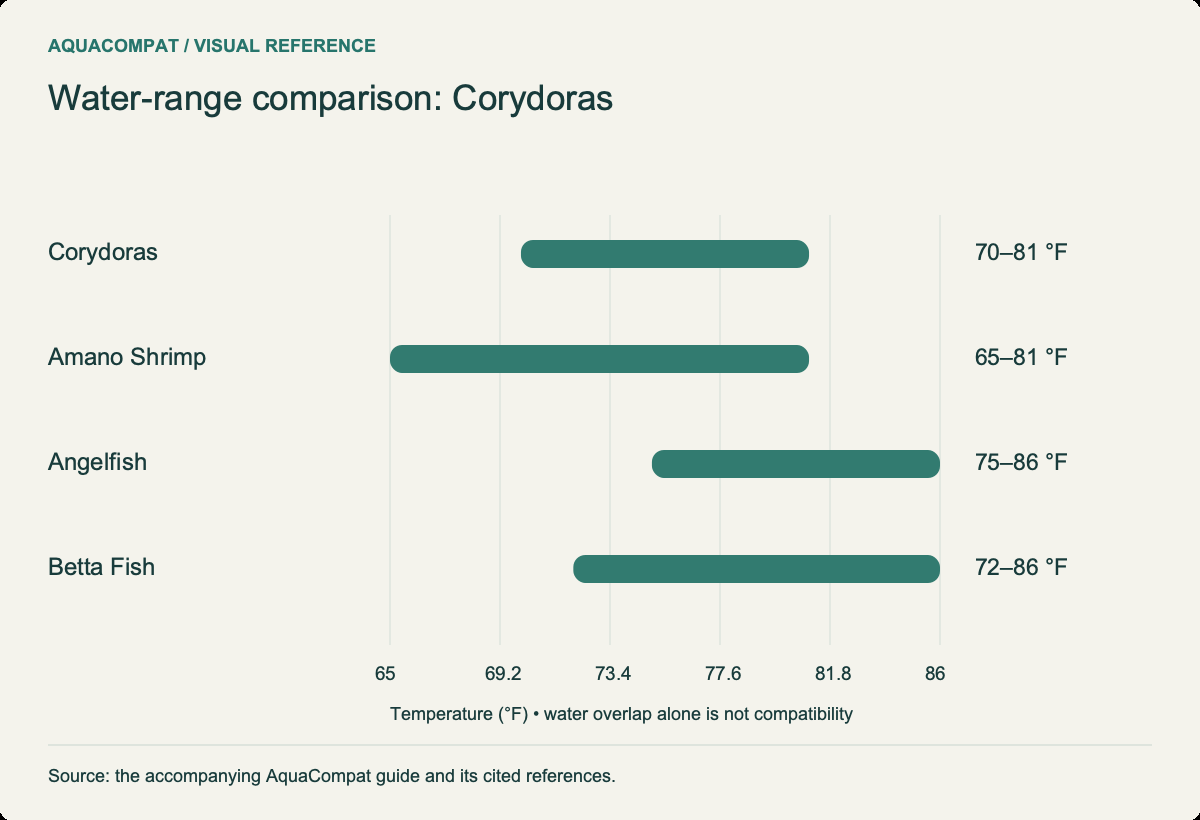
- Moderate shared water. Corydoras need 70–81 °F (21–27 °C), pH 6.5–7.5 and 2–15 dGH. That middle band overlaps most community fish but excludes coldwater goldfish and very warm-water discus.
- Food that reaches the floor. Seriously Fish describes corys as foraging omnivores that take sinking foods. Fast mid-water fish do not compete with them directly, which is why schooling tetras and rasboras top the list below.
Swim level is the easiest criterion to meet. Corydoras are bottom dwellers, so any upper or mid-water schooling fish adds activity without crowding them. The same logic drives the other pages in our tank mates by species series, and the species compatibility checker scores any pairing not listed here.
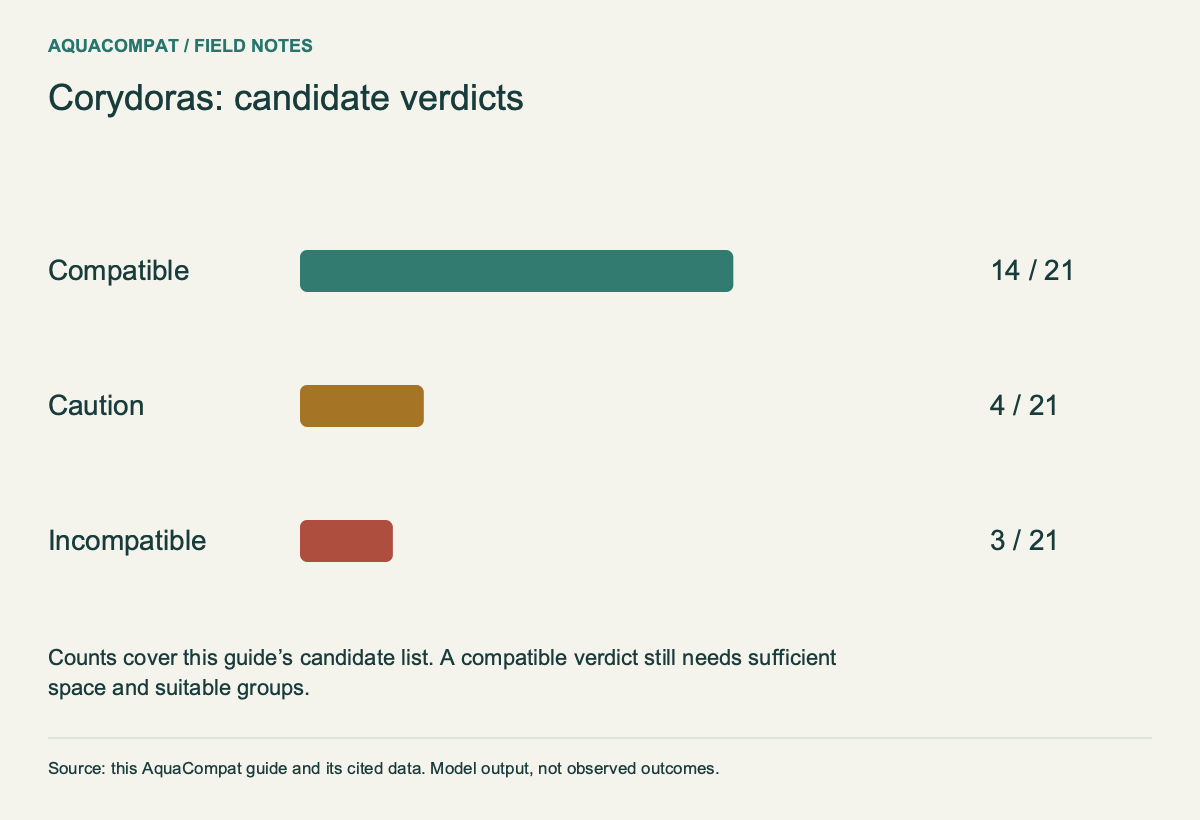
| Species | Verdict | Score | Shared temperature | Shared pH | Smallest tank |
|---|---|---|---|---|---|
| Harlequin Rasbora | compatible | 10/10 | 72–79 °F (22–26 °C) | pH 6.5–7.5 | 20 US gal (76 L) |
| Neon Tetra | compatible | 10/10 | 70–77 °F (21–25 °C) | pH 6.5–7.5 | 20 US gal (76 L) |
| Bristlenose Pleco | compatible | 9/10 | 72–79 °F (22–26 °C) | pH 6.5–7.2 | 20 US gal (76 L) |
| Cardinal Tetra | compatible | 9/10 | 73–81 °F (23–27 °C) | pH 6.5–7.5 | 20 US gal (76 L) |
| Dwarf Gourami | compatible | 9/10 | 72–81 °F (22–27 °C) | pH 6.5–7.5 | 40 US gal (151 L) |
| GloFish Tetra | compatible | 9/10 | 70–79 °F (21–26 °C) | pH 6.5–7.0 | 20 US gal (76 L) |
| Guppy | compatible | 9/10 | 70–81 °F (21–27 °C) | pH 7.0–7.5 | 20 US gal (76 L) |
| Kuhli Loach | compatible | 9/10 | 74–79 °F (23–26 °C) | pH 6.5–7.0 | 20 US gal (76 L) |
| Mystery Snail | compatible | 9/10 | 70–78 °F (21–26 °C) | pH 7.2–7.5 | 20 US gal (76 L) |
| Zebra Danio | compatible | 9/10 | 70–75 °F (21–24 °C) | pH 6.5–7.5 | 20 US gal (76 L) |
| Endler's Livebearer | compatible | 8/10 | 75–81 °F (24–27 °C) | pH 7.0–7.5 | 20 US gal (76 L) |
| Molly | compatible | 8/10 | 70–81 °F (21–27 °C) | pH 7.5–7.5 | 20 US gal (76 L) |
| Nerite Snail | compatible | 8/10 | 72–79 °F (22–26 °C) | pH 7.2–7.5 | 20 US gal (76 L) |
| Platy | compatible | 8/10 | 70–77 °F (21–25 °C) | pH 7.0–7.5 | 20 US gal (76 L) |
| Amano Shrimp | caution | 7/10 | 70–81 °F (21–27 °C) | pH 6.5–7.5 | 20 US gal (76 L) |
| Cherry Shrimp | caution | 7/10 | 70–79 °F (21–26 °C) | pH 6.5–7.5 | 20 US gal (76 L) |
| Betta Fish | caution | 7/10 | 72–81 °F (22–27 °C) | pH 6.5–7.5 | 40 US gal (151 L) |
| Angelfish | caution | 7/10 | 75–81 °F (24–27 °C) | pH 6.5–7.5 | 90 US gal (341 L) |
| Discus | incompatible | 3/10 | 79–81 °F (26–27 °C) | pH 6.5–7.5 | 75 US gal (284 L) |
| Goldfish | incompatible | 3/10 | 70–70 °F (21–21 °C) | pH 6.5–7.5 | 55 US gal (208 L) |
| Oscar | incompatible | 3/10 | 74–80 °F (23–27 °C) | pH 6.5–7.5 | 125 US gal (473 L) |
Which fish are the best corydoras tank mates?
The best corydoras tank mates are small schooling fish that swim above them in the same soft-to-moderate water. The groups below follow the order of the table.
Neon tetra and harlequin rasbora
The neon tetra scores 10/10 and the harlequin rasbora 10/10. Both are peaceful mid-water schoolers, and their pH ranges contain the cory’s, so the pair shares the cory’s full pH 6.5–7.5. Seriously Fish lists small catfish among the neon tetra’s suitable companions, and our harlequin data names catfish and loaches among the groups it suits. The neon needs a school of 8, as does the harlequin, so a tank holding both schools and six corys is a planned community rather than a nano tank.
Cardinal tetra, zebra danio and GloFish tetra
The cardinal tetra scores 9/10. It needs warmer water than the neon, so the pair shares 73–81 °F (23–27 °C) rather than the cory’s full range. Zebra danios score 9/10 but sit at the cool end, sharing only 70–75 °F (21–24 °C). GloFish tetras score 9/10; their fin-nipping reputation, which Seriously Fish attributes to the black tetra they are bred from, matters for long-finned fish but not for a short-finned catfish.
Guppies, platies, mollies and Endler’s livebearers
Livebearers score well on temperament but lose points on water chemistry, because they prefer harder, more alkaline water than corys. Guppies score 9/10 and share pH 7.0–7.5; platies score 8/10. Mollies score 8/10, but the shared pH is a single point at pH 7.5–7.5, and Seriously Fish says mollies become disease-prone in water that is not hard and alkaline. Endler’s livebearers score 8/10 and share only 15–15 dGH of hardness. Of the four, the guppy is the easiest match; the guppy tank mates guide covers its other companions.
Other bottom dwellers
Kuhli loaches score 9/10. Seriously Fish describes them as peaceful with their own kind and other fish, and they are nocturnal, so they use the floor at different hours; the page on fish that live with kuhli loaches ranks their other companions. The bristlenose pleco scores 9/10, but Aquarium Co-Op notes that males can guard against other bottom dwellers, so give it a cave of its own. The bristlenose pleco tank mates page explains that territorial streak.
Semi-aggressive centrepiece fish
Dwarf gouramis score 9/10 and bettas 7/10 with corys, because neither competes for the bottom. Both are semi-aggressive, which raises the shared tank to 40 US gal (151 L). The page on fish that live with bettas ranks corys among the stronger betta companions. Angelfish score 7/10 but need 90 US gal (341 L) together; the cory is large enough that the angelfish’s appetite for neon-sized fish does not apply, and the compatible tank mates for angelfish page explains where that line falls.
Which fish should never live with corydoras?
Oscars, goldfish and discus fail outright with corydoras in our data, each for a different reason.
Oscar
Oscars score 3/10. Seriously Fish and Aquarium Co-Op both describe a predator that eats any fish small enough to swallow, and at 14 in (35.6 cm) an adult oscar is several times longer than a 3 in (7.6 cm) cory. Water overlap does not rescue the pairing: the two share 74–80 °F (23–27 °C), but the size gap is enough on its own.
Goldfish
Goldfish score 3/10. The two share almost no temperature range, only 70–70 °F (21–21 °C), because goldfish are coldwater fish kept at 59–70 °F (15–21 °C). Aquarium Co-Op adds a physical hazard in its goldfish tank mates guide: corys are among the fish goldfish eat, and spiny catfish such as corydoras can lodge in a goldfish’s gills if swallowed.
Discus
Discus score 3/10. They are peaceful and would not harm a cory, but they need 79–86 °F (26–30 °C), so the pair shares only 79–81 °F (26–27 °C). Keeping a tank at the very top of the cory’s range leaves no margin for heater error. Readers planning a discus tank should start from the discus tank mates ranking instead.
Can corydoras live with shrimp and snails?
Corydoras live well with snails, and probably with adult shrimp, but no source in our data says directly whether corys eat dwarf shrimp.
Snails
Mystery snails score 9/10, and Aquarium Co-Op lists corydoras by name among the fish mystery snails can live with. Nerite snails score 8/10; Shrimp and Snail Breeder calls them peaceful herbivores that compete only with other snails for food. Both snails want harder, more alkaline water than corys, so the shared pH narrows to pH 7.2–7.5.
Shrimp
Cherry shrimp score 7/10 and amano shrimp 7/10 with corys. Water is not the problem: the cherry shrimp’s range sits almost entirely inside the cory’s. The lower score comes from a gap in the evidence. Our corydoras data records that corys eat eggs, including their own, but none of the cited sources states whether they eat dwarf shrimp, so the method caps the size factor rather than assuming safety. Aquarium Co-Op says almost all fish eat baby shrimp, which is the risk to plan for. The cherry shrimp compatibility guide explains how each fish is scored against shrimp.
Which corydoras tank mates fit a 10, 20 or 29-gallon tank?
Corydoras need at least 20 US gal (76 L) themselves, so a 20-gallon tank is the starting point and a 10-gallon tank is too small for the bronze cory. Aquarium Co-Op recommends 20 gallons or more for most non-dwarf corys, and Seriously Fish’s 80 × 30 cm base works out at about the same volume.
10-gallon tank
A 10-gallon tank falls below the bronze cory’s minimum, so we do not list it as a cory tank. Co-Op’s wording leaves room for dwarf corydoras species, but our data does not cover them. For small tanks, see the guide to choosing fish for a 10-gallon community tank.
20-gallon tank
At 20 gallons most peaceful pairings fit: neon tetras, harlequin rasboras, cardinal tetras, kuhli loaches, guppies and both snails all calculate at 20 US gal (76 L) with corys. That figure covers one pairing at a time. A group of six corys plus a school of 8 tetras is a larger load, so check the full plan in the stocking calculator.
40 gallons and larger
The semi-aggressive centrepiece fish need more room. Dwarf gouramis and bettas calculate at 40 US gal (151 L) with corys, because the method adds a margin for semi-aggressive species, and angelfish at 90 US gal (341 L).
Are corydoras a clean-up crew for other fish?
No. Corydoras are often sold as tank cleaners, but Aquarium Co-Op notes that they are not primarily algae eaters, and Seriously Fish describes a foraging omnivore that needs its own sinking dried foods plus small live or frozen foods such as bloodworm. A cory that lives only on what falls past fast mid-water tank mates may go hungry, which is the real cost of pairing them with greedy feeders.
A second misconception is that one or two corys are enough. PlanetCatfish and Aquarium Co-Op both say to keep at least 6 of the same species. Sources differ on the minimum: Seriously Fish gives four to six and Practical Fishkeeping at least three, with more being better. Mixing several species of one each does not satisfy the shoaling need.
What goes wrong in a corydoras community tank?
Most corydoras problems come from the tank rather than the tank mates. Three failure points recur across the sources, listed from most to least common.
- Rough substrate. PlanetCatfish and Seriously Fish warn that rough or chipped gravel can damage the barbels while corys dig, and recommend sand or smooth rounded gravel.
- A tank mate that grows into a predator. Aquarium Co-Op says corys are eaten by any tank mate large enough to attack them. A juvenile oscar or goldfish may look harmless next to a cory but outgrows it.
- Lost eggs. Corys spawn readily, but Aquarium Co-Op says all fish, parents included, eat cory eggs. In a community tank, expect few fry unless the eggs are moved.
Temperature drift is the quieter risk. The cory’s upper limit of 70–81 °F (21–27 °C) sits below the preferred range of warm-water fish, so a pairing such as corys with discus fails gradually rather than at once.
Questions people ask
How many corydoras should live with other tank mates?
Keep at least 6 of one species, as PlanetCatfish and Aquarium Co-Op advise, regardless of what else is in the tank. Corys are shoaling fish, and other species do not replace their own group. Add the group to the tank mates’ numbers before you choose a tank size.
Can corydoras live with bettas?
Usually, yes. The pairing scores 7/10 because corys stay on the bottom, away from the betta’s preferred upper water, and neither species has long fins the other targets. The betta’s semi-aggressive temperament raises the shared tank to 40 US gal (151 L), larger than either fish needs alone.
Can corydoras live with a bristlenose pleco?
Yes. The pair scores 9/10 and shares 72–79 °F (22–26 °C). Aquarium Co-Op notes that male bristlenose plecos can guard their cave against other bottom dwellers, so give the pleco its own cave and enough open floor for the cory group.
Will corydoras eat cherry shrimp?
The sources in our data do not say. Corys eat eggs, including their own, but none of the cited care sheets states whether they eat dwarf shrimp, so the pairing scores 7/10 on missing evidence rather than proven risk. Baby shrimp are at risk from most fish, according to Aquarium Co-Op, so dense moss is still advisable.
Can corydoras live with goldfish?
No. The pair scores 3/10 because the two share only 70–70 °F (21–21 °C). Aquarium Co-Op also lists corys among the fish goldfish eat, and the cory’s spines can lodge in a goldfish’s gills if it is swallowed.
Sources 120 documents from 19 publishers
- Applesnail.net (applesnail.net): “How to take care of apple snails”; “Quick guide”; “Pomacea diffusa”; “Apple snail FAQ”
- Aqualog (aqualog.de): “Discus (lexicon profile)”
- Aquarium Co-Op (aquariumcoop.com): “Care Guide for Cory Catfish”; “Care Guide for Harlequin Rasboras and Lambchop Rasboras”; “Neon and Cardinal Tetras: Beginner Schooling Fish”; “What Is Neon Tetra Disease and How Can It Be Prevented?”; “Top 5 Dither Fish to Help Shy or Aggressive Fish in Freshwater Tanks”; “Betta fish tank mates”; “Care Guide for Cardinal Tetras”; “Care Guide for Zebra and Leopard Danios”; “Care Guide for GloFish”; “10 Best Top-Dwelling Fish for Your Freshwater Community Aquarium”; “Guppy Care Guide”; “Care Guide for Platy Fish: Feeding, Breeding, and Tank Mates”; “Care Guide for Mollies: Feeding, Breeding, and Tank Mates”; “Endler's Livebearer Care Guide”; “Care Guide for Kuhli Loaches”; “Care Guide for Plecostomus”; “Care Guide for Dwarf Gouramis”; “Betta Fish Care Guide”; “Freshwater Angelfish Care Guide”; “Oscar Fish Care Guide”; “Care Guide for Fancy Goldfish”; “Goldfish Tank Mates”; “Care Guide for Amano Shrimp”; “Discus Fish Care Guide”; “Care Guide for Mystery Snails”; “Care Guide for Nerite Snails”; “Care Guide for Cherry Shrimp”
- AquariumInfo.org (aquariuminfo.org): “Apple Snail”
- FishBase (fishbase.se): “Osteogaster aenea, Bronze corydoras”; “Length-weight relationships for Osteogaster aenea”; “Paracheirodon innesi summary page”; “Trigonostigma heteromorpha summary page”; “Danio rerio summary (Bayesian length-weight estimate)”; “Gymnocorymbus ternetzi summary (Bayesian length-weight estimate)”; “Poecilia reticulata, Guppy: species summary”; “Xiphophorus maculatus, Southern platyfish: species summary”; “Poecilia wingei, Endlers guppy: species summary”; “Poecilia sphenops, Molly: species summary”; “Poecilia latipinna, Sailfin molly: species summary”; “Length-weight relationships for Poecilia sphenops”; “Pangio kuhlii summary (Bayesian length-weight estimate)”; “Ancistrus cirrhosus summary (Bayesian length-weight estimate)”; “Trichogaster lalius, Dwarf gourami: species summary”; “Betta splendens, Siamese fighting fish: species summary”; “Pterophyllum scalare, Freshwater angelfish: species summary”; “Length-weight relationships for Pterophyllum scalare”; “Astronotus ocellatus, Oscar: species summary”; “Length-weight relationships for Astronotus ocellatus”; “Carassius auratus, Goldfish: species summary”; “Length-weight relationships for Carassius auratus”; “Symphysodon aequifasciatus summary (Bayesian length-weight estimate)”
- fishkeeping.co.uk (fishkeeping.co.uk): “Goldfish Size, Life Expectancy and Tank Recommendations”; “Keeping Goldfish - The Right Way”
- GloFish (Spectrum Brands) (glofish.com): “GloFish FAQs”; “International Use and License Notice”
- Maidenhead Aquatics (fishkeeper.co.uk species data sheet) (fishkeeper.co.uk): “Neon Tetra data sheet”; “Harlequin Rasbora data sheet”; “Black Widow Tetra (Black Skirt Tetra) data sheet”; “Guppy data sheet”; “Platy data sheet”; “Molly data sheet”; “Angelfish data sheet”; “Oscar data sheet”; “Discus data sheet”; “Zebra Nerite Snail”
- Neotropical Ichthyology (Crampton 2008) (scielo.br): “Ecology and life history of an Amazon floodplain cichlid: the discus fish Symphysodon”
- Ornamental Aquatic Trade Association (OATA) (ornamentalfish.org): “How to look after fancy goldfish”; “How to look after goldfish in an aquarium / fish tank”
- PlanetCatfish (via Internet Archive snapshot, 2025) (web.archive.org): “Osteogaster aenea (Bronze Cory) Cat-eLog data sheet”; “Ancistrus sp. (3) Common Bristlenose Catfish Cat-eLog data sheet”
- Practical Fishkeeping (practicalfishkeeping.co.uk): “What can I keep in my hard water aquarium?”; “How long will my fish live?”; “A guide to the small rasboras from the genus Trigonostigma”; “Quick guide to livebearers”; “Bristlenose catfish: the hardworking Ancistrus”; “What water temperature do goldfish need?”; “How can I breed goldfish in my aquarium?”; “Will these snails starve without algae?”; “What can I add for algae control?”; “Frequently asked questions on Neocaridina shrimps”; “Amano shrimp: Spineless heroes (Nathan Hill)”; “An introduction to Shrimp”
- Practical Fishkeeping (Julian Dignall) (practicalfishkeeping.co.uk): “Focus on commonly kept Corydoras”
- Seriously Fish (seriouslyfish.com): “Osteogaster aenea (Bronze Cory)”; “Paracheirodon innesi (Neon Tetra)”; “Trigonostigma heteromorpha (Harlequin)”; “Paracheirodon axelrodi (Cardinal Tetra)”; “Danio rerio (Zebra Danio)”; “Gymnocorymbus ternetzi (Black Widow Tetra)”; “Poecilia reticulata”; “Xiphophorus maculatus”; “Poecilia sphenops”; “Poecilia latipinna”; “Poecilia wingei”; “Pangio semicincta ('Kuhli' Loach)”; “Ancistrus sp. '3' (Common Bristlenose Catfish)”; “Trichogaster lalius”; “Betta splendens”; “Pterophyllum scalare”; “Astronotus ocellatus”; “Symphysodon aequifasciatus”
- Shrimp and Snail Breeder (aquariumbreeder.com): “Cherry Shrimp in a Community Tank”; “Nerite Snails: detailed guide, care, diet and breeding”; “Red Cherry Shrimp: detailed guide, care, diet and breeding”; “Amano Shrimp: detailed guide, care, diet and breeding”; “How Copper Affects Dwarf Shrimp”
- Shrimp Science (shrimpscience.com): “Red Cherry Shrimp - Care Guide”; “General Hardness (GH) For Shrimp Tanks”; “Amano Shrimp”; “Carbonate Hardness (KH) For Shrimp Tanks”; “TDS For Shrimp Tanks”
- Tropical Fish Hobbyist Magazine (tfhmagazine.com): “Astronotus sp.”
- UF/IFAS EDIS (ask.ifas.ufl.edu): “Evolution, Culture, and Care for Betta splendens (FA212)”
- Wikipedia (en.wikipedia.org): “Vittina natalensis”
All sources accessed . Every number on this page comes from these documents.