What is the difference between Caridina and Neocaridina shrimp?
Caridina and Neocaridina are two genera of dwarf freshwater shrimp in the family Atyidae, and the practical difference is water chemistry. Shrimp Science gives GH 4–10 and KH 1–8 for Neocaridina against GH 4–6 and KH 0–1 for Caridina, and says the two are usually not kept in the same water. Practical Fishkeeping adds that Caridina prefer cooler, softer and more acidic water than Neocaridina.
This page compares three species from our data. The cherry shrimp (Neocaridina davidi) represents Neocaridina. The crystal red shrimp (Caridina cantonensis (aquarium 'Crystal Red' bee shrimp; trade also uses Caridina cf. cantonensis and Caridina logemanni)) represents the soft-water Caridina bee shrimp. The amano shrimp (Caridina multidentata) is a Caridina with a very different life cycle, included to show that the genus is not one water type.
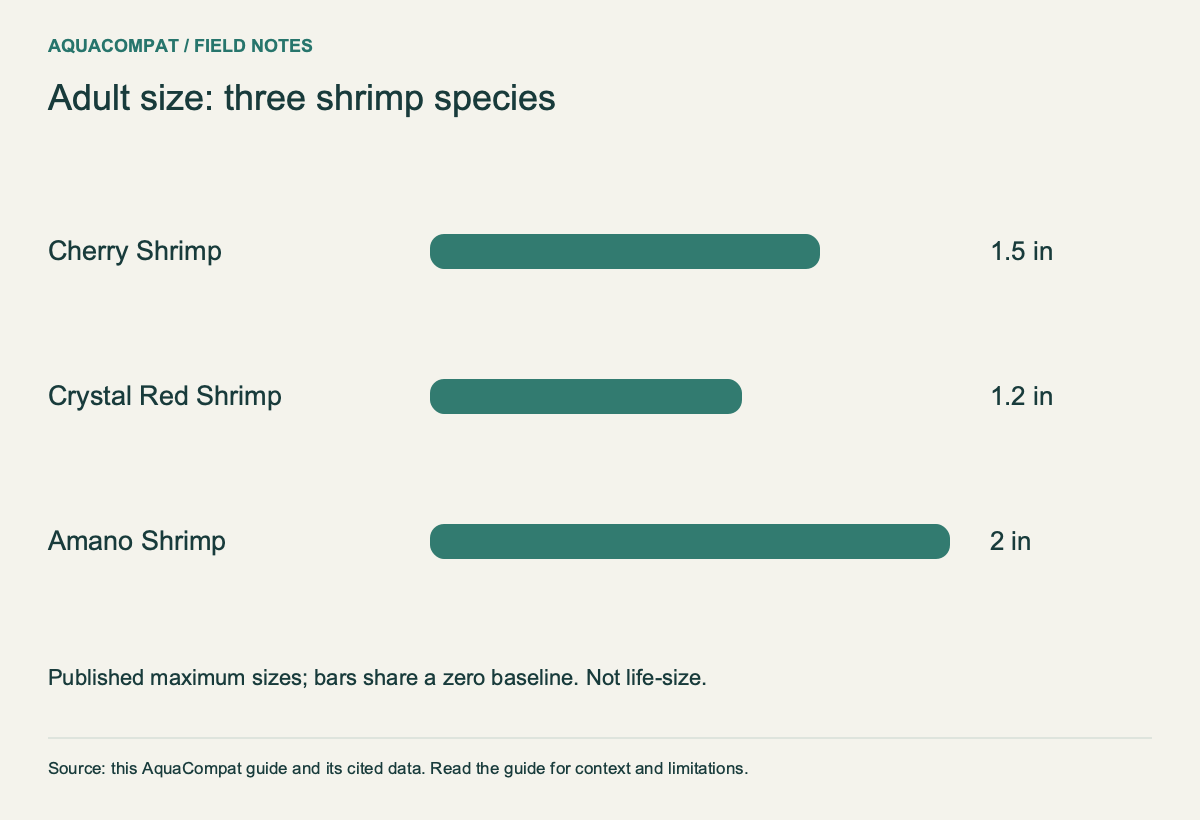
| Attribute | Cherry shrimp (Neocaridina) | Crystal red shrimp (Caridina) | Amano shrimp (Caridina) |
|---|---|---|---|
| TDS | 100–250 ppm | 100–180 ppm | 100–300 ppm |
| General hardness | 6–10 dGH | 4–6 dGH | 6–15 dGH |
| Carbonate hardness | 2–8 dKH | 0–2 dKH | 0–10 dKH |
| pH | pH 6.5–8.0 | pH 6.2–7.0 | pH 6.0–7.5 |
| Temperature | 70–79 °F (21–26 °C) | 70–74 °F (21–23 °C) | 65–81 °F (18–27 °C) |
| Adult size | 1.5 in (3.8 cm) | 1.2 in (3 cm) | 2 in (5.1 cm) |
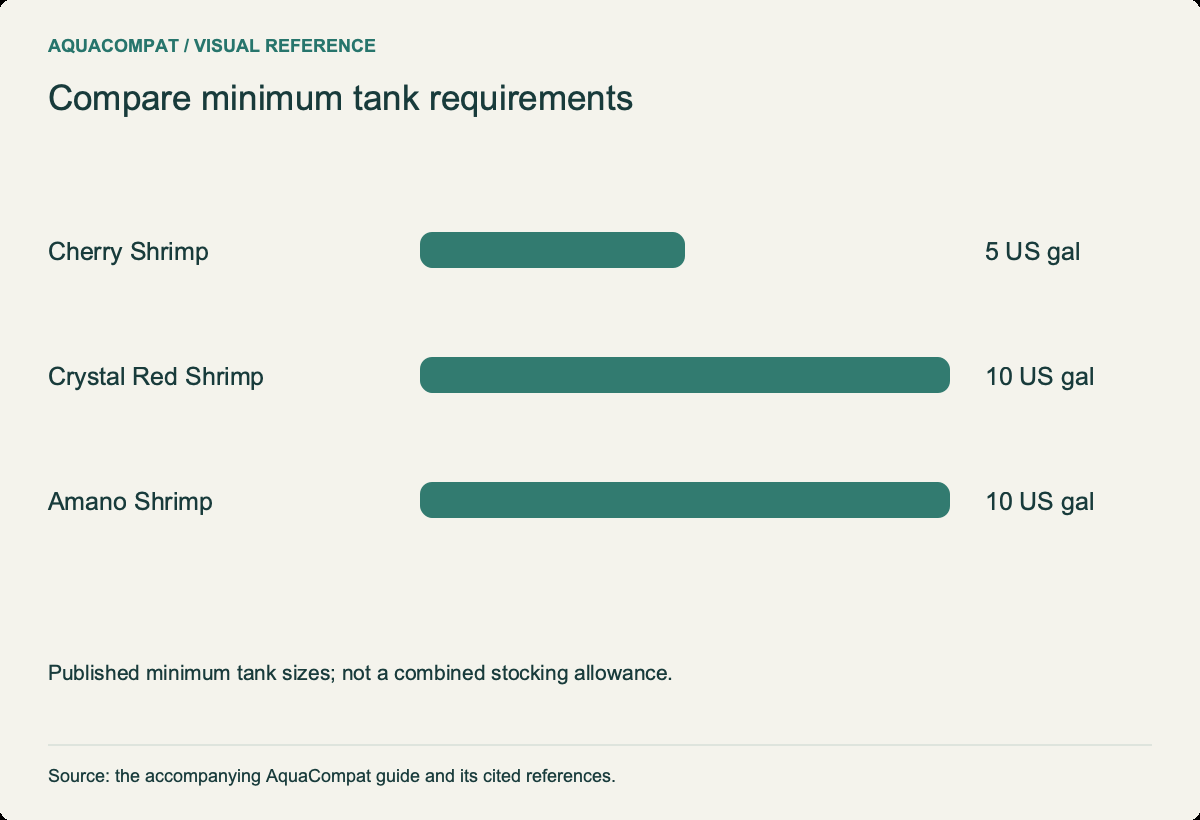
| Minimum tank | 5 US gal (19 L) | 10 US gal (38 L) | 10 US gal (38 L) |
| Care level | beginner | intermediate | beginner |
| Breeding difficulty | easy | moderate | hard; larvae need brackish water |
| Lifespan | 1–2 years | 1–2 years | 2–3 years |
What TDS, GH and KH do Caridina and Neocaridina need?
Caridina bee shrimp need soft water with almost no carbonate hardness, while Neocaridina need moderate hardness with some KH.
GH: general hardness
General hardness (GH) measures dissolved calcium and magnesium, the minerals shrimp use to build a new shell at each moult. Cherry shrimp are listed at 6–10 dGH and crystal reds at 4–6 dGH, so the two share only 6–6 dGH. Practical Fishkeeping’s introduction recommends harder water still for Neocaridina, which widens the gap.
KH: carbonate hardness
Carbonate hardness (KH) is the water’s buffer against acid, and it holds pH up. Cherry shrimp take 2–8 dKH; crystal reds need 0–2 dKH. KH is the clearest single dividing line between the genera, because low KH lets pH fall into the acidic range crystal reds prefer. Our guide to GH and KH testing explains both measures.
TDS: total dissolved solids
Total dissolved solids (TDS) is the total of everything dissolved in the water, usually estimated from conductivity. Bee shrimp keepers target about 100–150 ppm, according to SaltyShrimp, while Neocaridina targets sit around 200–250 ppm. Our species data lists 100–180 ppm for crystal reds and 100–250 ppm for cherries. The TDS in shrimp tanks guide covers how to measure it.
How do pH and temperature separate the two genera?
Crystal reds need cooler, more acidic water than cherry shrimp. The figure above shows the overlap: cherry shrimp are listed at pH 6.5–8.0 and crystal reds at pH 6.2–7.0, sharing pH 6.5–7.0. For temperature, cherries take 70–79 °F (21–26 °C), the range in which Practical Fishkeeping says they live longest and breed best, while crystal reds take 70–74 °F (21–23 °C). The shared band is 70–74 °F (21–23 °C), at the cool end of the cherry’s range and the warm end of the crystal red’s. Shrimp and Snail Breeder says warmer water shortens a crystal red’s life.
Do Caridina shrimp need RO water?
Soft-water Caridina such as crystal reds are usually kept in remineralised reverse osmosis (RO) water in the sources we use: SaltyShrimp describes RO water being remineralised up to the Caridina target. Reverse osmosis pushes water through a membrane that holds back most dissolved compounds, leaving water of about 5–10 ppm. That water is too pure to use alone, so a remineraliser adds GH back. SaltyShrimp’s Bee Shrimp Mineral GH+ adds GH without KH at about 2–3 g per 10 L RO water; its GH/KH+ product for Neocaridina uses about 3 g per 10 L RO water. Shrimp Science also notes that remineralised RO water gives full control of crystal red parameters. The RO/DI water for aquariums guide explains the process and its waste-water cost.
Neocaridina are less demanding. If your dechlorinated source water already falls inside 6–10 dGH and 2–8 dKH, cherry shrimp need no RO stage, and a GH and KH test will show whether it does.
Can Caridina and Neocaridina shrimp live together?
They can share a tank, but only in a compromise that suits neither species well. The cherry and crystal red pairing scores 9/10 and is rated compatible, because both are peaceful grazers of similar size and their ranges do touch. The shared water is narrow, though: 6–6 dGH of GH, pH 6.5–7.0 and 70–74 °F (21–23 °C). Our crystal red record calls a shared tank a compromise, and Shrimp Science says the two are usually not kept in the same water. Shrimp and Snail Breeder adds that crystal reds lose condition when water parameters swing, so a tank held at the edge of both ranges leaves little margin.
Can Caridina and Neocaridina interbreed?
The sources disagree. Shrimp and Snail Breeder says there is no risk of crystal reds hybridising with Neocaridina. Shrimp Science claims the two can interbreed near pH 7, which is exactly where a mixed tank would sit. We cannot resolve that conflict from the published data, so if keeping lines pure matters, keep the genera in separate tanks.
Within each genus, crossbreeding is not in doubt. Crystal reds crossbreed with other Caridina bee and tiger shrimp, according to Shrimp Science and Shrimp and Snail Breeder, so keep one Caridina line per tank. Practical Fishkeeping says Neocaridina colour varieties crossbreed with one another too.
Where do amano shrimp fit between the two?
The amano shrimp is a Caridina, but its water needs are closer to the Neocaridina band than to crystal reds. It is listed at 6–15 dGH, 0–10 dKH and pH 6.0–7.5, wide enough to share water with either. It pairs as compatible with cherry shrimp and compatible with crystal reds in our data.
Two traits set amanos apart. They cannot breed in freshwater: Aquarium Co-Op says the larvae need brackish to marine water, and lab work by Kondo, Hamasaki and Dan (2021) found the larvae adapt across a wide range of salinities, with freshwater not among the conditions tested. They also grow to 2 in (5.1 cm) and feed boldly; Aquarium Co-Op and Shrimp and Snail Breeder say large amanos steal food from smaller dwarf shrimp. Shrimp and Snail Breeder says attacks on cherry shrimp are unlikely unless the amano is starving.
Which is easier for beginners, Caridina or Neocaridina?
Neocaridina are easier. Shrimp Science rates the cherry shrimp beginner and the crystal red intermediate, and Shrimp and Snail Breeder says crystal reds are harder than cherry shrimp and not for novice breeders. Cherry shrimp breed with no special steps, according to Practical Fishkeeping, while Shrimp and Snail Breeder rates crystal red breeding as medium, with young maturing at about four months in stable soft water. Start with cherry shrimp unless you are ready to manage RO water and remineralisation.
Both genera need the same basics: a fully cycled tank, because Practical Fishkeeping warns that any trace of ammonia or nitrite is dangerous to shrimp, and no copper, which Shrimp and Snail Breeder says is fatal far below fish treatment doses. For gentle filtration, the best sponge filters guide compares foam filters rated for small shrimp tanks, and the cherry shrimp tank mates hub ranks fish that leave shrimp alone.
Is TDS the most important number in a shrimp tank?
No. TDS is a useful summary, but Shrimp Science states it is not a useful measurement on its own: GH, KH and nitrogen readings matter more. Two tanks at the same TDS can hold very different amounts of calcium, magnesium and carbonate, and a crystal red tank needs GH without KH. Treat TDS as a quick check that water has not drifted, and use GH and KH tests to set it. The SaltyShrimp product notes support this, since they target bee shrimp TDS with a GH-only mineral.
What goes wrong when Caridina are kept like Neocaridina?
Crystal reds kept in hard, high-KH tap water sit outside every published range for them, and Shrimp and Snail Breeder links shrimp losses to unstable parameters. Pests are a second risk in shrimp tanks. Planaria prey on small invertebrates and can threaten shrimplets and eggs, and hydra can catch shrimplets, so a breeding colony of either genus needs controlled feeding. The guide to planaria and hydra in shrimp tanks covers the treatments that are safe with shrimp. Fish are the third risk: even small nano fish take baby shrimp, as the harlequin, chili and galaxy rasbora comparison shows.
Other side-by-side comparisons are collected on the species comparisons page.
Questions people ask
Can cherry shrimp and crystal red shrimp live together?
They can survive together in a narrow band, around pH 6.5–7.0 and 6–6 dGH of GH, but neither species is at its best there. Shrimp Science says the genera are usually kept in separate water, and the sources disagree on whether they can interbreed.
Is the amano shrimp a Caridina or a Neocaridina?
A Caridina: its scientific name is Caridina multidentata. Unlike crystal reds, it tolerates a wide range, 6–15 dGH and pH 6.0–7.5, and it cannot breed in freshwater because its larvae need brackish water.
What TDS should a crystal red shrimp tank have?
Our crystal red data lists 100–180 ppm, from Shrimp Science and Shrimp and Snail Breeder. SaltyShrimp targets about 100–150 ppm for bee shrimp. Set GH to 4–6 dGH with KH near zero first, then check TDS.
Do Neocaridina need RO water?
Not if your source water already fits. Cherry shrimp take 6–10 dGH and 2–8 dKH, so test GH and KH before deciding. In our sources RO water is used mainly to build the soft, low-KH water that Caridina bee shrimp need.
Sources 37 documents from 20 publishers
- Aquarium Co-Op (aquariumcoop.com): “Care Guide for Cherry Shrimp”; “Care Guide for Amano Shrimp”; “How to Get Rid of Hydra in Your Aquarium”
- AquariumScience.org (aquariumscience.org): “10.13.1 Hydra”
- Crustacean Research 49 (Hamasaki et al. 2020) (jstage.jst.go.jp): “Dietary effects of phytoplankton and zooplankton on larval survival, duration and growth of four Caridina species”
- Crustacean Research 50 (Kondo, Hamasaki, Dan 2021) (jstage.jst.go.jp): “Larval performance of three amphidromous shrimp species in the genus Caridina under different temperature and salinity conditions”
- Environmental Science and Pollution Research (via PMC) (pmc.ncbi.nlm.nih.gov): “Wagil M. et al. Toxicity of anthelmintic drugs (fenbendazole and flubendazole) to aquatic organisms”
- FishTankAdvisor (fishtankadvisor.com): “Planaria in the Aquarium: Removal and Prevention”
- Green Aqua (greenaqua.hu): “Shrimp in the aquarium”
- Green Aqua (Biomax) (greenaqua.hu): “Biomax NO Planaria product instructions”
- Maidenhead Aquatics (fishkeeper.co.uk species data sheet) (fishkeeper.co.uk): “Amano Shrimp”
- Merck Veterinary Manual (merckvetmanual.com): “Environmental Diseases of Aquatic Animals in Aquatic Systems, Francis-Floyd, Yanong and Petty”; “Management of Aquarium Fish, Petty, Francis-Floyd and Yanong”
- Michigan State University Extension (archive) (sanweb.lib.msu.edu): “Reverse Osmosis for Home Treatment of Drinking Water (WQ24, 1990)”
- Practical Fishkeeping (practicalfishkeeping.co.uk): “Frequently asked questions on Neocaridina shrimps”; “An introduction to Shrimp”; “Amano shrimp: Spineless heroes (Nathan Hill)”
- SaltyShrimp (product information via Furry Critter Network) (furrycritter.com): “SaltyShrimp Remineralizers for Invertebrates”
- Seriously Fish (seriouslyfish.com): “New shrimp from Hong Kong and southern China”
- Shrimp and Snail Breeder (aquariumbreeder.com): “Red Cherry Shrimp: detailed guide, care, diet and breeding”; “Cherry Shrimp in a Community Tank”; “How Copper Affects Dwarf Shrimp”; “Crystal Red Shrimp: detailed guide, care, diet and breeding”; “Amano Shrimp: detailed guide, care, diet and breeding”
- Shrimp Science (shrimpscience.com): “Red Cherry Shrimp - Care Guide”; “General Hardness (GH) For Shrimp Tanks”; “Carbonate Hardness (KH) For Shrimp Tanks”; “TDS For Shrimp Tanks”; “Crystal Red Shrimp - Care Guide”; “Amano Shrimp”
- Southern Regional Aquaculture Center (srac.msstate.edu): “Interactions of pH, Carbon Dioxide, Alkalinity and Hardness in Fish Ponds, SRAC Publication No. 464, Wurts and Durborow”; “SRAC 4606: Interpretation of Water Analysis Reports for Fish Culture (Stone, Shelton, Haggard, Thomforde)”; “How to Start a Biofilter, SRAC Publication No. 4502, DeLong and Losordo”
- University of Florida IFAS Extension (ask.ifas.ufl.edu): “FA165: Use of Copper in Marine Aquaculture and Aquarium Systems (R.P.E. Yanong)”
- University of Florida IFAS Extension (EDIS) (ask.ifas.ufl.edu): “Ammonia in Aquatic Systems (FA16/FA031), Francis-Floyd, Watson, Petty and Pouder”
- Wikipedia (en.wikipedia.org): “dGH”; “Carbonate hardness”
All sources accessed . Every number on this page comes from these documents.