How do you tell planaria from hydra?
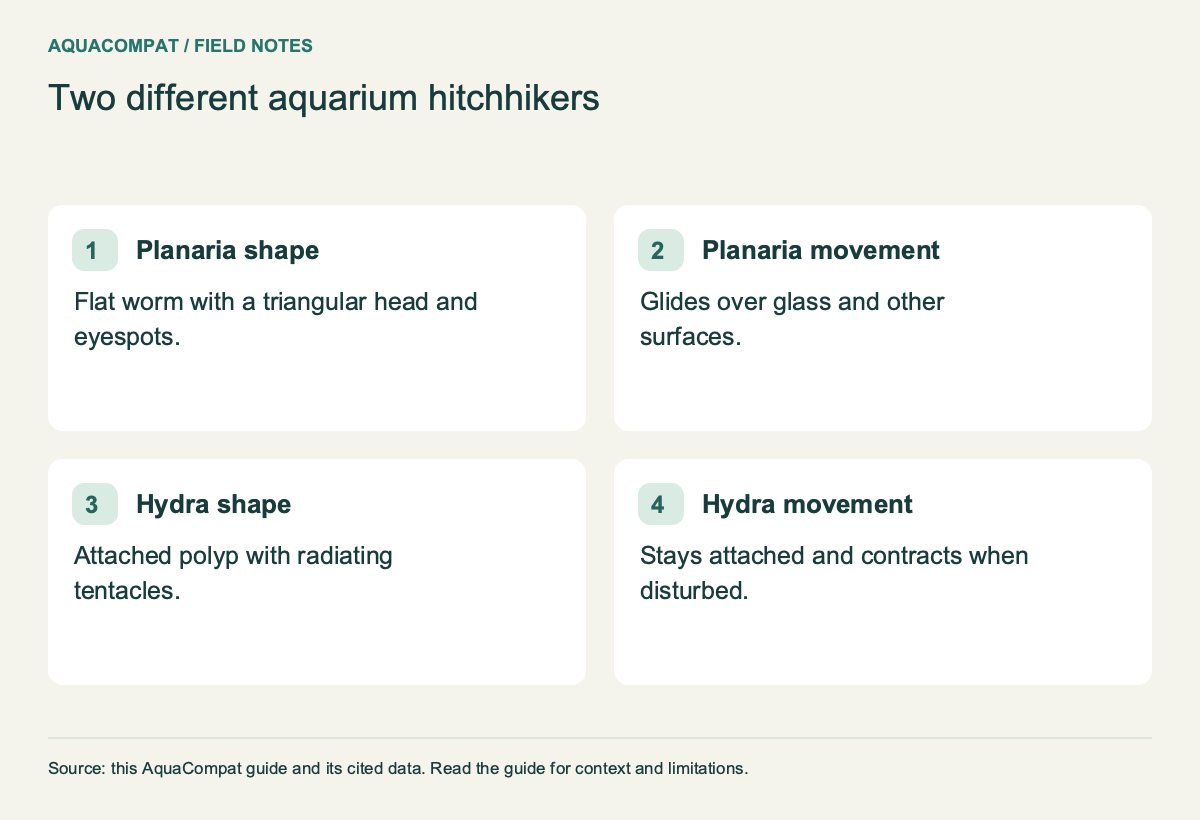
You tell them apart by shape and movement: planaria are flat worms that glide, and hydra are fixed polyps with tentacles. FishTankAdvisor, Aquarium Co-Op and AquariumScience.org describe the features compared below.
| Feature | Planaria | Hydra |
|---|---|---|
| What it is | Free-living flatworm | Small polyp related to jellyfish and anemones |
| Size | About 2.5–10 mm | Up to about 0.4 in |
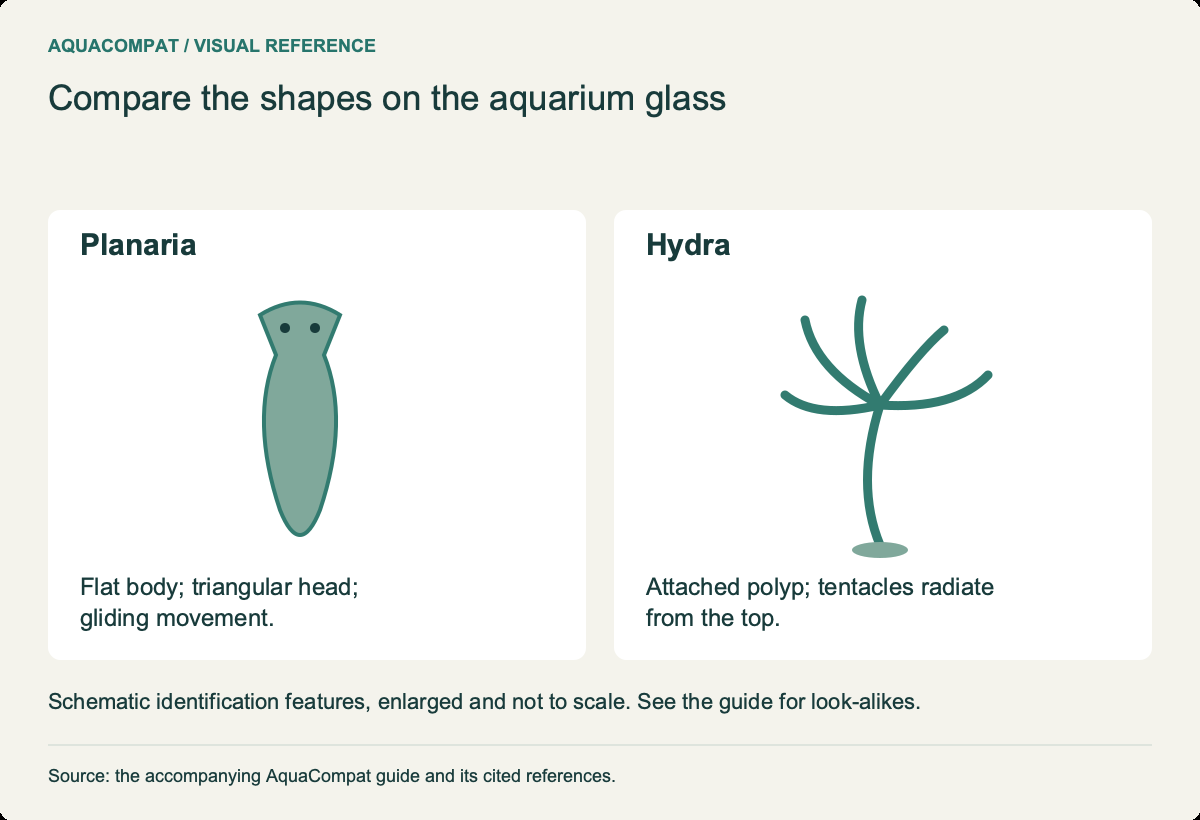
| Shape | Spade or triangle-shaped head with eyespots | Foot attached to a surface, with a ring of thin tentacles |
| Movement | Glides up the glass on a slime trail | Stays attached; pulls back when touched |
| Threat to shrimp and fry | Preys on small invertebrates; can take shrimplets and eggs | Stinging tentacles can catch shrimplets and fry |
| Threat to adult fish | Not described as a threat | Generally harmless to adult fish |
Are the white worms on the glass planaria?
White worms on the glass are planaria only if they have a triangular head with eyespots. FishTankAdvisor stresses that planaria are told apart from other small white worms by that head shape, not by colour, because their colour changes with their diet. A worm without that head and those eyespots is not a planarian by this test. Hydra are easier: AquariumScience.org notes they can look like small tufts of algae, but touching one settles it, because hydra recoil and algae does not.
The threat level differs too. Hydra carry stinging cells that can catch shrimplets and fish fry, according to AquariumScience.org and Aquarium Co-Op, but they are generally harmless to adult fish. FishTankAdvisor describes planaria as predators of small invertebrates that can threaten shrimplets and eggs in breeding tanks. In a cherry shrimp colony, both are a problem for the young rather than the adults.
Why do planaria and hydra appear in an aquarium?
Planaria and hydra appear because they were carried in, then multiply because there is surplus food. The sources agree that both hitchhike on plants, decor, snails, shrimp or fish, and that they boom with heavy feeding and fine live foods such as baby brine shrimp.
Uneaten food matters for the water as well as for the pests. UF/IFAS notes that uneaten food makes ammonia worse, and cherry shrimp are listed as intolerant of any trace of ammonia or nitrite. The nitrogen cycle explains how the biofilter handles that load and why an overfed shrimp tank is under strain on two fronts.
How do you get rid of planaria and hydra?
You get rid of them by cutting the food supply first and medicating only if that fails. The steps below follow Aquarium Co-Op, AquariumScience.org, FishTankAdvisor and the Biomax NO Planaria label.
- Reduce food. Cut back feeding, especially fine live foods like baby brine shrimp. Aquarium Co-Op and AquariumScience.org say hydra starve when surplus food is removed.
- Move snails you want to keep. Every medicated route below can kill snails, so rehome them first.
- Planaria: fenbendazole. FishTankAdvisor’s protocol removes snails and carbon, doses Panacur-C at 0.1 g per 10 gallons (38 L), waits 48 hours, then siphons out dead worms and changes at least 25% of the water.
- Hydra: fenbendazole. Aquarium Co-Op uses a fenbendazole livestock dewormer at 1 drop per gallon and changes 50% of the water after 3 days if needed. AquariumScience.org doses 3 times, 3 days apart, with no water changes during treatment.
- Or a betel-nut product, per its label. The Biomax NO Planaria label gives, per 50 L, 1 measuring spoon on day 1, half a spoon on day 2 and a quarter on day 3, then a 50% water change after 72 hours, while watching ammonia and nitrite.
- Clean up after the kill. FishTankAdvisor and the Biomax label both warn that dead worms rot and can cause an ammonia spike, so siphon them out and change water.
The two fenbendazole doses are not interchangeable. FishTankAdvisor gives 0.1 g of Panacur-C powder per 10 gallons, while Aquarium Co-Op gives 1 drop of a liquid dewormer per gallon, and the fact base records that the two forms cannot be compared directly. Use one protocol from start to finish, and test ammonia and nitrite through the clean-up; the guide to choosing aquarium test kits compares kits that read both.
A betel-nut planaria and hydra treatment
The product below is the planaria and hydra treatment in the AquaCompat catalog. Its record has gaps worth knowing before you buy: the fact base has no manufacturer web page for Genchem No Planaria, its details come from two retailers, the matched Amazon listing carries a seller name, SOBAKEN, ahead of Genchem’s, and its dose and schedule are not verified. The Biomax label quoted above is for a different betel-nut product. AquaCompat did not use or test either.
As an Amazon Associate I earn from qualifying purchases. Prices change often, so they are not shown here; the button opens the current listing.

Genchem No Planaria
- Active ingredient
- betel nut (areca palm) extract
- Sold for
- planaria and hydra
- Shrimp
- sold as shrimp safe at recommended dose
- Snails
- harmful to snails; relocate them during treatment
- Filter
- remove or turn off carbon during treatment
- Afterwards
- partial water change after treatment
Fits: a shrimp-only tank where cutting food has not cleared planaria or hydra; retailers describe shrimp as unaffected at the recommended dose.
Skip it if: you cannot move your snails out; retailers say it can kill them. Follow the pack’s own directions, since the fact base has no verified dose, and expect a partial water change afterwards.
Check price on AmazonAre planaria and hydra treatments safe for shrimp and snails?
Snails are at real risk from every medicated route, and shrimp are safe only within the dose. The cautions below come from the planaria and hydra sources, a laboratory toxicity study and the species data.
- Snails and fenbendazole. FishTankAdvisor and AquariumScience.org report that fenbendazole kills snails, so remove the ones you want to keep. Aquarium Co-Op says that in its experience fenbendazole has been safe with snails and shrimp; with sources split, moving the snails is the cautious choice.
- Snails and betel nut. The Biomax label says its betel-nut product kills most snail species, and advises waiting at least 2–3 weeks before re-adding snails and up to 4–5 months for sensitive ones. Genchem’s retailers likewise describe it as harmful to snails; relocate them during treatment. Nerite and mystery snails both belong in the move-out group; the aquarium snail tank mates guide covers where to house them.
- Shrimp and fenbendazole. In a laboratory study, Wagil and colleagues found fenbendazole and flubendazole most toxic to the crustacean Daphnia magna, with 48-hour EC50 values of 19 µg/L and 45 µg/L. AquariumScience.org warns that overdosing fenbendazole can harm shrimp. Shrimp are crustaceans too, so measure the dose exactly.
- Shrimp and copper. Copper is sometimes used against hydra, but AquariumScience.org and UF/IFAS (Yanong, FA165) say it kills shrimp and usually snails. Shrimp and Snail Breeder puts the danger level for cherry shrimp near 0.03 mg/L, and Amano shrimp are equally at risk. Copper is not a route for a shrimp tank.
How should you change water after treating a shrimp tank?
You should change water with the same kind of water the shrimp already live in, because the clean-up changes are large. The protocols above call for 25% to 50% changes, and Green Aqua stresses that shrimp do not tolerate parameter changes. Crystal red shrimp are listed at 100–180 ppm and cherry shrimp at 100–250 ppm, and the crystal red shrimp data records that shrimp losses follow swings in parameters, so a 50% change with mismatched water carries its own risk. Tanks run on remineralised reverse osmosis water should be topped up with the same mix; the guide to RO/DI water for aquariums explains the process, and TDS in shrimp tanks shows how to check the match with a meter.
Do you need medication to get rid of hydra?
No: hydra often disappear without medication once the surplus food is gone. Aquarium Co-Op and AquariumScience.org both put reduced feeding first, and both say hydra starve when there is nothing extra for them to catch. Medication kills the hydra present but leaves the food supply that let them multiply, so a medicated tank that goes back to heavy feeding with baby brine shrimp can see them return. Planaria are less clear-cut, and the sources reach for fenbendazole or a betel-nut product sooner, but the same feeding cut is the starting point for both.
What if planaria or hydra come back after treatment?
Planaria or hydra that return after treatment point to a food surplus or a new hitchhiker, not to a weak medication. A single treated outbreak and a recurring one need different responses. A recurring outbreak means something keeps feeding them or bringing them in: fine live food, uneaten pellets, or new plants and livestock added without quarantine.
Repeating the medication is the wrong escalation in a shrimp tank. Each fenbendazole or betel-nut course risks the snails, adds a dead-worm ammonia load, and calls for another large water change, and the Wagil study shows how sensitive crustaceans are to fenbendazole. Fix the feeding and the source first. Mature filtration is part of AquariumScience.org’s prevention advice, and the sponge filters we compared are built for shrimp and fry tanks.
When should you ask an aquatic vet about planaria or hydra?
These pests do not infect fish, so most outbreaks never need a vet. The fact base notes one exception: livestock dewormers such as fenbendazole are off-label uses, so ask an aquatic veterinarian before using them in a tank with valuable or sensitive animals.
How can you keep planaria and hydra out of a shrimp tank?
Quarantine and measured feeding keep most planaria and hydra out. FishTankAdvisor recommends quarantining new plants and livestock before adding them, since both pests hitchhike. AquariumScience.org suggests feeding about 1–2% of fish body weight per day, keeping the filtration mature and the plants healthy. Breeders who raise shrimplets on fine foods should feed in small amounts and remove what is left. For the wider choice of shrimp, the comparison of Caridina and Neocaridina shrimp compares the two groups’ water needs. More tank problems are covered in the fish disease guides.
Questions people ask
Are planaria harmful to shrimp?
Planaria are a threat to shrimplets and eggs rather than adult shrimp. FishTankAdvisor describes them as predators of small invertebrates that can threaten shrimplets and eggs in breeding tanks. Hydra are similar: their stinging tentacles can catch shrimplets and fry but are generally harmless to adult fish.
Is fenbendazole safe for cherry shrimp?
The sources are split. Aquarium Co-Op says that in its experience fenbendazole has been safe with snails and shrimp, while AquariumScience.org warns that overdosing it can harm shrimp. A laboratory study found fenbendazole highly toxic to the crustacean Daphnia magna. If you use it, follow one protocol exactly and move snails out first.
How long after No Planaria can I add snails back?
For the Biomax NO Planaria product, the maker says to wait at least 2–3 weeks before re-adding snails, and up to 4–5 months for sensitive species. The fact base has no equivalent figure for Genchem No Planaria, whose retailers say only that it is harmful to snails and that snails should be relocated during treatment.
Do planaria come from overfeeding?
Overfeeding does not create planaria, but it lets them multiply. The sources say both planaria and hydra arrive on plants, decor, snails, shrimp or fish, then boom when there is a lot of surplus food such as heavy feeding or baby brine shrimp.
Sources 52 documents from 22 publishers
- Applesnail.net (applesnail.net): “Pomacea diffusa”; “How to take care of apple snails”; “Quick guide”; “Apple snail FAQ”
- Aquarium Co-Op (aquariumcoop.com): “How to Get Rid of Hydra in Your Aquarium”; “Care Guide for Cherry Shrimp”; “Care Guide for Nerite Snails”; “Care Guide for Mystery Snails”; “Betta fish tank mates”; “Care Guide for Amano Shrimp”
- AquariumInfo.org (aquariuminfo.org): “Apple Snail”
- AquariumScience.org (aquariumscience.org): “10.13.1 Hydra”
- Crustacean Research 49 (Hamasaki et al. 2020) (jstage.jst.go.jp): “Dietary effects of phytoplankton and zooplankton on larval survival, duration and growth of four Caridina species”
- Crustacean Research 50 (Kondo, Hamasaki, Dan 2021) (jstage.jst.go.jp): “Larval performance of three amphidromous shrimp species in the genus Caridina under different temperature and salinity conditions”
- Environmental Science and Pollution Research (via PMC) (pmc.ncbi.nlm.nih.gov): “Wagil M. et al. Toxicity of anthelmintic drugs (fenbendazole and flubendazole) to aquatic organisms”
- FishTankAdvisor (fishtankadvisor.com): “Planaria in the Aquarium: Removal and Prevention”
- Gensou (gensou.sg): “Planaria Aquarium Removal with No Planaria”
- Green Aqua (greenaqua.hu): “Shrimp in the aquarium”
- Green Aqua (Biomax) (greenaqua.hu): “Biomax NO Planaria product instructions”
- Illinois State University Environmental Health and Safety (ehs.illinoisstate.edu): “Aeromonas (clinical signs in fish)”
- Maidenhead Aquatics (fishkeeper.co.uk species data sheet) (fishkeeper.co.uk): “Zebra Nerite Snail”; “Amano Shrimp”
- McMerwe (mcmerwe.co.za): “Genchem No Planaria”
- Practical Fishkeeping (practicalfishkeeping.co.uk): “Tempting the difficult diner”; “Frequently asked questions on Neocaridina shrimps”; “An introduction to Shrimp”; “Will these snails starve without algae?”; “What can I add for algae control?”; “Amano shrimp: Spineless heroes (Nathan Hill)”
- SaltyShrimp (product information via Furry Critter Network) (furrycritter.com): “SaltyShrimp Remineralizers for Invertebrates”
- Seriously Fish (seriouslyfish.com): “New shrimp from Hong Kong and southern China”
- Shrimp and Snail Breeder (aquariumbreeder.com): “Red Cherry Shrimp: detailed guide, care, diet and breeding”; “Cherry Shrimp in a Community Tank”; “How Copper Affects Dwarf Shrimp”; “Nerite Snails: detailed guide, care, diet and breeding”; “Amano Shrimp: detailed guide, care, diet and breeding”; “Crystal Red Shrimp: detailed guide, care, diet and breeding”
- Shrimp Science (shrimpscience.com): “Red Cherry Shrimp - Care Guide”; “General Hardness (GH) For Shrimp Tanks”; “Carbonate Hardness (KH) For Shrimp Tanks”; “TDS For Shrimp Tanks”; “Amano Shrimp”; “Crystal Red Shrimp - Care Guide”
- Southern Regional Aquaculture Center (srac.msstate.edu): “SRAC Publication No. 476: Ich (White Spot Disease)”; “SRAC Publication No. 478: Motile Aeromonas Septicemia (MAS) in Fish (2019)”; “SRAC Publication No. 474: The Role of Stress in Fish Disease (Green and Haukenes)”; “SRAC 4606: Interpretation of Water Analysis Reports for Fish Culture (Stone, Shelton, Haggard, Thomforde)”
- University of Florida IFAS Extension (ask.ifas.ufl.edu): “FA165: Use of Copper in Marine Aquaculture and Aquarium Systems (R.P.E. Yanong)”; “FA031: Ammonia in Aquatic Systems (Francis-Floyd, Watson, Petty, Pouder)”; “FA006: Ichthyophthirius multifiliis (White Spot) Infections in Fish (Francis-Floyd, Yanong, Pouder)”; “FA084: Use of Antibiotics in Ornamental Fish Aquaculture (R.P.E. Yanong)”
- Wikipedia (en.wikipedia.org): “Vittina natalensis”
All sources accessed . Every number on this page comes from these documents.