What makes a planted tank low-tech?
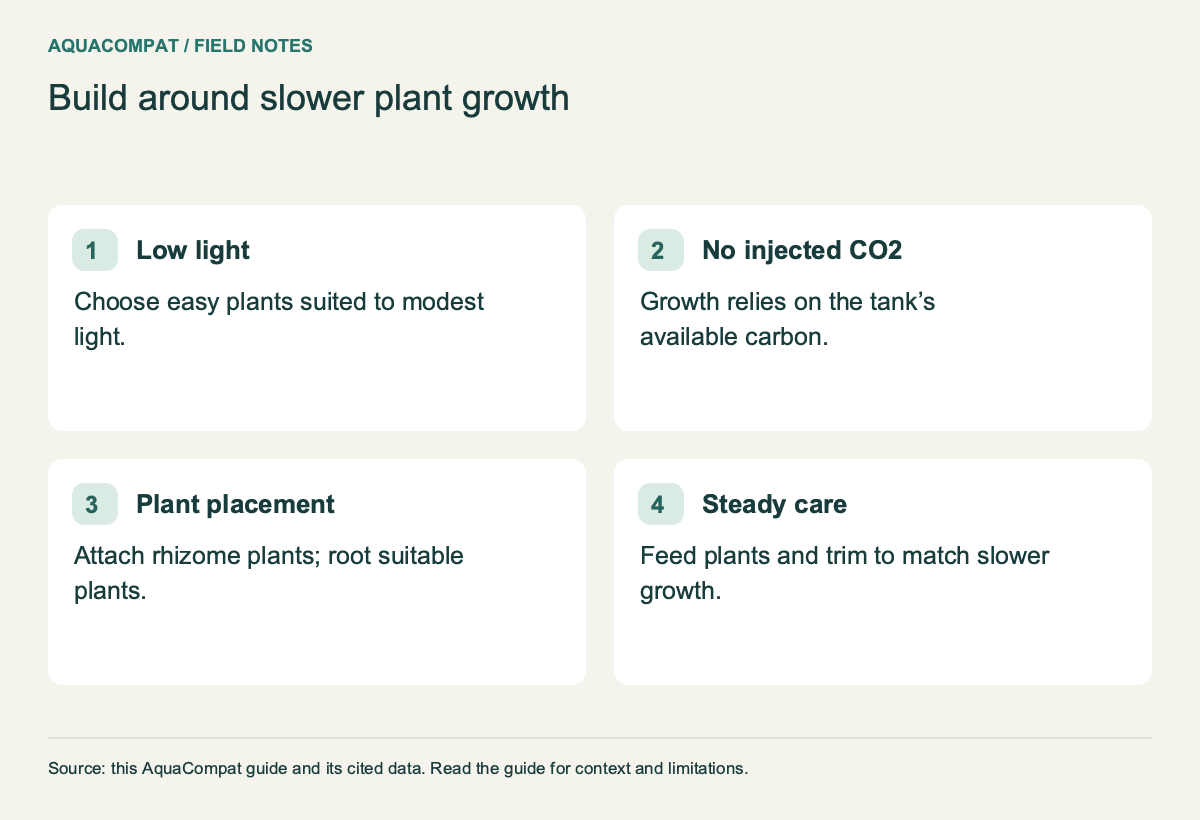
A planted tank is low-tech when it runs on low light, no added CO2 and minimal fertiliser, which is how Aquarium Co-Op defines the style. The opposite is a high-tech tank, which uses bright lighting, pressurised CO2 and heavier fertilising, and needs more maintenance. Tropica draws the same line from the plant side: its easy plants cope without added CO2, while its Medium and Advanced plants need it.
The three inputs are linked. Aquarium Co-Op says that the brighter the light, the more CO2 and fertiliser plants need, and that high light without CO2 tends to favour algae. A low-tech tank keeps all three low together, so no one input runs ahead of the others. That balance is what lets it run on 2–3 ppm of CO2, compared with the 10–15 mg/L that Tropica says its Medium plants need. The CO2 levels in planted tanks guide explains where those figures come from.
Which plants grow in a low-tech tank without CO2?
Ten common plants grow without injected CO2, according to Tropica, Aquarium Co-Op, Flowgrow and Aquasabi. Anubias nana, java fern, cryptocoryne wendtii and java moss are the most tolerant, all rated for low light. Amazon sword, vallisneria, hornwort, water sprite and dwarf sagittaria add faster growth, and the marimo ball, strictly an alga, rounds out the list. The table gives each one’s published needs.
| Plant | Light | CO2 | Placement | Growth | Max height | Temperature tolerance |
|---|---|---|---|---|---|---|
| Anubias nana (Anubias barteri var. nana) | low | not required | attach to hardscape | slow | 4 in | 54–86 °F |
| Java fern (Microsorum pteropus) | low | not required | attach to hardscape | slow | 16 in | 39–86 °F |
| Cryptocoryne wendtii | low | not required | midground | medium | 12 in | 59–86 °F |
| Java moss (Taxiphyllum barbieri) | low | not required | attach to hardscape | medium | Not published | 54–93 °F |
| Amazon sword | low to medium | not required | background | fast | 20 in | 64–86 °F |
| Vallisneria (Vallisneria spiralis) | low to medium | not required | background | fast | 31 in | 41–86 °F |
| Hornwort (Ceratophyllum demersum) | low to medium | not required | floating | fast | 31 in | 50–85 °F |
| Water sprite (Ceratopteris thalictroides) | medium | not required | background or floating | fast | Not published | 64–86 °F |
| Dwarf sagittaria (Sagittaria subulata) | low to medium | beneficial | foreground | fast | 24 in | 39–86 °F |
| Marimo ball (Aegagropila linnaei) | low | Low demand (Tropica) | foreground | very slow | 4 in across | 39–82 °F |
Where does each low-tech plant go in the tank?
Low-tech plants split into four placements: attached to hardscape, rooted in the front or middle, rooted at the back, and floating. Each group has its own planting method, set out below.
On wood and stone
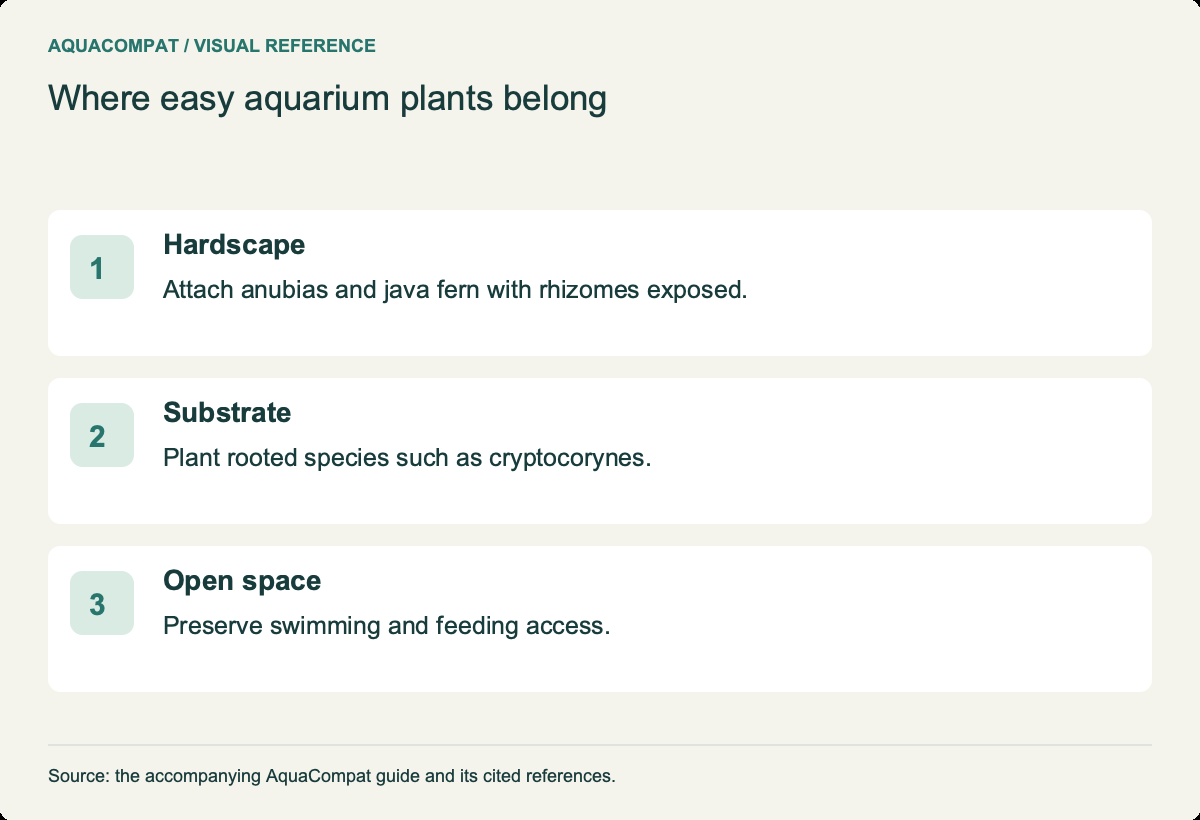
Anubias nana, java fern and java moss grow attached rather than rooted. Tropica says anubias does best on stone or root with its rhizome uncovered, and that java fern should be tied or wedged on without burying the rhizome. Java moss attaches like ivy, Aquarium Co-Op says, and does not root into gravel. These three feed mainly from the water, so they suit any substrate, even bare sand.
Foreground and midground
Dwarf sagittaria spreads by runners into a grass-like lawn, and Tropica, Aquarium Co-Op and Aquasabi note that it stays shorter in bright light and grows taller in dim light, so in a low-tech tank expect it to reach higher than in a bright one. Cryptocoryne wendtii is a midground plant that also works in the foreground. Marimo balls rest loose on the bottom; Aquarium Co-Op suggests rolling them gently now and then to keep them round.
Background
Vallisneria and the Amazon sword fill the back. Vallisneria sends out runners every few days once established, and the Amazon sword can reach 20 in or more, so Aquarium Co-Op treats it as a background or centrepiece plant for larger tanks.
Floating
Hornwort is best left floating, because Aquarium Co-Op says buried ends tend to rot, and water sprite can be planted at the back or left to float. Both grow fast and take up nutrients quickly, which helps a new low-tech tank keep algae down.
How much light does a low-tech planted tank need?
A low-tech planted tank needs low light, about 10–20 PAR, run for about 8–10 hours/day once plants are established. Aquarium Co-Op lists that band as ideal for anubias and cryptocoryne. Start a new tank at about 6 hours/day for the first two to three weeks, as Tropica advises, then raise it.
The light is the input most likely to break a low-tech tank, because a strong fixture run at full power pushes plant demand past what 2–3 ppm of CO2 can support. Aquarium Co-Op treats 40–50+ PAR as high light, a level where CO2 is usually needed to stop algae taking over. If your light is dimmable, set it low and raise it only while the plants keep pace.
How do you fertilise a low-tech planted tank?
Fertilise a low-tech tank lightly, about once a week, and match the method to the plant. Aquarium Co-Op says mosses, floating plants and epiphytes such as anubias and java fern feed mainly from the water and need liquid fertiliser rather than root tabs. Cryptocoryne wendtii is a root feeder that needs root tabs in inert substrate, and the Amazon sword is a heavy root feeder; Aquarium Co-Op starts it with two to three root tabs and adds more as it grows.
Place root tabs about every 5–6 in in a grid near the root feeders and top them up about monthly. Hold back for the first 3–4 weeks, because Tropica says nursery plants arrive with stored nutrients. Watch new leaves: Aquarium Co-Op says pale or yellow new leaves with dark veins point to iron shortage. A test kit that reads nitrate helps you judge whether the dose is too high; our page of best aquarium test kits compared lists the options.
Which low-tech plants tolerate cooler water?
Java fern, vallisneria, dwarf sagittaria, hornwort and the marimo ball tolerate the coolest water of the ten. Java fern and dwarf sagittaria are listed at 39–86 °F, vallisneria at 41–86 °F, and hornwort at 50–85 °F, a range Aquarium Co-Op says suits tropical, coldwater and pond setups. The marimo ball is listed at 39–82 °F; Flowgrow gives its best range as 15 to 24 °C (59 to 75 °F), and Aquarium Co-Op says it prefers cooler water.
That makes these plants the natural choice for an unheated tank. Goldfish, for example, are temperate fish with an optimum of 65–75 °F, which sits inside all five ranges. Anubias nana, at 54–86 °F, and the Amazon sword, at 64–86 °F, also cover that optimum but have higher lower limits, which leaves less margin if an unheated room cools further.
Is a marimo moss ball a plant?
No. Despite the name, the marimo ball is a green alga, not a moss or a true plant; Tropica, Aquarium Co-Op and Flowgrow all say so. Its scientific name is Aegagropila linnaei, formerly Cladophora aegagropila. It still behaves like a low-tech plant in practice, with low light needs and very slow growth of about 5 mm (0.2 in) a year, and Aquarium Co-Op advises keeping it out of direct sunlight.
When does a low-tech planted tank fail?
A low-tech tank fails when one input outruns the others, or when the plants chosen need more than the tank gives. Three cases come up most often.
- Too much light: Aquarium Co-Op and Tropica say plants and algae compete for the same light, nutrients and CO2, so a bright light without extra CO2 hands the surplus to algae.
- The wrong plants: Monte Carlo is listed as required for CO2, because Tropica says it needs the additive to form a compact carpet. It does not belong in a low-tech tank.
- Slow leaves: anubias leaves last for years, which Tropica notes can let slow algae settle on them. Fast growers such as water sprite, which Tropica says helps prevent algae, use spare nutrients first.
Buried rhizomes are a fourth, avoidable failure: Tropica warns an anubias rhizome may rot if covered. When algae does appear, cut the photoperiod first; the aquarium algae types and fixes page explains each type and its cause.
How does a low-tech tank compare with a high-tech one?
A low-tech tank grows more slowly and needs less equipment and care, while a high-tech tank grows faster and supports demanding plants at the cost of daily attention. Tropica says CO2 is the main plant nutrient and main growth limiter, and Aquarium Co-Op says injection with matching light and fertiliser gives faster, stronger growth. A low-tech tank accepts slower growth in exchange for stability. The full set-up sequence for either style, from substrate to first trim, is in our guide to starting a planted tank.
A low-tech tank also avoids one fish risk entirely: with no injection, CO2 is not pushed toward the level that Merck lists as potentially toxic above 12 mg/L. The best fish for a 20-gallon planted tank page builds three stockings around a planted set-up. Other water topics are collected in our water chemistry and setup guides.
Questions people ask
Can a low-tech tank have a carpet?
Not with Monte Carlo, which Tropica says needs added CO2 to form a compact carpet. Dwarf sagittaria is the closer option: it spreads by runners into a grass-like lawn and its CO2 need is listed as beneficial. In dim light it grows taller than in bright light, so it reads as a low meadow rather than a tight carpet.
Do low-tech plants need special substrate?
Not all of them. Anubias, java fern and java moss attach to wood or stone and feed from the water, so substrate does not matter for them. Root feeders such as cryptocoryne and Amazon sword do need nutrients at the roots: either a nutrient soil or root tabs in plain gravel, placed about every 5–6 in.
Why are my cryptocoryne leaves melting?
Aquarium Co-Op notes that cryptocoryne leaves often melt after a move, then regrow. Melting after planting does not mean the plant has died. Leave the roots in place and keep root tabs nearby, since Aquarium Co-Op lists the plant as a root feeder.
How long should the light be on in a low-tech tank?
About 6 hours/day for the first two to three weeks, then 8–10 hours/day, following Tropica. Aquarium Co-Op allows up to 12 hours as plants grow but says to reduce it if algae spreads.
Sources 50 documents from 6 publishers
- Aquarium Co-Op (aquariumcoop.com): “CO2 in Planted Aquariums: What Does It Really Do and Is It Natural?”; “Anubias Nana (care page)”; “Java Fern (care page)”; “Cryptocoryne Wendtii 'Green' (care page)”; “Java Moss (care page)”; “Care Guide for Java Moss”; “Amazon Sword Plant (care page)”; “Vallisneria (care page)”; “How to Care for Hornwort (Ceratophyllum demersum) in Aquariums & Ponds”; “Water Sprite (care page)”; “Dwarf Sagittaria (care page)”; “Marimo Moss Ball Care Guide”; “What is PAR? Lighting & Brightness Explained for Planted Tanks”; “How to Balance Aquarium Lights to Grow Healthy Plants (& Avoid Algae)”; “How to Use Root Tabs to Fertilize Your Live Aquarium Plants”; “How to Set Up a Low Tech Planted Aquarium for Beginners”
- Aquasabi (aquasabi.de): “Anubias barteri var. nana”; “Microsorum pteropus”; “Cryptocoryne wendtii 'Green'”; “Taxiphyllum barbieri 'Java moss'”; “Echinodorus grisebachii 'Bleherae'”; “Vallisneria spiralis”; “Ceratopteris thalictroides”; “Sagittaria subulata”
- Flowgrow Aquatic Plant Database (flowgrow.de): “Anubias barteri var. nana”; “Microsorum pteropus”; “Cryptocoryne wendtii 'grün'”; “Taxiphyllum barbieri (Java moss)”; “Echinodorus grisebachii 'Bleherae'”; “Vallisneria spiralis”; “Ceratophyllum demersum”; “Ceratopteris thalictroides”; “Sagittaria subulata”; “Aegagropila linnaei”; “Micranthemum tweediei”
- Merck Veterinary Manual (merckvetmanual.com): “Environmental Diseases of Aquatic Animals in Aquatic Systems (Francis-Floyd, Yanong, Petty)”
- Southern Regional Aquaculture Center (srac.msstate.edu): “SRAC 7201: Species Profile: Koi and Goldfish (Watson, Hill, Pouder)”
- Tropica Aquarium Plants (tropica.com): “Fertiliser and CO2 for your aquarium”; “Anubias barteri var. nana (101)”; “Microsorum pteropus (008)”; “Cryptocoryne wendtii 'Green' (109)”; “Taxiphyllum barbieri 'Bogor Moss' (003 TC)”; “Echinodorus grisebachii 'Bleherae' (071)”; “Vallisneria spiralis 'Tiger' (055A)”; “Ceratophyllum demersum (021A POR)”; “Ceratopteris thalictroides (005A)”; “Sagittaria subulata (079)”; “Aegagropila linnaei (000 CST)”; “Starting a new aquarium (growing-in guide)”; “Micranthemum tweediei 'Monte Carlo' (025)”
All sources accessed . Every number on this page comes from these documents.