What decides which fish food suits your species?
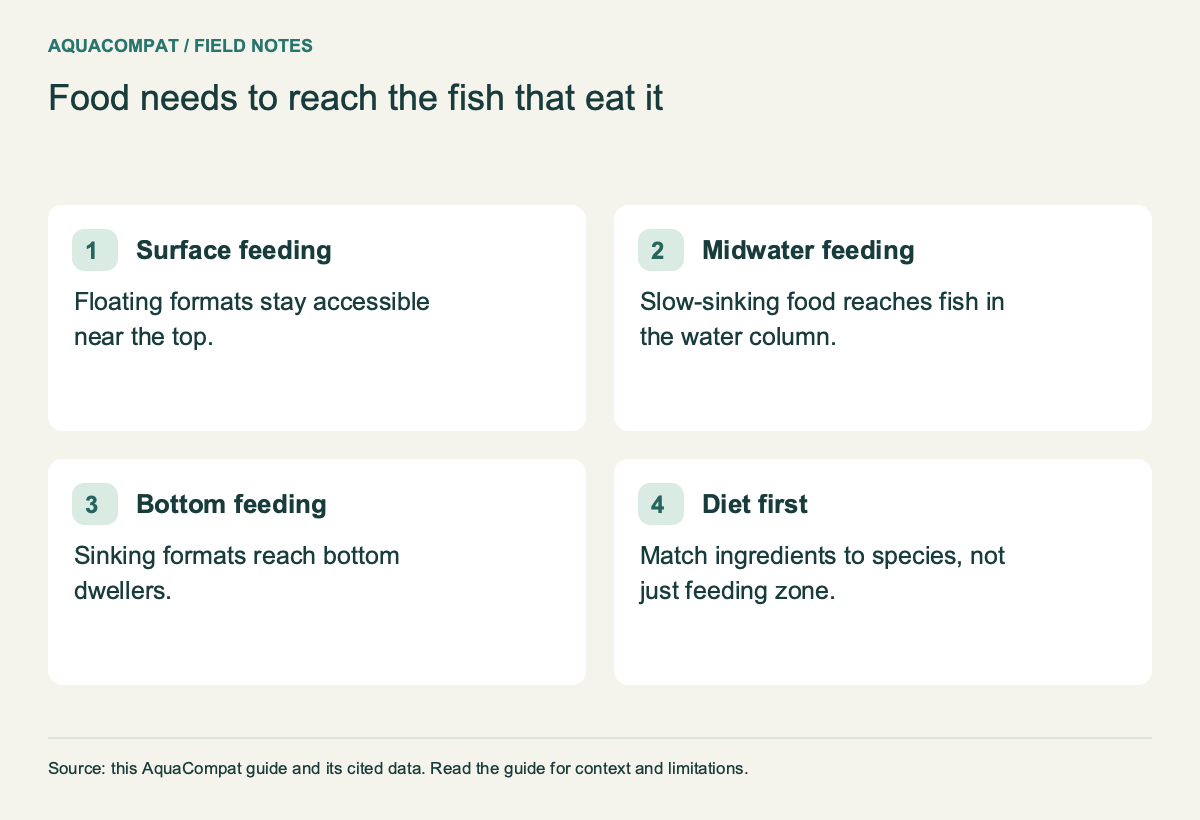
Three species traits decide the right food: where the fish feeds in the water, what it eats in the wild, and how big its mouth is. Fish food formats differ in exactly those ways: flakes float, micro pellets hang at the surface and midwater, granules sink slowly, and wafers sink to the bottom.
Swim level
Swim level is the part of the water column a species spends its time in, and it decides whether a food reaches the fish before it reaches the substrate. Zebra danios are listed as top swimmers and neon tetras as middle, while corydoras and bristlenose plecos feed at the bottom. A floating flake suits the first two and mostly misses the second two.
Diet
Diet sets the ingredients. Most community fish here are listed as omnivores, but the betta is a carnivore that eats zooplankton and insect larvae in the wild, and the bristlenose is a herbivore that rasps algae and biofilm. Food built around fish meal and krill suits omnivores; insect protein suits bettas; plant-heavy wafers suit grazers.
Mouth size
Adult size is the simplest guide to mouth size. A neon tetra reaches 1.2 in (3 cm), so it needs small food; an angelfish reaches 6 in (15.2 cm) and can take larger pieces. Fluval publishes a 0.7–1 mm granule for its small Bug Bites, but Hikari publishes no pellet size for Micro Pellets, so mouth fit there rests on Hikari’s description of the food as made for small-mouthed fish.
Which food format matches each species type?
Match the format to swim level first, then check diet. The table pairs common community species with the formats on this page that reach their feeding zone; the last column is our judgement from the species data and the food specifications.
| Species | Diet | Swim level | Adult size | Formats that reach it |
|---|---|---|---|---|
| Zebra Danio | omnivore | top | 2 in (5.1 cm) | Flakes, micro pellets |
| Neon Tetra | omnivore | middle | 1.2 in (3 cm) | Micro pellets, flakes |
| Harlequin Rasbora | omnivore | middle | 2 in (5.1 cm) | Micro pellets, flakes |
| Guppy | omnivore | all | 2.4 in (6.1 cm) | Flakes, micro pellets, granules |
| Betta Fish | carnivore | top | 2.8 in (7.1 cm) | Insect granules, micro pellets |
| Dwarf Gourami | omnivore | all | 3.5 in (8.9 cm) | Granules, flakes |
| Angelfish | omnivore | middle | 6 in (15.2 cm) | Granules, flakes |
| Molly | omnivore | all | 5 in (12.7 cm) | Flakes with plant content, algae wafers |
| Corydoras | omnivore | bottom | 3 in (7.6 cm) | Slow-sinking granules |
| Kuhli Loach | carnivore | bottom | 3.9 in (9.9 cm) | Slow-sinking granules |
| Bristlenose Pleco | herbivore | bottom | 5 in (12.7 cm) | Algae wafers |
| Cherry Shrimp | detritivore | bottom | 1.5 in (3.8 cm) | Algae wafers, sinking granules |
How do the four fish foods compare on published specs?
The four foods differ most in format and buoyancy, which is why they suit different fish rather than competing with one another. Blank analysis cells mean the maker or retailer gives no guaranteed analysis.
| Food | Format | Buoyancy | Lead ingredients | Protein / fat | Pack (listing) |
|---|---|---|---|---|---|
| New Life Spectrum Optimum Flakes | flake | floating | whole Antarctic krill, spirulina, garlic, whole fish | Not published | 90 g |
| Hikari Micro Pellets | micro pellet | semi-floating | fish meal, krill meal, soybean meal, flaked corn, cuttlefish meal | 43 % / 7 % min. | 22 g |
| Fluval Bug Bites Tropical | granule, 0.7–1 mm | slow sinking | black soldier fly larvae, salmon, peas, potato, wheat | Not published | 45 g |
| Hikari Algae Wafers | wafer | sinking | fish meal, dehydrated alfalfa meal, wheat flour, wheat-germ meal, starch | 32 % / 4 % min. | 250 g |
Fish foods matched to feeding zone
Each food below covers one feeding zone, from the surface to the substrate. AquaCompat did not feed-test them; the notes explain which species the published format and ingredients suit and who should choose something else.
As an Amazon Associate I earn from qualifying purchases. Prices change often, so they are not shown here; the button opens the current listing.

New Life Spectrum Optimum Flakes
- Format
- flake
- Buoyancy
- floating
- Key ingredients
- whole Antarctic krill, spirulina, garlic, whole fish
- Pack
- 90 g
Fits: guppies, danios, platies and mollies that feed at the top, where the spirulina content adds some of the plant matter mollies need.
Skip it if: you need a guaranteed analysis or exact ingredient order; neither was published in the retailer sources we found.
Check price on Amazon
Hikari Micro Pellets
- Format
- micro pellet
- Buoyancy
- semi-floating
- Protein (min)
- 43 %
- Made for
- small tropical fish such as tetras and barbs
Fits: a school of neon tetras or harlequin rasboras feeding in midwater, the small-mouthed fish Hikari names as its target.
Skip it if: your main feeders live on the bottom; a semi-floating pellet may be eaten before it reaches corydoras or loaches.
Check price on Amazon
Fluval Bug Bites Tropical
- Format
- granule
- Granule
- 0.7–1 mm
- Buoyancy
- slow sinking
- Insect content
- up to 40 %
Fits: bettas and gouramis that eat insect larvae in the wild, and mixed tanks where a slow sink lets midwater fish and corydoras both feed.
Skip it if: you keep plant-grazing bottom fish such as bristlenose plecos, whose main diet is vegetable food.
Check price on Amazon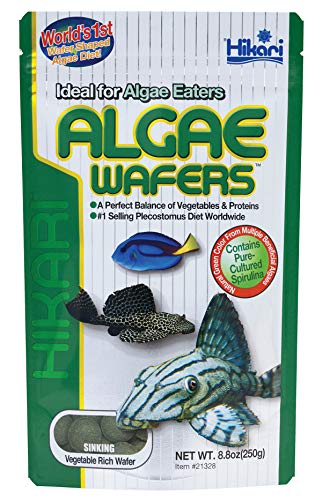
Hikari Algae Wafers
- Format
- wafer
- Buoyancy
- sinking
- Made for
- herbivorous bottom feeders such as plecos
- Protein (min)
- 32 %
Fits: bristlenose plecos, nerite snails and shrimp colonies grazing at the bottom; a 20-gallon bristlenose tank is its natural home.
Skip it if: you are feeding corydoras alone; Aquarium Co-Op describes them as foraging omnivores, not algae eaters, so a meatier sinking food suits them better.
Check price on AmazonHow did we choose these fish foods?
Every food here was chosen by matching published format, buoyancy and ingredients to the diet and swim level of common community species. We did not feed these foods to fish or compare growth or colour. Manufacturer pages for all four were unreachable when we checked, so label data comes from retailers that reproduce the maker’s label, and we name each one. The criteria were one food per feeding zone, a published format and buoyancy, and a US listing matching the exact product and size. Prices are left out because they change daily. Our process is on the methodology page.
Sera Vipagran was on our plan but had no verified specification file, so it is not compared.
Do community tanks need more than one fish food?
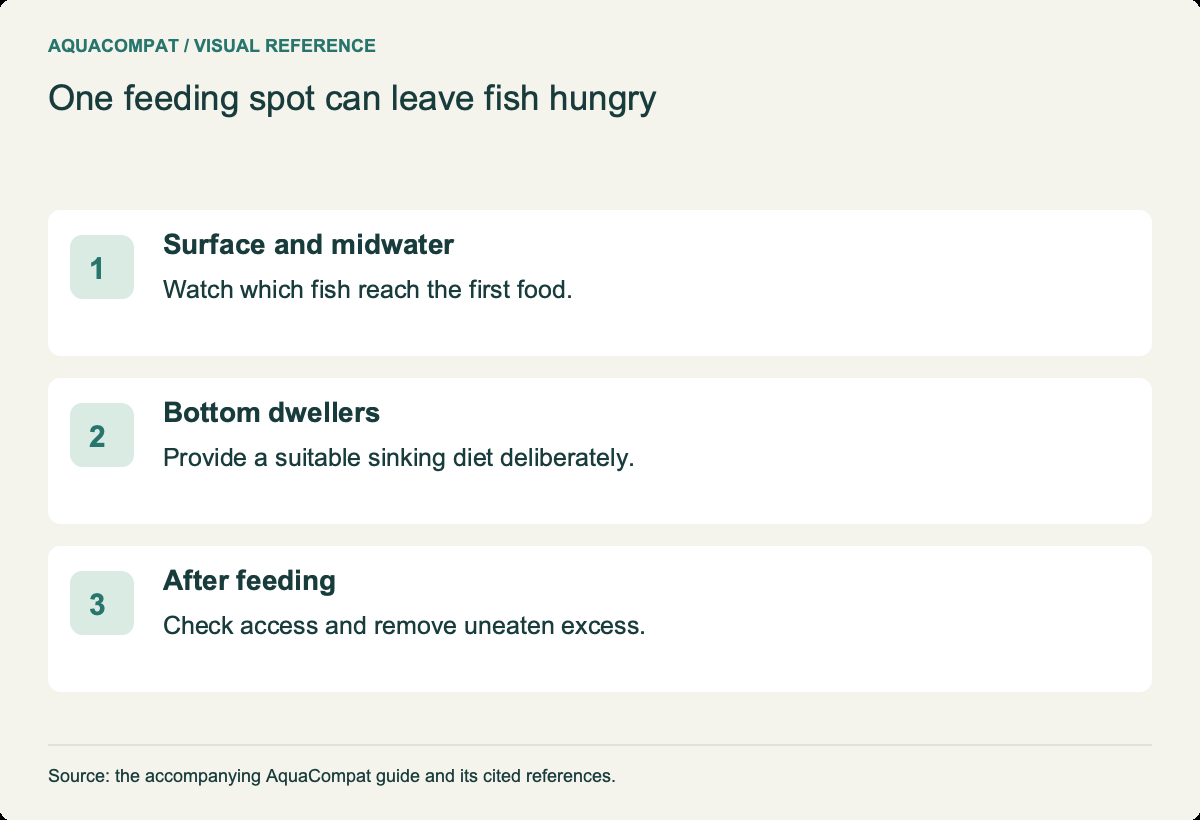
Yes, most community tanks need at least two foods, one for the upper water and one for the bottom. A typical 10-gallon community tank might hold midwater tetras with a few bottom-dwelling corydoras: flakes or micro pellets feed the tetras, and slow-sinking granules reach the corydoras after the tetras have eaten. Herbivores add a third need. Mollies need vegetable matter and algae as well as protein, according to Seriously Fish, FishBase and Aquarium Co-Op , and PlanetCatfish and Practical Fishkeeping say the bristlenose needs mainly vegetable foods such as algae wafers . For which bottom dwellers suit which tanks, see corydoras tank mates and bristlenose pleco tank mates.
Are algae wafers the right food for corydoras?
Not as their main food. Corydoras are often sold as clean-up fish, but Seriously Fish, PlanetCatfish and Aquarium Co-Op describe them as foraging omnivores that take sinking dried foods plus small live and frozen foods such as bloodworm, and state plainly that they are not algae eaters . An algae wafer is built for grazers: Hikari names herbivorous bottom feeders such as plecos as its target , and its guaranteed protein is 32 % against 43 % for the Micro Pellets. Corydoras will eat a wafer, but a slow-sinking protein food such as Bug Bites matches their listed diet more closely.
How much should you feed, and can fish skip a day?
Feed small amounts that fish finish quickly, and adult fish can safely skip a day or more. Sources differ on the exact amount: AquariumScience suggests about 1 percent of fish body weight per day in its cloudy-water advice and 1 to 2 percent in its pest-control advice .
UF/IFAS says stopping feeding for one to three days does not usually harm adult fish, which matters when ammonia appears and food must be cut back. Fry are the exception: UF/IFAS warns they should not be fasted like adults. Fry also need food small enough to swallow. Seriously Fish notes that platy fry are large at birth and can take brine shrimp nauplii or powdered flake immediately , so a crushed flake such as New Life Spectrum can serve livebearer fry from their first day.
Which fish do none of these four foods suit?
Large cichlids, discus and goldfish each need something more specific. Adult oscars grow to 14 in (35.6 cm), and Seriously Fish and FishBase list cichlid pellets plus live or frozen foods for them in aquaria ; none of these four foods is sized for that. Discus need small granules and frozen foods, so Bug Bites fits the granule part, but Aquarium Co-Op also notes they are slow, shy feeders that faster tank mates outcompete; see discus tank mates for calmer companions. Goldfish need more carbohydrate than many fish, with vegetables as a supplement , and none of these four is a goldfish formula; the goldfish tank mates guide covers what shares their tank.
What goes wrong when fish are overfed or fed the wrong format?
Overfeeding is the most common feeding failure, because uneaten food turns into ammonia. UF/IFAS and SRAC name overfeeding as a major cause of ammonia build-up , and AquariumScience suggests feeding about 1 to 2 percent of fish body weight per day; surplus food also lets planaria and hydra multiply . A new tank has no capacity for that waste yet, which is why the guide to fishless cycling uses measured ammonia rather than food to start the filter. Heavy feeders also need filtration sized to match; the best canister filters by tank size list each model’s published rating.
The wrong format causes its own problems. PetMD and Practical Fishkeeping link air gulped during surface feeding to buoyancy trouble, and PetMD says a sinking or neutrally buoyant diet may help mild cases . Fancy goldfish are particularly prone, so PetMD’s sinking-diet advice matters most for them; the swim bladder disorder guide explains the other causes. When a fish ignores food altogether, Practical Fishkeeping notes it may simply not recognise a new prepared food; if water tests are normal and the fish shows no disease signs, the guide to fish that stop eating walks through the checks.
Questions people ask
What fish food is best for neon tetras?
A small food that stays in midwater, where neon tetras feed. Hikari Micro Pellets are semi-floating and made for small-mouthed fish such as tetras. Neon tetras are listed as omnivores, and Seriously Fish and FishBase suggest adding small live and frozen foods to dried food.
Are Fluval Bug Bites good for bettas?
On published data they match a betta’s diet closely. Bettas are carnivores that eat insect larvae in the wild, and Bug Bites list black soldier fly larvae first, at up to 40 %. The granules sink slowly, so feed a few at a time to a top-feeding betta.
Can cherry shrimp eat algae wafers?
Yes. Cherry shrimp are detritivores that graze algae, biofilm and detritus, and wafers sink to where they feed. Shrimp keepers also add calcium-enriched shrimp foods, which none of these four products claims to be.
Should I soak dry fish food before feeding?
Practical Fishkeeping suggests briefly soaking dry food for fish prone to swim bladder trouble, to reduce air gulped at the surface. PetMD and WikiVet name short, round-bodied fancy goldfish as particularly prone to that trouble.
Sources 102 documents from 27 publishers
- Amazon (amazon.com): “New Life Spectrum Naturox Optimum All Purpose Flakes 90g”; “Hikari Micro Pellets Semi-Floating Fish Food 0.77 oz (22g)”; “Fluval Bug Bites Tropical Fish Food 1.6 oz A6577”; “Hikari Algae Wafers Sinking Wafers 8.8 oz (250g)”
- AquaLab Aquaria (retailer) (aqualabaquaria.com): “Optimum All Purpose Formula Flakes”
- Aquarium Co-Op (aquariumcoop.com): “10 Best Top-Dwelling Fish for Your Freshwater Community Aquarium”; “Top 5 Dither Fish to Help Shy or Aggressive Fish in Freshwater Tanks”; “Freshwater Angelfish Care Guide”; “Care Guide for Zebra and Leopard Danios”; “Care Guide for Harlequin Rasboras and Lambchop Rasboras”; “Guppy Care Guide”; “Care Guide for Dwarf Gouramis”; “Care Guide for Mollies: Feeding, Breeding, and Tank Mates”; “Care Guide for Cory Catfish”; “Care Guide for Kuhli Loaches”; “Care Guide for Cherry Shrimp”; “Care Guide for Plecostomus”; “How to Clear Up Cloudy Fish Tank Water with 5 Easy Methods”; “Care Guide for Platy Fish: Feeding, Breeding, and Tank Mates”; “Oscar Fish Care Guide”; “Care Guide for Fancy Goldfish”; “Goldfish Tank Mates”; “Amano Shrimp Care Guide”; “How to Get Rid of Hydra in Your Aquarium”
- Aquarium Depot (retailer) (aquariumdepot.ca): “New Life Spectrum Optimum All Purpose Flakes 90g”
- AquariumScience.org (aquariumscience.org): “6.2.3 Cloudy Water”; “10.13.1 Hydra”
- Complete Aquatics (retailer, Fluval label data) (completeaquatics.co.uk): “Fluval Bug Bites Tropical Small Micro Granule 45g”
- Environmental Science and Pollution Research (via PMC) (pmc.ncbi.nlm.nih.gov): “Wagil M. et al. Toxicity of anthelmintic drugs (fenbendazole and flubendazole) to aquatic organisms”
- FishBase (fishbase.se): “Osteogaster aenea, Bronze corydoras”; “Paracheirodon innesi summary page”; “Betta splendens, Siamese fighting fish: species summary”; “Danio rerio summary page”; “Trigonostigma heteromorpha summary page”; “Poecilia reticulata, Guppy: species summary”; “Trichogaster lalius, Dwarf gourami: species summary”; “Poecilia latipinna, Sailfin molly: species summary”; “Pangio kuhlii summary page”; “Ancistrus cirrhosus summary (Bayesian length-weight estimate)”; “Poecilia sphenops, Molly: species summary”; “Length-weight relationships for Poecilia sphenops”; “Length-weight relationships for Osteogaster aenea”; “Xiphophorus maculatus summary (Bayesian length-weight estimate)”; “Astronotus ocellatus, Oscar: species summary”; “Length-weight relationships for Astronotus ocellatus”; “Carassius auratus, Goldfish: species summary”; “Length-weight relationships for Carassius auratus”
- fishkeeping.co.uk (fishkeeping.co.uk): “Goldfish Size, Life Expectancy and Tank Recommendations”; “Keeping Goldfish - The Right Way”
- FishTankAdvisor (fishtankadvisor.com): “Planaria in the Aquarium: Removal and Prevention”
- Green Aqua (Biomax) (greenaqua.hu): “Biomax NO Planaria product instructions”
- Illinois State University Environmental Health and Safety (ehs.illinoisstate.edu): “Aeromonas (clinical signs in fish)”
- LiveAquaria (retailer, Hikari label data) (liveaquaria.com): “Hikari Micro Pellets”
- Maidenhead Aquatics (fishkeeper.co.uk species data sheet) (fishkeeper.co.uk): “Angelfish data sheet”; “Molly data sheet”; “Platy data sheet”; “Oscar data sheet”
- Ornamental Aquatic Trade Association (OATA) (ornamentalfish.org): “How to look after goldfish in an aquarium / fish tank”; “How to look after fancy goldfish”
- PetMD (petmd.com): “Swim Bladder Disorders in Fish, Dr Jessie Sanders DVM (Fish Practice)”
- PlanetCatfish (via Internet Archive snapshot, 2025) (web.archive.org): “Osteogaster aenea (Bronze Cory) Cat-eLog data sheet”; “Ancistrus sp. (3) Common Bristlenose Catfish Cat-eLog data sheet”
- Practical Fishkeeping (practicalfishkeeping.co.uk): “Bristlenose catfish: the hardworking Ancistrus”; “A guide to the small rasboras from the genus Trigonostigma”; “Quick guide to livebearers”; “How long will my fish live?”; “What can I keep in my hard water aquarium?”; “Why is my aquarium water cloudy?”; “What water temperature do goldfish need?”; “How can I breed goldfish in my aquarium?”; “Tempting the difficult diner”; “The A-Z of Fish Health, Part 1: A-E, Dr Peter Burgess”; “When might my fish need veterinary help?, Willie Wildgoose”
- Practical Fishkeeping (Julian Dignall) (practicalfishkeeping.co.uk): “Focus on commonly kept Corydoras”
- Seriously Fish (seriouslyfish.com): “Paracheirodon innesi (Neon Tetra)”; “Betta splendens”; “Pterophyllum scalare”; “Danio rerio (Zebra Danio)”; “Trigonostigma heteromorpha (Harlequin)”; “Poecilia reticulata”; “Trichogaster lalius”; “Poecilia sphenops”; “Poecilia latipinna”; “Osteogaster aenea (Bronze Cory)”; “Pangio semicincta ('Kuhli' Loach)”; “Ancistrus sp. '3' (Common Bristlenose Catfish)”; “Xiphophorus maculatus”; “Astronotus ocellatus”
- Shrimp and Snail Breeder (aquariumbreeder.com): “Red Cherry Shrimp: detailed guide, care, diet and breeding”; “Cherry shrimp in a community tank: how to make it successful”
- Shrimp Science (shrimpscience.com): “Red Cherry Shrimp - Care Guide”
- Southern Regional Aquaculture Center (srac.msstate.edu): “SRAC Publication No. 466: Algae Blooms in Commercial Fish Production Ponds”; “SRAC Publication No. 476: Ich (White Spot Disease)”; “SRAC Publication No. 478: Motile Aeromonas Septicemia (MAS) in Fish (2019)”; “SRAC Publication No. 474: The Role of Stress in Fish Disease (Green and Haukenes)”
- That Pet Place (retailer, Hikari label data) (thatpetplace.com): “Hikari Algae Wafers 8.8oz”
- Tropical Fish Hobbyist Magazine (tfhmagazine.com): “Astronotus sp.”
- University of Florida IFAS Extension (ask.ifas.ufl.edu): “FA031: Ammonia in Aquatic Systems (Francis-Floyd, Watson, Petty, Pouder)”; “FA006: Ichthyophthirius multifiliis (White Spot) Infections in Fish (Francis-Floyd, Yanong, Pouder)”; “FA084: Use of Antibiotics in Ornamental Fish Aquaculture (R.P.E. Yanong)”; “FA165: Use of Copper in Marine Aquaculture and Aquarium Systems (R.P.E. Yanong)”
- WikiVet (en.wikivet.net): “Buoyancy Disorders”
All sources accessed . Every number on this page comes from these documents.