How do you identify swim bladder disorder?
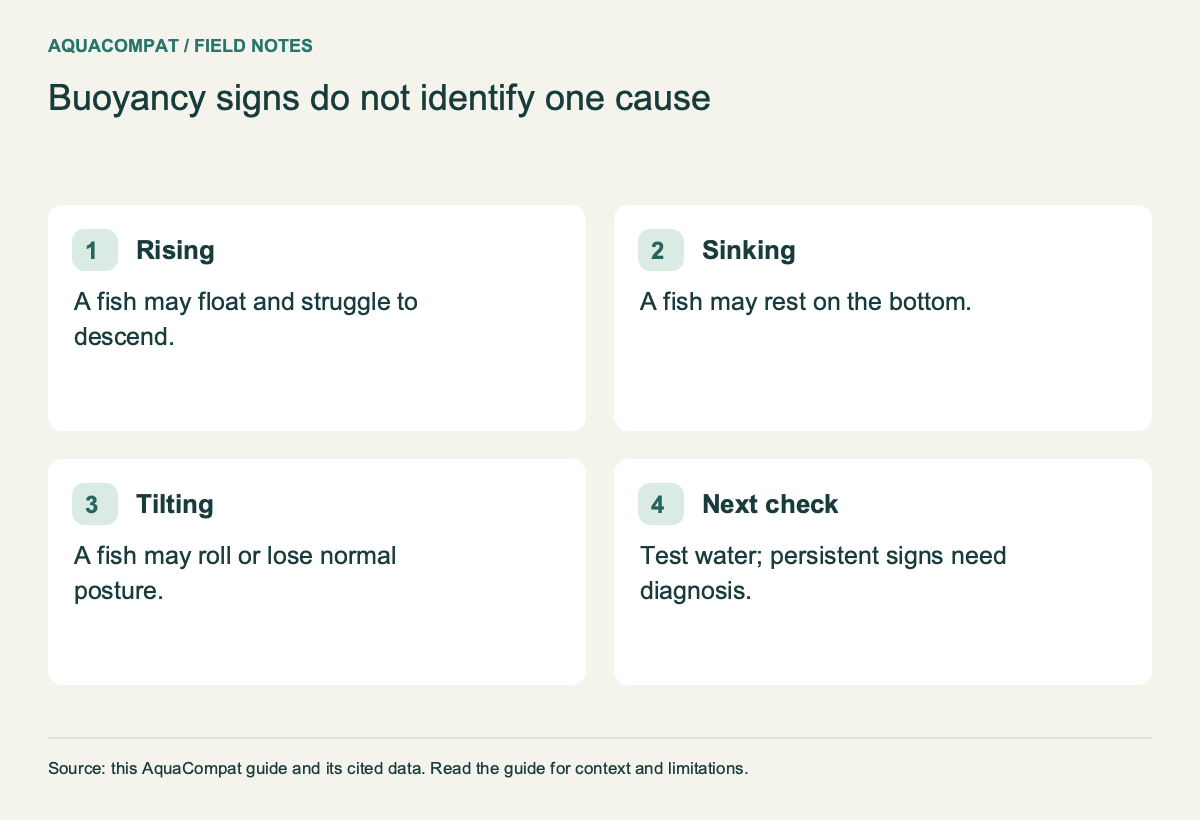
You identify swim bladder disorder by a fish that cannot hold its position in the water: it floats, sinks or tilts, often with a sudden onset. PetMD (Dr Jessie Sanders, a fish-practice veterinarian) and WikiVet describe the signs below, from the most to the least commonly seen.
- Floating at the surface. Positive buoyancy: the fish rises and stays at the top, and PetMD notes that skin left exposed can ulcerate.
- Lying on the bottom. Negative buoyancy: the fish sinks and rests on the substrate.
- Abnormal posture. The fish swims on its side, upside down or rolls as it moves.
- Swelling and pop-eye. WikiVet notes that abdominal swelling and pop-eye can accompany systemic disease, which means the buoyancy problem is one sign of something wider.
The swim bladder is the gas-filled organ a fish uses to control its buoyancy, which is why WikiVet files these cases under buoyancy disorders. Whether the fish floats or sinks is the first clue to what has gone wrong, but it is not a diagnosis on its own: both directions have several possible causes.
What causes swim bladder disorder?
Swim bladder disorder is caused by anything that changes how much gas the fish holds or where it sits, from water quality and feeding to infection and anatomy. The table below groups the causes listed by PetMD, WikiVet and Practical Fishkeeping (Dr Peter Burgess), starting with the ones a fishkeeper can check at home.
| Cause | Source | Can you check it at home? |
|---|---|---|
| Poor water quality | PetMD | Yes: test ammonia, nitrite and nitrate |
| Diet and air swallowed while feeding at the surface | PetMD, Practical Fishkeeping | Yes: watch how the fish feeds |
| Gas in the intestine | WikiVet | Partly: a short fast targets it |
| Infection or inflammation | PetMD, WikiVet | No: needs a vet |
| Over-inflation, displacement or torsion of the swim bladder | WikiVet | No: needs radiographs |
| Fluid in the swim bladder or rupture | WikiVet | No: needs radiographs |
| Tumours and body deformity | PetMD, WikiVet | No: needs a vet |
How does water quality affect buoyancy?
Poor water quality is the most frequently overlooked contributor, according to PetMD, so testing comes before any change to feeding. Ammonia and nitrite are the readings to check first. UF/IFAS gives 0.05 mg/L un-ionized ammonia as the level at which tissue damage starts, and treats nitrite as toxic from 0.1 mg/L nitrite. The nitrogen cycle guide explains where those come from, and a fish that turns up floating in a tank only weeks old should be checked for new tank syndrome as well. A liquid kit that reads both is covered in the aquarium test kits we compared.
Temperature is the other reading worth confirming, because goldfish and tropical fish need very different water. Goldfish are listed at 59–70 °F (15–21 °C), and changes should be gradual; the aquarium temperature guide lists ranges for other species.
How do you treat swim bladder disorder at home?
You treat swim bladder disorder at home by fixing the water, changing the feeding, and giving the gut a chance to empty; anything beyond that needs a vet. The steps below follow PetMD, WikiVet and Practical Fishkeeping.
- Test and correct the water. PetMD names poor water quality as the most frequently overlooked contributor. Correct any ammonia or nitrite before changing anything else.
- Change how you feed. Practical Fishkeeping suggests briefly soaking dry food before feeding so the fish gulps less air at the surface. PetMD adds that a sinking or neutrally buoyant diet may help mild cases by reducing the air the fish takes in.
- Fast briefly, then feed crushed pea. WikiVet lists withholding food for two to three days so gas-producing gut contents can empty, followed by daily crushed green pea to purge the intestine.
- Make the tank easier to live in. PetMD advises smooth substrate and stable conditions for an affected fish, because skin that is exposed above the water or rubbing on the bottom can ulcerate.
- Get a veterinary diagnosis if it persists. PetMD and WikiVet call radiographs the most useful diagnostic tool. A vet may use antibiotics for a bacterial cause and occasionally surgery.
No catalog product is listed on this page. None of the products AquaCompat tracks has a published specification that addresses buoyancy disorders, and the home steps above need no special equipment beyond a test kit.
Which fish are most prone to swim bladder problems?
Fancy goldfish are the most prone, especially the short, round-bodied varieties, according to PetMD, WikiVet and Practical Fishkeeping. The same sources say koi and cichlids also develop buoyancy problems.
- Fancy goldfish. The goldfish data notes that fancy varieties are less hardy than single-tailed types, and the body shape that makes them fancy is the one the swim bladder sources single out. Goldfish also need more carbohydrate than many fish, with vegetables as a good supplement. The goldfish tank mates guide covers which fish share their cooler water.
- Cichlids. Cichlids appear in the same source list. For mbuna such as the kenyi cichlid, the species data separately links protein-rich food to Malawi bloat, so a swollen cichlid has more than one possible explanation and the fact base does not describe how to tell them apart.
- Fish with systemic disease. WikiVet notes that abdominal swelling and pop-eye can accompany systemic disease, so any species with those signs alongside a buoyancy problem needs a vet rather than a diet change.
Do peas cure swim bladder disorder?
No: peas address only one cause, gas-producing contents in the gut. WikiVet lists a two-to-three-day fast followed by daily crushed green pea as a way to purge the intestine, which can help when intestinal gas is pushing the fish off balance. It does nothing for an infection, an over-inflated or twisted swim bladder, fluid in the organ, a rupture, a tumour or a deformity, all of which appear in the same WikiVet list. Treating every floating fish with peas can delay the diagnosis that the other causes need.
What else looks like swim bladder disorder?
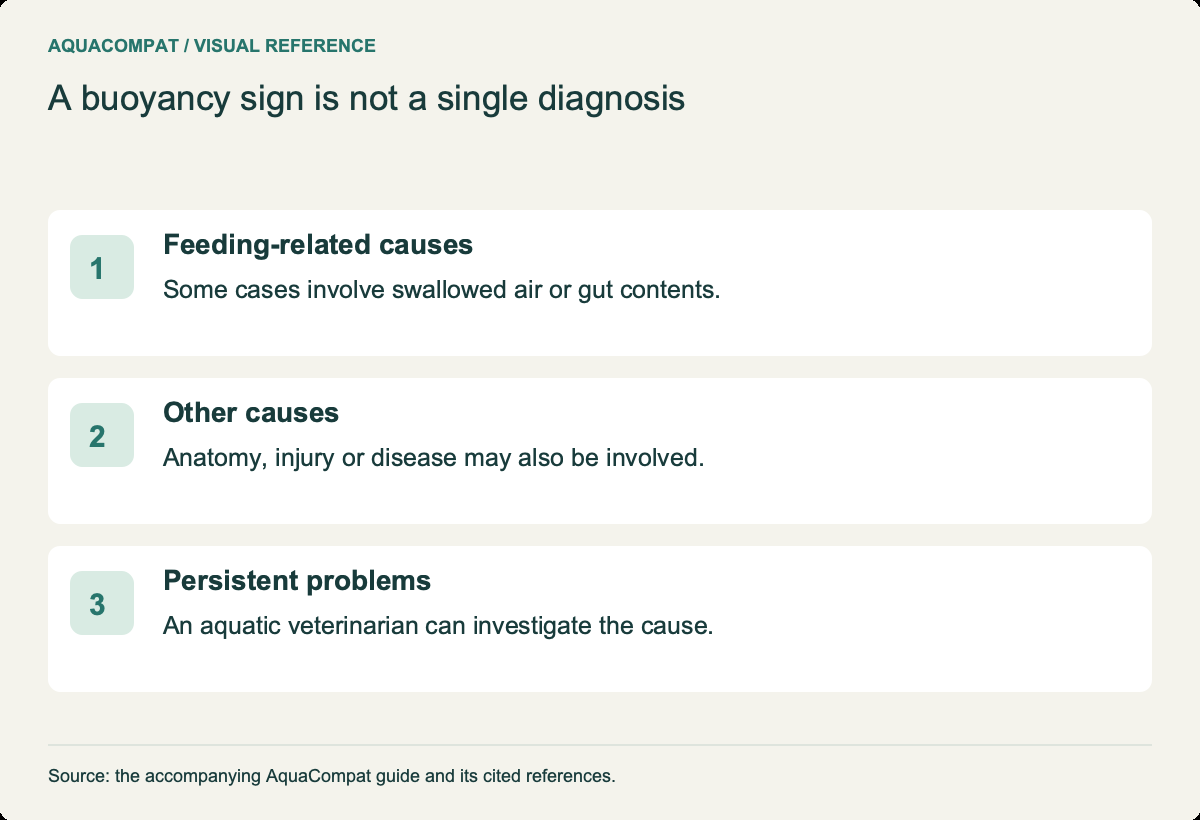
Intestinal gas and air gulped while feeding are the two main look-alikes. WikiVet notes that gas in the intestine can mimic a swim bladder fault, and radiographs are what tell them apart. Practical Fishkeeping describes a temporary imbalance after a fish gulps air while feeding at the surface, which passes and is managed by changing how the food is offered. A fish that is lethargic and refusing food but swims level has a different problem; the guide to fish not eating works through those causes. Flashing, white spots and heavy mucus point to a parasite instead, covered in the ich (white spot disease) guide, and ragged fins to fin rot.
What if swim bladder problems do not improve?
A fish whose buoyancy does not improve after water correction, feeding changes and a short fast needs a veterinary diagnosis, and its outlook depends on the cause. A fish that tipped over after gulping air at feeding time and a fish with a fluid-filled or twisted swim bladder are not the same case, even though they look alike from the front of the tank. The first responds to feeding changes; the second needs radiographs, and a vet may consider antibiotics for a bacterial cause or, occasionally, surgery.
The sources disagree on the outlook for permanent cases. PetMD, writing as a fish-practice vet, says fish with permanent swim bladder problems can often live long lives with good care. WikiVet says the response to treatment is often poor and the prognosis is poor. A 2020 University of Bologna case series in the journal Animals shows both outcomes. In pond koi seen in Belgium between 2016 and 2019 with swollen abdomens and abnormal swimming, imaging found deformed or fluid-filled swim bladders; 3 of 9 koi recovered fully on antibiotics, and the other six were euthanised as their condition worsened. Until a vet has examined the fish, a stable fish that floats but eats and shows no other signs should get the supportive care PetMD describes, smooth substrate and stable water, while swelling, pop-eye or worsening posture should bring the vet visit forward.
When should you consult an aquatic vet about swim bladder disorder?
You should consult an aquatic veterinarian when the buoyancy problem persists after the home steps, or appears with swelling, pop-eye or other signs of illness. A vet can take radiographs to find the cause, which no home test can do. The vet note in the fact base adds that specialist fish vets report buoyancy problems among their most frequent cases.
How can you prevent swim bladder disorder?
Good, stable water and feeding methods that keep fish from gulping air prevent the causes a fishkeeper controls. PetMD and Practical Fishkeeping both name these two measures. Soaking dry food briefly before feeding, as Practical Fishkeeping suggests, and choosing sinking foods for fish prone to the problem, as PetMD suggests for mild cases, reduce the air taken in at the surface. Regular testing keeps ammonia and nitrite at zero. Fancy goldfish, the most prone group, are where these habits should start. Other conditions are covered in the fish disease guides.
Questions people ask
Is swim bladder disorder contagious?
Swim bladder disorder is a clinical sign rather than one disease, so it is not contagious in itself. Some of its causes can be: PetMD and WikiVet list infection among them. If several fish develop buoyancy problems at once, test the water first, because poor water quality affects every fish in the tank.
How long should I fast a fish with swim bladder problems?
WikiVet lists withholding food for two to three days so gas-producing gut contents can empty, followed by daily crushed green pea. This targets intestinal gas only. If buoyancy does not improve after the fast and water correction, the cause is likely one that needs radiographs.
Can a fish live with permanent swim bladder disorder?
The sources disagree. PetMD, written by a fish-practice vet, says fish with permanent swim bladder problems can often live long lives with good care, such as smooth substrate and stable conditions to protect exposed skin. WikiVet says response to treatment is often poor and the prognosis is poor. A vet’s diagnosis decides which applies.
Why does my goldfish float upside down after eating?
Practical Fishkeeping describes a temporary imbalance after a fish gulps air while feeding at the surface, and fancy goldfish are the most prone group. Soaking dry food before feeding, or using a sinking food, reduces the air taken in. If the fish stays upside down well after feeding, follow the full steps on this page.
Sources 42 documents from 15 publishers
- Animals (MDPI), Sirri et al., University of Bologna (pmc.ncbi.nlm.nih.gov): “Swim Bladder Disorders in Koi Carp (Cyprinus carpio)”
- Aquarium Co-Op (aquariumcoop.com): “Care Guide for Fancy Goldfish”; “Goldfish Tank Mates”; “Amano Shrimp Care Guide”; “Ich-X product guide”; “5 Quick and Easy Steps for Treating Fin Rot in Aquarium Fish”
- FishBase (fishbase.se): “Carassius auratus, Goldfish: species summary”; “Length-weight relationships for Carassius auratus”; “Maylandia lombardoi summary (Bayesian length-weight estimate)”
- fishkeeping.co.uk (fishkeeping.co.uk): “Goldfish Size, Life Expectancy and Tank Recommendations”; “Keeping Goldfish - The Right Way”
- Illinois State University Environmental Health and Safety (ehs.illinoisstate.edu): “Aeromonas (clinical signs in fish)”
- Maidenhead Aquatics (fishkeeper.co.uk species data sheet) (fishkeeper.co.uk): “Kenyi data sheet”
- Merck Veterinary Manual (merckvetmanual.com): “Environmental Diseases of Aquatic Animals in Aquatic Systems, Francis-Floyd, Yanong and Petty”; “Disorders and Diseases of Fish (pet owner version)”; “Management of Aquarium Fish, Petty, Francis-Floyd and Yanong”; “Parasitic Diseases of Fish, Petty, Francis-Floyd and Yanong”
- Ornamental Aquatic Trade Association (OATA) (ornamentalfish.org): “How to look after fancy goldfish”; “How to look after goldfish in an aquarium / fish tank”
- PetMD (petmd.com): “Swim Bladder Disorders in Fish, Dr Jessie Sanders DVM (Fish Practice)”
- Practical Fishkeeping (practicalfishkeeping.co.uk): “The A-Z of Fish Health, Part 1: A-E, Dr Peter Burgess”; “When might my fish need veterinary help?, Willie Wildgoose”; “Problem solver: New Tank Syndrome”; “What water temperature do goldfish need?”; “How can I breed goldfish in my aquarium?”; “Tempting the difficult diner”; “The A-Z of Fish Health, Part 2: F-L, Dr Peter Burgess”
- Seriously Fish (seriouslyfish.com): “Maylandia lombardoi”
- Shrimp and Snail Breeder (aquariumbreeder.com): “Cherry Shrimp in a Community Tank”
- Southern Regional Aquaculture Center (srac.msstate.edu): “Nitrite in Fish Ponds, SRAC Publication No. 462, Durborow, Crosby and Brunson”; “How to Start a Biofilter, SRAC Publication No. 4502, DeLong and Losordo”; “Ich (White Spot Disease), SRAC Publication No. 476, Durborow, Mitchell and Crosby”; “SRAC Publication No. 478: Motile Aeromonas Septicemia (MAS) in Fish (2019)”; “SRAC Publication No. 474: The Role of Stress in Fish Disease (Green and Haukenes)”; “Columnaris Disease: A Bacterial Infection Caused by Flavobacterium columnare, SRAC Publication No. 479”; “Motile Aeromonas Septicemia (MAS) in Fish, SRAC Publication No. 478 (2019)”
- University of Florida IFAS Extension (EDIS) (ask.ifas.ufl.edu): “Ammonia in Aquatic Systems (FA16/FA031), Francis-Floyd, Watson, Petty and Pouder”; “Ichthyophthirius multifiliis (White Spot) Infections in Fish (CIR920/FA006), Francis-Floyd, Yanong and Pouder”; “Use of Antibiotics in Ornamental Fish Aquaculture (Circular 84 / FA084), Yanong”; “Use of Copper in Marine Aquaculture and Aquarium Systems (FA165), Yanong”; “Use of Copper in Freshwater Aquaculture and Farm Ponds (FA-13), Watson and Yanong”
- WikiVet (en.wikivet.net): “Buoyancy Disorders”
All sources accessed . Every number on this page comes from these documents.