Work out your tank's running cost
Choose your state, then add each device with its wattage (printed on the device or its box) and how many hours a day it actually draws power. A heater only draws power while it heats, so estimate its on-time rather than 24 hours. The starting wattages and hours are placeholders to replace with your own devices' figures.
How much does it cost to run an aquarium?
A tank with one 100-watt device switched on all day and all year costs $150.93 per year at the 2025 US average price of 17.23 cents per kWh, according to AquaCompat's calculation from U.S. Energy Information Administration (EIA) data. Real tanks rarely draw a steady 100 watts. A heater switches on and off, a light runs for part of the day, and a filter or air pump may run continuously at a much lower wattage, so the useful figure is your own total, which the calculator above adds up device by device.
The 100-watt case is still a handy yardstick because it scales in a straight line. Half the wattage, or the same wattage for half the hours, halves the cost; double either and the cost doubles. A 2025 price is the latest full year of final EIA figures. Prices have kept rising since: the EIA's preliminary monthly series puts the US average at 18.31 cents per kWh for July 2026, so a bill paid this year may run slightly higher than the 2025 benchmark.
The state you live in can matter as much as the equipment. Residential prices in 2025 ran from 11.82 cents per kWh in North Dakota to 40.4 cents per kWh in Hawaii, which is why the calculator starts by asking where you live.
How does the calculator work out the cost?
The calculator multiplies each device's watts by its hours a day, divides by 1,000 to get kilowatt-hours (kWh) per day, then multiplies by your price per kWh.
- Energy per device: watts × hours a day ÷ 1,000 = kWh a day. A 100-watt device running 24 hours uses 100 × 24 ÷ 1,000 = 2.4 kWh a day.
- Energy for the tank: the kWh of every device are added together.
- Month and year: daily kWh is multiplied by 30.4 for an average month and by 365 for a year.
- Cost: kWh is multiplied by the price you choose. Picking a state fills in its 2025 average residential price from EIA Electric Power Annual Table 2.10; you can overwrite it with the rate on your own bill.
The state list holds 50 states, the District of Columbia and the US average from the same EIA table as the state table further down this page. Results show energy and cost per day, per month and per year, plus a line for each device so you can see which one drives the bill.
How do you use the aquarium electricity calculator?
Choose your state, then replace the starting wattages and hours with your own devices' figures. The placeholders (a heater, a filter and a light) are there only to show the layout; they are not typical values.
- Set the price. Pick your state, or choose “Enter your own price” and type the cents per kWh from your bill. Outside the US, type your local rate in the same box; the result then reads in your currency, even though it carries a dollar sign.
- Find each device's wattage. It is printed on the device, its plug or its box. Heaters are sold by wattage, so the number is usually in the model name.
- Estimate the hours. Use the hours your light timer is set to. For a pump or filter that never switches off, use 24. For a heater, estimate how long it actually heats rather than how long it is plugged in (see the heater section below).
- Add the rest. Use “Add a device” for air pumps, CO2 solenoids, second heaters or anything else on the tank's power strip.
Running costs are one part of planning a tank; the AquaCompat stocking calculator checks the fish side of the same setup, and every other free tool on the site is listed on the aquarium tools index.
Which US states pay the most and least to run an aquarium?
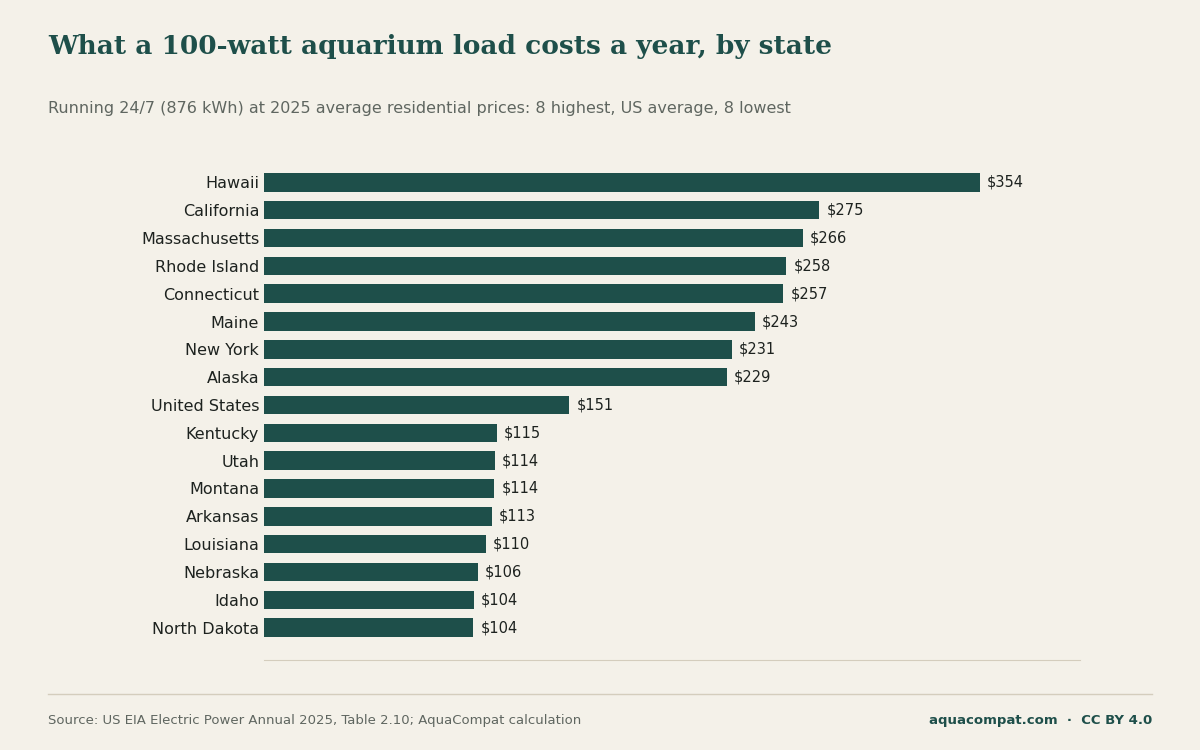
Hawaii is the most expensive state to run an aquarium and North Dakota the cheapest, based on 2025 residential prices. Hawaii averaged 40.4 cents per kWh, followed by California, Massachusetts, Rhode Island and Connecticut. North Dakota averaged 11.82 cents per kWh, with Idaho, Nebraska, Louisiana and Arkansas close behind. The chart applies those prices to the 100-watt benchmark, and the table below it lists every state.
Price changes were not uniform. EIA figures show residential prices rose between 2024 and 2025 in 46 states and DC; Nevada, Hawaii, California and North Carolina were the only declines. In a high-price state every kWh saved is worth more, so the device choices below matter more in dollars.
| State | cents per kWh (2025) | Annual cost ($) |
|---|---|---|
| United States | 17.23 | 150.93 |
| Alabama | 16.09 | 140.95 |
| Alaska | 26.11 | 228.72 |
| Arizona | 15.26 | 133.68 |
| Arkansas | 12.87 | 112.74 |
| California | 31.35 | 274.63 |
| Colorado | 15.69 | 137.44 |
| Connecticut | 29.31 | 256.76 |
| Delaware | 17.15 | 150.23 |
| District of Columbia | 21.92 | 192.02 |
| Florida | 15.21 | 133.24 |
| Georgia | 14.74 | 129.12 |
| Hawaii | 40.4 | 353.9 |
| Idaho | 11.83 | 103.63 |
| Illinois | 17.67 | 154.79 |
| Indiana | 15.96 | 139.81 |
| Iowa | 13.62 | 119.31 |
| Kansas | 14.44 | 126.49 |
| Kentucky | 13.13 | 115.02 |
| Louisiana | 12.52 | 109.68 |
| Maine | 27.69 | 242.56 |
| Maryland | 19.53 | 171.08 |
| Massachusetts | 30.41 | 266.39 |
| Michigan | 20.03 | 175.46 |
| Minnesota | 15.83 | 138.67 |
| Mississippi | 14.03 | 122.9 |
| Missouri | 13.3 | 116.51 |
| Montana | 12.99 | 113.79 |
| Nebraska | 12.05 | 105.56 |
| Nevada | 13.26 | 116.16 |
| New Hampshire | 24.53 | 214.88 |
| New Jersey | 22.48 | 196.92 |
| New Mexico | 14.85 | 130.09 |
| New York | 26.39 | 231.18 |
| North Carolina | 14.0 | 122.64 |
| North Dakota | 11.82 | 103.54 |
| Ohio | 16.9 | 148.04 |
| Oklahoma | 13.21 | 115.72 |
| Oregon | 15.46 | 135.43 |
| Pennsylvania | 19.29 | 168.98 |
| Rhode Island | 29.48 | 258.24 |
| South Carolina | 15.12 | 132.45 |
| South Dakota | 13.32 | 116.68 |
| Tennessee | 13.22 | 115.81 |
| Texas | 15.4 | 134.9 |
| Utah | 13.02 | 114.06 |
| Vermont | 22.79 | 199.64 |
| Virginia | 15.28 | 133.85 |
| Washington | 13.17 | 115.37 |
| West Virginia | 15.39 | 134.82 |
| Wisconsin | 18.08 | 158.38 |
| Wyoming | 13.37 | 117.12 |
Which aquarium device uses the most electricity?
On a heated tropical tank, the heater usually has by far the highest rated wattage, but what it costs depends on how long it actually heats. A heater's thermostat switches the element on when the water drops below the set point and off once it is reached, so a 100-watt heater that heats for a quarter of the day uses a quarter of 2.4 kWh, not the full amount. How hard it works depends on the gap between the room and the tank. Aquarium Co-Op's sizing rule of 5 W/gal assumes holding water about 10 °F above room temperature with a lid on, and All Pond Solutions suggests 1 W/L in a normally heated room but 1.5 to 2 W per litre in a cold one. A colder room or a bigger temperature rise means longer heating time, and longer heating time means a higher bill.
The table lists manufacturer power ratings from the equipment in our fact base. These are rated maximums: a heater draws its full rating only while heating, and lights with a dimmer draw less when turned down.
| Device type | Example model | Rated power | Typical hours drawing power |
|---|---|---|---|
| Small heater | Hydor Theo 50 W | 50 W | Only while heating |
| Mid-size heater | Eheim Jager 100 | 100 W | Only while heating |
| Mid-size heater | Fluval M150 | 150 W | Only while heating |
| Large heater | Fluval E300 | 300 W | Only while heating |
| Hang-on-back filter | AquaClear 20 (120 V) | 7 W | Usually continuous |
| Canister filter | Eheim Classic 250 | 8 W | Usually continuous |
| Canister filter | Fluval 307 | 16 W | Usually continuous |
| Large canister filter | Fluval FX4 | 30 W | Usually continuous |
| Heated canister filter | Oase BioMaster Thermo 250 (pump / heater) | 15 W / 150 W | Pump continuous; heater only while heating |
| LED light | NICREW ClassicLED Plus 30–36 in | 21 W | Photoperiod (timer setting) |
| Planted-tank LED | Fluval Plant 3.0, 15–24 in | 22 W | Photoperiod (timer setting) |
| High-output planted LED | Chihiros WRGB II Pro 60 | 74 W | Photoperiod (timer setting) |
How do filters and lights compare with the heater?
Filters draw little power but never stop, so their small wattage adds up across 24 hours. A canister rated at 16 W running all day uses 16 × 24 ÷ 1,000 = 0.384 kWh, which is about the same as a 100-watt heater that heats for under four hours. Because a filter's hours are fixed, the main lever is choosing a model sized for the tank rather than a larger one; the canister filter comparison lists rated wattage alongside flow for each model.
Lights fall in between. Their wattage ranges widely, from a basic LED bar to a high-output planted-tank fixture, and their hours are whatever the timer is set to. For planted tanks, Tropica and Aquarium Co-Op suggest about 6 hours/day of light while new plants settle, rising to 8–10 hours/day once established. Two extra hours on a high-wattage fixture cost the same as two extra hours on any other device of that wattage, so the timer is worth checking. The planted aquarium light guide gives the rated wattage of each fixture it covers.
Heater choice is mostly about matching wattage to the tank and the room. Our heater buying guide compares models by wattage and tank size, and the guide to aquarium water temperature explains what temperature each kind of fish needs, which sets how hard the heater has to work.
What does aquarium electricity cost in the UK and EU?
UK fishkeepers on the Ofgem price cap pay an average unit rate of 26.32 pence per kWh for 1 October to 31 December 2026 (Direct Debit, England, Scotland and Wales), plus a daily standing charge that is paid regardless of use. Eurostat puts the EU average household price at 0.2832 EUR per kWh, all taxes included, for the first half of 2026.
To use the calculator with either figure, choose “Enter your own price” and type the unit rate as a plain number in pence or euro cents (for the EU figure, multiply the euro price by 100). The result is then in pence or euro cents converted to pounds or euros, even though the display shows a dollar sign. The standing charge does not belong in an aquarium estimate, because it is the same whether the tank is running or not. The UK cap is an average unit rate and the EU figure an average across member states, so your own tariff is the better input.
How can you cut the cost of running an aquarium?
The reliable savings come from cutting the hours or the watts of the biggest draws, and the calculator lets you test each change before making it.
- Use LED lighting. The US Department of Energy's consumer lighting guide says LEDs use up to 90% less energy than incandescent bulbs and last up to four times longer than compact fluorescents. Older tanks with incandescent or fluorescent hoods have the most to gain.
- Check the light timer. Running lights for the hours your fish and plants need, rather than all day, cuts that line of the bill in direct proportion.
- Reduce the heater's workload. The heater sizing rules above are written for a lidded tank in a heated room, and they call for more wattage in a cold room. Keeping the tank out of the coldest part of the house works with that, and choosing species whose temperature range sits closer to your room temperature means less heating. Coldwater fish such as goldfish do best at about 65–75 °F, cooler than the tropical target.
- Size the filter to the tank. Within a range, filter wattage rises with model size, so an oversized canister adds a continuous draw with no benefit to the fish.
Never cut costs by switching the filter off. It houses the bacteria that process waste, and those colonies depend on a steady flow of water.
What can the calculator not tell you?
The calculator gives an estimate, and its accuracy depends mostly on the hours you enter. Its main limits are:
- Heater hours are a guess. Nothing in a published price table says how long your heater runs; that depends on the room, the season, the lid and the target temperature. A plug-in energy meter on the heater's socket is the only way to measure it directly.
- Rated watts are maximums. Manufacturer ratings are the most a device draws. Dimmed lights and some pumps draw less, so a result based on rated watts errs on the high side.
- Average prices are not your tariff. State figures are annual averages of all residential bills. Time-of-use rates, tiered pricing, fixed charges and taxes vary by utility and are not modelled.
- Prices date. The state list uses final 2025 annual values. The EIA's 2026 monthly figures are preliminary and higher, as noted above.
Where do the electricity prices come from?
US prices are the average residential price per kWh for each state, DC and the US total in 2025, from the EIA's Electric Power Annual 2025, Table 2.10 (released 21 October 2026, final values). The monthly comparison figure for July 2026 comes from EIA Electric Power Monthly Tables 5.6.A and 5.6.B, which are preliminary. UK figures are Ofgem's published price cap unit rate for October to December 2026, and the EU figure is Eurostat dataset nrg_pc_204 for household consumers using 2,500 to 4,999 kWh a year, all taxes and levies included.
The 100-watt annual costs are AquaCompat's own calculation: 0.1 kW × 24 hours × 365 days = 876 kWh, multiplied by each state's 2025 price. No figure on this page comes from measuring any aquarium; device wattages are the makers' published ratings.
How to cite this page
Please cite as: AquaCompat, “Aquarium Electricity Cost Calculator: What Your Tank Costs to Run”, updated 22 October 2026, https://aquacompat.com/tools/aquarium-electricity-cost-calculator/
The state price table, the 100-watt cost figures and the chart are free to reuse under the Creative Commons Attribution 4.0 licence (CC BY 4.0), with a link to this page. For the underlying prices, the original sources are the US Energy Information Administration, Ofgem and Eurostat.
Download the data
The CSV holds every US state, DC and the US total with 2025 and 2024 annual prices, the 2024–2025 change, the 2025 rank, July 2026 and July 2025 monthly prices, the 2026 year-to-date average and the 100-watt annual cost. Both files are CC BY 4.0.
- Residential electricity prices by state (CSV) CSV · 4 KB
- EIA 2025 annual and 2026 monthly residential prices, with AquaCompat's 100 W annual cost column.
- Chart: annual cost of a 100 W aquarium load by state (PNG) PNG · 75 KB
- 1200 × 750 image showing the eight highest states, the US average and the eight lowest.
Questions people ask
How much does a 100-watt aquarium heater cost to run each month?
Does an aquarium add much to an electricity bill?
Is a larger heater more expensive to run than a smaller one?
How often is the price data updated?
Sources 44 documents from 20 publishers
- All Pond Solutions (allpondsolutions.co.uk): “Aquarium Heater Buying Guide”
- Amazon (amazon.com): “Hydor Theo Shatterproof Aquarium Heater, 50-Watt (B00061UQ6G)”; “EHEIM Jager Aquarium Thermostat Heater 100W (B003SNU1I2)”; “Fluval M 150-Watt Submersible Aquarium Heater (B0027VONH6)”; “Fluval E 300 Watt Electronic Heater (B001VMSK0I)”; “Fluval Plant 3.0 LED Planted Aquarium Lighting, 22 Watts, 15-24 Inches (B083QP62MP)”
- Amazon (NICREW listing) (amazon.com): “NICREW ClassicLED Plus LED Aquarium Light, 21W, 30 to 36 Inch (B07F6XD2FH)”
- Aquarium Co-Op (aquariumcoop.com): “How to Choose the Right Aquarium Heater”; “How to Balance Aquarium Lights to Grow Healthy Plants (& Avoid Algae)”; “Is Nitrate Good or Bad for Your Aquarium?”; “CO2 in Planted Aquariums: What Does It Really Do and Is It Natural?”; “What is PAR? Lighting & Brightness Explained for Planted Tanks”; “How to Use Root Tabs to Fertilize Your Live Aquarium Plants”; “Which Planted Tank Fertilizer Is Right for You?”; “Beginner's Guide to Fertilizing Your Planted Tank the EASY Way”; “How to Set Up a Low Tech Planted Aquarium for Beginners”; “Monte Carlo (plant care page)”
- Aquasabi (aquasabi.de): “Chihiros LED System Serie WRGB II PRO 60”
- Bulk Reef Supply (bulkreefsupply.com): “Fluval Plant 3.0 Bluetooth LED Light”
- EHEIM (eheim.com): “EHEIM thermocontrol 100”; “EHEIM classic 250”
- Eurostat (ec.europa.eu): “Electricity prices for household consumers - bi-annual data (from 2007 onwards) (nrg_pc_204)”
- Fluval (Hagen) (fluvalaquatics.com): “07 Series Aquarium Filters - Fluval USA”; “FX4 Canister Filter, up to 250 US Gal / 1000 L - Fluval USA”; “Plant 3.0 product page”
- Fluval (Rolf C. Hagen) (fluvalaquatics.com): “M150 Submersible Heater, 150W, up to 45 US Gal / 150 L”; “E300 Electronic Heater, 300W, up to 100 US Gal / 375 L”; “AC20 Power Filter, 5-20 US Gal / 18-76 L”
- GreenAqua (greenaqua.hu): “Chihiros WRGB II Pro 60 cm LED light”
- Hydor (hydor.com): “THEO”
- Merck Veterinary Manual (merckvetmanual.com): “Special Considerations for Fish (pet owner version)”; “Environmental Diseases of Aquatic Animals in Aquatic Systems (Francis-Floyd, Yanong, Petty)”
- OASE (oase.com): “BioMaster 2 Thermo 250”
- Ofgem (ofgem.gov.uk): “Energy price cap unit rates and standing charges”
- Reef Supplies (retailer) (reefsupplies.ca): “Fluval M150 Submersible Heater - 150W”
- Southern Regional Aquaculture Center (srac.msstate.edu): “SRAC 7201: Species Profile: Koi and Goldfish (Watson, Hill, Pouder)”
- Tropica Aquarium Plants (tropica.com): “Starting a new aquarium (growing-in guide)”; “Fertiliser and CO2 for your aquarium”; “Hardscape and bottom layer in the tank”; “Trimming”
- U.S. Department of Energy, Energy Saver (energy.gov): “Consumer Guide to Energy-Efficient Lighting (DOE/EE-2465)”
- U.S. Energy Information Administration (eia.gov): “Electric Power Annual 2025, Table 2.10. Average Price of Electricity to Ultimate Customers by End-Use Sector, by State, 2025 and 2024”; “Electric Power Monthly, Table 5.6.A. Average Price of Electricity to Ultimate Customers by End-Use Sector, by State, July 2026 and 2025”; “Electric Power Monthly, Table 5.6.B. Average Price of Electricity to Ultimate Customers by End-Use Sector, by State, Year-to-Date through July 2026 and 2025”
All sources accessed , . Every number on this page comes from these documents.