What are the main findings?
Each finding below can be quoted on its own.
- Pet fish caused 3 outbreaks and 6 illnesses out of the 467 outbreaks that CDC's Animal Contact Outbreak Surveillance System attributed to a single kind of animal in the US, 2009–2021.
- Aquatic frogs caused only 2 outbreaks in the same CDC data but 241 illnesses, all from Salmonella, the most illnesses per outbreak of any animal category.
- Fish tank maintenance was the exposure for 83% of Danish fish tank granuloma (Mycobacterium marinum) patients with records, 2004–2017, while national incidence stayed at 0.04–0.13 cases per 100,000 people a year.
- Of 333 ornamental fish from eight Brazilian farms examined in 2018–2019, 70.6% carried at least one parasite.
- Of 234 Aeromonas isolates from diseased ornamental fish in Brazil, 2016–2019, 82.5% were multidrug resistant and 92.7% resisted sulfonamide.
- The Cefas Fish Health Inspectorate listed 160 outbreaks of koi herpesvirus disease in England and Wales from 2018 to 2025, about 20 sites a year.
- Cardinal tetras had a 96-hour LC50 of 1.1 mg/L NO2- in laboratory tests published in 2008, and every fish died at 2 mg/L nitrite.
Can you catch diseases from aquarium fish?
Yes, but recorded cases are few: CDC's Animal Contact Outbreak Surveillance System attributed 3 outbreaks and 6 illnesses to pet fish in the US between 2009 and 2021, according to a 2025 MMWR Surveillance Summary by Eisenstein and colleagues. That is 0.6% of the 467 outbreaks CDC tied to a single kind of animal. A zoonosis is an infection that passes from animals to people; the CDC system counts enteric (gut) infections such as Salmonella that cause a recognised outbreak, not single sporadic cases.
Poultry account for two thirds of all illnesses in the same surveillance, and small turtles for most of the reptile total.
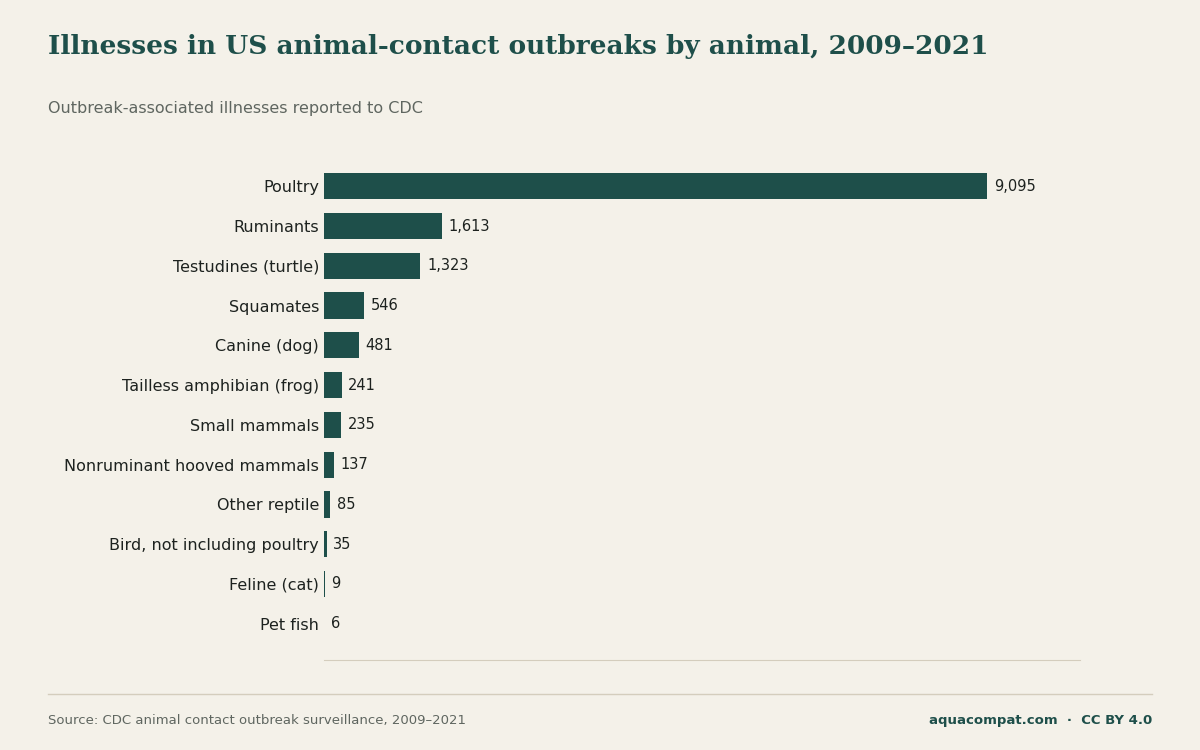
| Animal class | Level | Animal category | Outbreaks | Illnesses | Share of outbreaks (%) | Share of illnesses (%) | Illnesses per outbreak |
|---|---|---|---|---|---|---|---|
| Mammal | class | Mammal | 233 | 2,475 | 49.9 | 17.9 | 10.6 |
| Mammal | group | Small mammals | 15 | 235 | 3.2 | 1.7 | 15.7 |
| Mammal | subgroup | Rodent | 5 | 54 | 1.1 | 0.4 | 10.8 |
| Mammal | subgroup | Other small mammal | 10 | 181 | 2.1 | 1.3 | 18.1 |
| Mammal | group | Feline (cat) | 4 | 9 | 0.9 | 0.1 | 2.2 |
| Mammal | group | Canine (dog) | 31 | 481 | 6.6 | 3.5 | 15.5 |
| Mammal | group | Ruminants | 171 | 1,613 | 36.6 | 11.7 | 9.4 |
| Mammal | subgroup | Bovine (cattle) | 128 | 1,136 | 27.4 | 8.2 | 8.9 |
| Mammal | subgroup | Ovine (goat) | 27 | 319 | 5.8 | 2.3 | 11.8 |
| Mammal | subgroup | Caprine (sheep) | 5 | 21 | 1.1 | 0.2 | 4.2 |
| Mammal | subgroup | Multiple ruminants | 11 | 137 | 2.4 | 1 | 12.5 |
| Mammal | group | Nonruminant hooved mammals | 12 | 137 | 2.6 | 1 | 11.4 |
| Mammal | subgroup | Swine (pig) | 7 | 108 | 1.5 | 0.8 | 15.4 |
| Mammal | subgroup | Equine (horse) | 4 | 25 | 0.9 | 0.2 | 6.2 |
| Mammal | subgroup | Multiple nonruminant hooved mammal | 1 | 4 | 0.2 | 0 | 4 |
| Bird | class | Bird | 158 | 9,130 | 33.8 | 66.1 | 57.8 |
| Bird | group | Poultry | 155 | 9,095 | 33.2 | 65.9 | 58.7 |
| Bird | subgroup | Baby chick, duckling, or both | 42 | 1,078 | 9 | 7.8 | 25.7 |
| Bird | subgroup | Multiple poultry types | 90 | 7,859 | 19.3 | 56.9 | 87.3 |
| Bird | subgroup | Other types of poultry | 23 | 158 | 4.9 | 1.1 | 6.9 |
| Bird | group | Bird, not including poultry | 3 | 35 | 0.6 | 0.3 | 11.7 |
| Reptile | class | Reptile | 71 | 1,954 | 15.2 | 14.2 | 27.5 |
| Reptile | group | Squamates | 29 | 546 | 6.2 | 4 | 18.8 |
| Reptile | subgroup | Lizard | 25 | 487 | 5.4 | 3.5 | 19.5 |
| Reptile | subgroup | Snake | 4 | 59 | 0.9 | 0.4 | 14.8 |
| Reptile | group | Testudines (turtle) | 39 | 1,323 | 8.4 | 9.6 | 33.9 |
| Reptile | subgroup | Turtle (shell length <4 inches) | 24 | 1,143 | 5.1 | 8.3 | 47.6 |
| Reptile | subgroup | Turtle (size unspecified) | 15 | 180 | 3.2 | 1.3 | 12 |
| Reptile | group | Other reptile | 3 | 85 | 0.6 | 0.6 | 28.3 |
| Amphibian | class | Amphibian | 2 | 241 | 0.4 | 1.7 | 120.5 |
| Amphibian | group | Tailless amphibian (frog) | 2 | 241 | 0.4 | 1.7 | 120.5 |
| Fish | class | Fish | 3 | 6 | 0.6 | 0 | 2 |
| Fish | group | Pet fish | 3 | 6 | 0.6 | 0 | 2 |
Which aquarium animals have caused Salmonella outbreaks?
African dwarf frogs kept in home aquariums caused the largest aquarium-linked Salmonella outbreak on record: 376 cases of Salmonella Typhimurium in 44 states from 2008 to 2011, according to the study's published abstract (Mettee Zarecki and colleagues, Pediatrics, 2013). Of patients with outcome data, 29% were hospitalised and none died. The median patient was 5 years old, and investigators traced the frogs to one breeding facility.
Fish tanks have been linked to a smaller outbreak. In Australia, an OzFoodNet investigation of multidrug-resistant Salmonella Java in 2003–2004 found that 82% of 22 enrolled cases had contact with a tropical fish aquarium, and the outbreak strain was cultured from the tank water or gravel in 5 homes (Musto and colleagues, Communicable Diseases Intelligence, 2006). In that series 61% of the aquarium-exposed patients said their fish had been sick or had died in the week before they fell ill. The median patient age was 3.
| Investigation | Period | Cases | Linked exposure | Hospitalized | Median age (years) | Source |
|---|---|---|---|---|---|---|
| US multistate, S. Typhimurium (initial MMWR report) | Mar-Nov 2009 onsets | 85 | African dwarf frogs; 31 states | 16 of 47 (34%) | 5 | s2 |
| US multistate, S. Typhimurium (final) | 2008-2011 | 376 | African dwarf frogs; 44 states; 61% of 114 interviewed reported frog exposure | 56 of 193 (29%) | 5 | s3 |
| Australia, multidrug-resistant S. Paratyphi B var. Java | Mar 2003-Apr 2004 | 22 | 18 of 22 (82%) contact with tropical fish aquariums | 8 of 22 (37%) | 3 | s4 |
What do the Salmonella figures mean for a home aquarium?
The aquarium cases on record cluster around young children and around the aquatic frog rather than fish. Fish produced about 2 illnesses per outbreak in CDC's data and frogs 120.5 illnesses per outbreak, because one contaminated supply chain reached many states. The Australian link between sick fish and human illness comes from one case series, not a measured risk, but it is one more reason to work out why fish are dying; the aquarium fish disease guides cover the common causes by symptom.
How common is fish tank granuloma (Mycobacterium marinum)?
Fish tank granuloma is uncommon: Oregon's statewide laboratory surveillance found 21 infections of Mycobacterium marinum in 2007–2012, an average of 0.1 cases per 100,000 per year (Henkle and colleagues, Emerging Infectious Diseases, 2017). M. marinum is a bacterium that lives in fish and water and causes slow-healing skin lesions, usually on the hands. In Denmark, a nationwide study of culture-confirmed cases put annual incidence at 0.04–0.06 cases per 100,000 person-years in 2004–2009 and 0.05–0.13 cases per 100,000 person-years in 2010–2016 (Holden and colleagues, Scientific Reports, 2018).
When it does occur, the aquarium is usually the source. In the Danish study, fish tank maintenance was the exposure for 83% of the 53 patients with records. Patients waited a median of 194 days from first symptoms to diagnosis. In Oregon's wider surveillance of all extrapulmonary nontuberculous mycobacteria, 2014–2016, 9% of patients asked reported fish tank maintenance in the 14 to 70 days before symptoms began.
| Study | Place | Period | Cases | Incidence per 100,000 per year | Fish tank exposure | Source |
|---|---|---|---|---|---|---|
| Nationwide culture-confirmed cases | Denmark | 2004-2017 | 55 | 0.04-0.13 | 44 of 53 with records (83.0%) | s7 |
| Statewide laboratory surveillance | Oregon, USA | 2007-2012 | 21 | 0.1 | not reported | s5 |
| Single-center case series | Duke University, North Carolina, USA | 1996-2014 | 28 | not reported | 7 of 23 with known exposure (30%) | s8 |
How common are parasites and viruses in ornamental fish?
Parasites are common in ornamental fish even when the fish look healthy. A 2023 Brazilian Journal of Biology study examined 333 ornamental fish of 48 species from eight farms in five Brazilian states on arrival at a São Paulo wholesaler and found 70.6% carrying at least one parasite, although most fish were alert. White spot disease, the protozoan Ichthyophthirius multifiliis, was found on 25.8% of the fish from one farm, yet none of the 333 fish showed white spots. The white spot (ich) guide covers how that parasite is spotted and treated once it shows.
Viruses travel with traded fish too. Megalocytivirus, also called dwarf gourami iridovirus, was found in 18.7% of 2,086 imported gouramis tested before Australian quarantine, according to the study's published abstract (Rimmer and colleagues, Preventive Veterinary Medicine, 2015). The same abstract reports 68.6% of 51 fish that sickened or died in quarantine as positive, and 21.9% of fish sampled in Australian aquarium shops, against 14.5% at wholesalers.
Shipping itself kills relatively few fish. UF/IFAS Extension reports that death-on-arrival losses between exporter and importer have been reduced to less than 5%, citing Lim (2005). Infections that arrive with the fish can surface later, so the method for acclimating new fish matters as much as the purchase.
Why do antibiotics often fail on sick aquarium fish?
Antibiotics often fail because the bacteria in ornamental fish are frequently resistant to them. Aeromonas is a common water bacterium that can infect stressed or injured fish. In a 2024 study in Microorganisms, de Oliveira and colleagues at the University of São Paulo tested 234 Aeromonas isolates from 123 diseased ornamental fish of 32 species, collected in 2016–2019, against 16 antimicrobials. The fish had septicaemia, skin or eye lesions, and 82.5% of the isolates were multidrug resistant.
Resistance was highest to the sulfonamide group, at 92.7%, and still above a third for enrofloxacin and florfenicol. Tetracycline still worked against 73.5% of isolates.
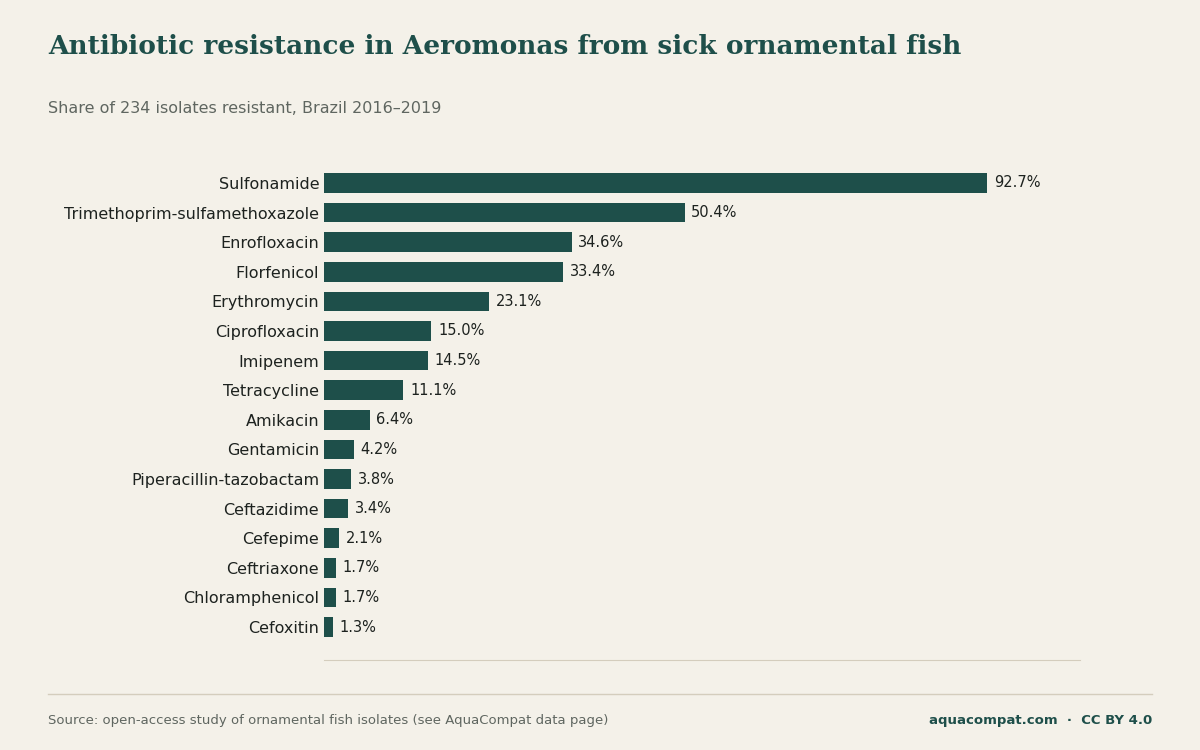
| Antimicrobial | Disc (ug) | Susceptible (%) | Intermediate (%) | Resistant (%) | Non-susceptible (%) |
|---|---|---|---|---|---|
| Sulfonamide | 300 | 3.4 | 3.9 | 92.7 | 96.6 |
| Trimethoprim-sulfamethoxazole | 25 | 41.9 | 7.7 | 50.4 | 58.1 |
| Enrofloxacin | 5 | 14.5 | 50.9 | 34.6 | 85.5 |
| Florfenicol | 30 | 45.7 | 20.9 | 33.4 | 54.3 |
| Erythromycin | 15 | 2.1 | 74.8 | 23.1 | 97.9 |
| Ciprofloxacin | 5 | 47 | 38 | 15 | 53 |
| Imipenem | 10 | 43.6 | 41.9 | 14.5 | 56.4 |
| Tetracycline | 30 | 73.5 | 15.4 | 11.1 | 26.5 |
| Amikacin | 30 | 79.5 | 14.1 | 6.4 | 20.5 |
| Gentamicin | 10 | 86.8 | 9 | 4.2 | 13.2 |
| Piperacillin-tazobactam | 110 | 88.5 | 7.7 | 3.8 | 11.5 |
| Ceftazidime | 30 | 84.6 | 12 | 3.4 | 15.4 |
| Cefepime | 30 | 76.5 | 21.4 | 2.1 | 23.5 |
| Ceftriaxone | 30 | 91.5 | 6.8 | 1.7 | 8.5 |
| Chloramphenicol | 30 | 88.9 | 9.4 | 1.7 | 11.1 |
| Cefoxitin | 30 | 97.4 | 1.3 | 1.3 | 2.6 |
Where does antibiotic resistance in aquarium fish come from?
Routine antibiotic use in the trade is one likely source. In Hong Kong, researchers at Hong Kong Metropolitan University bought 30 packs of zebrafish from 10 ornamental fish shops in July–September 2023 and detected 9 of 20 antibiotics in the bag water, with oxytetracycline reaching 2,262,064.2 ng/L in one sample (Microorganisms, 2024). An earlier study by the same group found that Aeromonas from fish bought at the city's Goldfish Market in 2022 showed resistance above 90% to oxytetracycline, tetracycline and oxolinic acid (Journal of Xenobiotics, 2022).
The pattern is not limited to Asia. A 2009 PLoS ONE study by the UK government laboratory Cefas sampled 25 consignments of tropical fish arriving in the UK in 2008 and found that 47 of 94 isolates tolerated 15 or more of 34 antibiotics tested.
The practical lesson is not to dose antibiotics blindly. A drug picked at random may meet bacteria already resistant to it. Our fin rot treatment guide sets out when antibiotics are justified and why matching the drug to the bacterium matters. A fish that does not improve on an antibiotic is not proof the disease is untreatable: resistance, wrong diagnosis and poor water are all plausible explanations.
What is koi herpesvirus and how often does it break out in the UK?
Koi herpesvirus (KHV) disease is a viral disease of koi and other carp that, in England and Wales, is confirmed at about 20 sites a year. The Cefas Fish Health Inspectorate, which places controls on sites where it confirms the disease, listed 160 outbreaks across 2018–2025, according to AquaCompat's count of its yearly GOV.UK notices. The busiest year was 2018 with 30 sites, the quietest 2020 with 11, and 2025 recorded 24 outbreaks.
Most listed sites are angling fisheries; only a few are koi and aquatics dealers, so the figures describe UK carp waters rather than the risk to one garden pond.
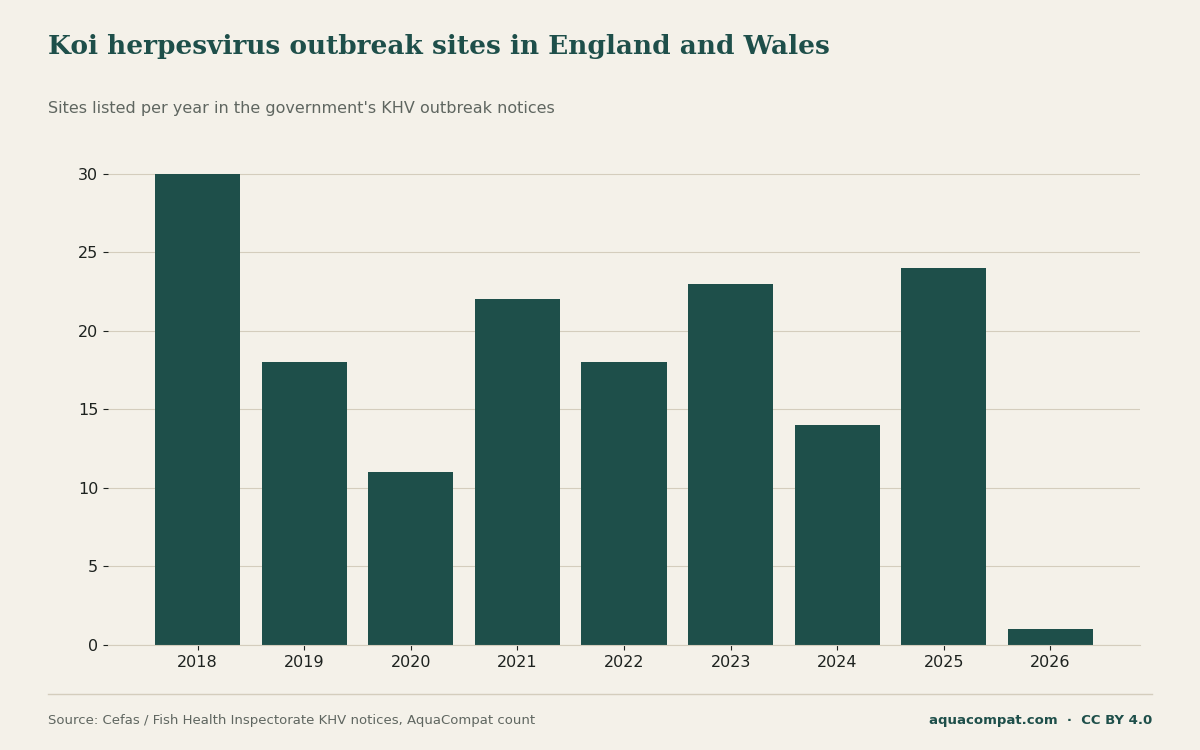
| Year | Outbreak sites | Notice last updated |
|---|---|---|
| 2018 | 30 | 2020-02-28 |
| 2019 | 18 | 2021-02-12 |
| 2020 | 11 | 2022-02-15 |
| 2021 | 22 | 2022-07-28 |
| 2022 | 18 | 2022-11-16 |
| 2023 | 23 | 2023-11-20 |
| 2024 | 14 | 2024-10-31 |
| 2025 | 24 | 2025-11-06 |
| 2026 | 1 | 2026-09-24 |
How sensitive are aquarium fish to water conditions?
Aquarium fish can die within four days of a water problem a test kit would show. The clearest published example for a popular species is a 2008 laboratory study at Brazil's National Institute of Amazonian Research (Oliveira and colleagues, Acta Amazonica), which exposed cardinal tetras to falling temperature, acid and alkaline pH, ammonia and nitrite for 96 hours.
The main results are summarised below.
- Nitrite. The 96-hour LC50, the level that kills half the fish, was 1.1 mg/L NO2-, and every fish died at 2 mg/L nitrite. Nitrite builds up while a tank's filter bacteria are still establishing, as the aquarium nitrogen cycle explains.
- Ammonia. The LC50 was 23.7 mg/L total ammonia, equal to 0.36 mg/L of the toxic unionised form, at pH 7.6. Higher pH shifts total ammonia toward the toxic unionised form, so the same total reading is more dangerous in alkaline water.
- Cold. The lower lethal temperature (LT50) was 19.6 degrees C (67.3 °F); 92% died at 17 °C and all died at 15 °C. The guide to aquarium temperature lists the temperature each common species needs and how to keep it stable.
- pH. Cardinal tetras tolerated acid water well, with no deaths down to pH 5.2, but 42.5% died at pH 8.8 and all died at pH 9.3. Our page on aquarium pH explains how pH, KH and carbon dioxide work together.
A common misreading of LC50 figures is that anything below them is safe. It is not: the LC50 is where half the fish die, and the table shows deaths well below it, such as 7% mortality at 0.5 mg/L nitrite.
| Condition | Level | Mortality after 96 h (%) |
|---|---|---|
| Low temperature (°C) | 25 | 0 |
| Low temperature (°C) | 21 | 17 |
| Low temperature (°C) | 19 | 30 |
| Low temperature (°C) | 17 | 92 |
| Low temperature (°C) | 15 | 100 |
| High temperature (°C) | 25 | 0 |
| High temperature (°C) | 27 | 0 |
| High temperature (°C) | 29 | 2.5 |
| High temperature (°C) | 31 | 25 |
| High temperature (°C) | 33 | 63 |
| High temperature (°C) | 35 | 100 |
| Acidic pH (pH units) | 6 | 0 |
| Acidic pH (pH units) | 5.6 | 0 |
| Acidic pH (pH units) | 5.2 | 0 |
| Acidic pH (pH units) | 4.7 | 5 |
| Acidic pH (pH units) | 4.3 | 15 |
| Acidic pH (pH units) | 3.6 | 45 |
| Acidic pH (pH units) | 3.1 | 72 |
| Acidic pH (pH units) | 2.6 | 100 |
| Alkaline pH (pH units) | 6 | 0 |
| Alkaline pH (pH units) | 6.5 | 2.5 |
| Alkaline pH (pH units) | 7.2 | 0 |
| Alkaline pH (pH units) | 7.4 | 2.5 |
| Alkaline pH (pH units) | 7.8 | 0 |
| Alkaline pH (pH units) | 8.4 | 0 |
| Alkaline pH (pH units) | 8.8 | 42.5 |
| Alkaline pH (pH units) | 9.3 | 100 |
| Total ammonia (mg/L) | 0 | 0 |
| Total ammonia (mg/L) | 0.9 | 0 |
| Total ammonia (mg/L) | 1.4 | 2 |
| Total ammonia (mg/L) | 8.5 | 12 |
| Total ammonia (mg/L) | 13.1 | 15 |
| Total ammonia (mg/L) | 18.6 | 38 |
| Total ammonia (mg/L) | 23.7 | 70 |
| Total ammonia (mg/L) | 35.6 | 75 |
| Un-ionized ammonia, NH3 (mg/L) | 0 | 0 |
| Un-ionized ammonia, NH3 (mg/L) | 0.022 | 0 |
| Un-ionized ammonia, NH3 (mg/L) | 0.032 | 2 |
| Un-ionized ammonia, NH3 (mg/L) | 0.19 | 12 |
| Un-ionized ammonia, NH3 (mg/L) | 0.23 | 15 |
| Un-ionized ammonia, NH3 (mg/L) | 0.31 | 38 |
| Un-ionized ammonia, NH3 (mg/L) | 0.44 | 70 |
| Un-ionized ammonia, NH3 (mg/L) | 0.85 | 75 |
| Nitrite (mg/L) | 0 | 0 |
| Nitrite (mg/L) | 0.5 | 7 |
| Nitrite (mg/L) | 1 | 40 |
| Nitrite (mg/L) | 1.5 | 65 |
| Nitrite (mg/L) | 2 | 100 |
How we built this data
AquaCompat compiled these figures from public health surveillance, peer-reviewed studies, UF/IFAS Extension and the Cefas koi herpesvirus notices on GOV.UK, all read on 22 October 2026 and listed in full under Sources. We did no laboratory or field work of our own.
Our own calculations are limited and simple.
- Shares and illnesses per outbreak in the CDC table divide CDC's published counts.
- The non-susceptible column in the Aeromonas table adds the intermediate and resistant shares.
- The koi herpesvirus counts are the number of unique sites on each yearly GOV.UK notice, collected through the GOV.UK Content API.
The data have clear limits.
- Outbreak surveillance counts only recognised outbreaks. Single cases, and illnesses never linked to an animal, are missing, so the CDC figures undercount all zoonotic illness.
- The African dwarf frog total (376 cases, 2008–2011) and CDC's frog figure (241 illnesses, 2009–2021) cover different periods and counting rules, so they cannot be compared directly.
- The frog outbreak case count and the megalocytivirus figures rest on the published abstracts only; the full texts are not open access.
- The Danish study reports slightly different patient totals in its abstract and results; we used the 53 patients with records.
- Aeromonas resistance comes from Brazilian, Hong Kong and UK samples; no comparable US survey was found.
- The cardinal tetra figures come from one laboratory study of one species, and the abstract and results give slightly different upper lethal temperatures (33.3 and 33.7 °C), so we do not headline that value.
How to cite this page
Use this citation, or link to the page with the figure you use.
AquaCompat, "Aquarium Fish Disease and Zoonosis Statistics: Salmonella, Fish Tank Granuloma, Antibiotic Resistance and KHV", updated 22 October 2026, https://aquacompat.com/data/aquarium-fish-disease-statistics/.
The data, tables and charts on this page are free to reuse under a Creative Commons Attribution 4.0 (CC BY 4.0) licence, provided you credit AquaCompat with a link to this page. Please also name the original study or agency for any single figure you quote.
Download the data
Each CSV holds one table from this page with plain column names. The charts are 1,200 by 750 pixel PNG images.
- US animal-contact outbreaks by animal, 2009–2021 (CSV) CSV · 2 KB
- Outbreaks, illnesses, shares and illnesses per outbreak by animal class, group and subgroup.
- Aeromonas antimicrobial susceptibility, ornamental fish (CSV) CSV · 1 KB
- Counts and shares susceptible, intermediate and resistant for 16 antimicrobials.
- Koi herpesvirus outbreaks by year, England and Wales (CSV) CSV · 1 KB
- Outbreak sites per year with the source notice and its last update.
- Koi herpesvirus outbreak sites, England and Wales (CSV) CSV · 10 KB
- Every listed site with year and notice date.
- Cardinal tetra 96-hour mortality by water condition (CSV) CSV · 1 KB
- Mortality at each tested temperature, pH, ammonia and nitrite level.
- Chart: illnesses from animal-contact outbreaks by animal PNG · 65 KB
- US, 2009–2021, pet fish compared with other animals.
- Chart: Aeromonas resistance by antibiotic PNG · 77 KB
- Share of 234 isolates resistant, Brazil, 2016–2019.
- Chart: koi herpesvirus outbreak sites by year PNG · 40 KB
- England and Wales, 2018–2026.
Questions people ask
Is fish tank granuloma dangerous?
Most recorded cases are skin infections. In Oregon's surveillance, 20 of 21 M. marinum infections in 2007–2012 were skin or soft tissue infections. The main problem the studies show is delay: Danish patients waited a median of 194 days before diagnosis.
Do aquarium shop fish carry megalocytivirus?
Some do. Australian researchers found megalocytivirus in 21.9% of fish sampled from aquarium shops, according to the study's published abstract, with gouramis the main group studied. A positive test shows the virus is present, not that the fish is sick.
Why are African dwarf frogs linked to more Salmonella than fish?
The frog figures are dominated by one outbreak traced to a single breeding facility, which supplied frogs to homes across the US. That produced 241 illnesses from just 2 outbreaks in CDC's 2009–2021 data, against 6 illnesses from pet fish.
Can koi herpesvirus infect people or tropical fish?
The sources used here describe koi herpesvirus only as a disease of koi and other carp, and none of them reports human infection.
What nitrite level is safe for cardinal tetras?
The 2008 Acta Amazonica study did not set a safe level, but it found deaths at every nitrite concentration tested: 7% at 0.5 mg/L, 40% at 1.0 mg/L and all fish at 2 mg/L over 96 hours. General water-quality sources used on our nitrogen cycle page note that nitrite can be toxic from 0.1 mg/L nitrite, and a fully cycled tank shows no detectable nitrite.
Sources 29 documents from 24 publishers
- Acta Amazonica, INPA (Oliveira et al.) (assinpa.inpa.gov.br): “Tolerance to temperature, pH, ammonia and nitrite in cardinal tetra, Paracheirodon axelrodi, an amazonian ornamental fish”
- Animals (MDPI), Sirri et al., University of Bologna (pmc.ncbi.nlm.nih.gov): “Swim Bladder Disorders in Koi Carp (Cyprinus carpio)”
- Brazilian Journal of Biology, Dominguez et al., University of São Paulo (scielo.br): “Parasitological diagnosis in ornamental freshwater fish from different fish farmers of five Brazilian states”
- CDC, Emerging Infectious Diseases (Henkle et al., Oregon Health Authority) (wwwnc.cdc.gov): “Surveillance of Extrapulmonary Nontuberculous Mycobacteria Infections, Oregon, USA, 2007-2012”
- CDC, MMWR Surveillance Summaries (Eisenstein et al.) (cdc.gov): “Enteric Disease Outbreaks Associated with Animal Contact - Animal Contact Outbreak Surveillance System, United States, 2009-2021”
- CDC, MMWR Weekly (cdc.gov): “Multistate Outbreak of Human Salmonella Typhimurium Infections Associated with Aquatic Frogs - United States, 2009”
- CDC, MMWR Weekly (Oregon Health Authority) (cdc.gov): “Extrapulmonary Nontuberculous Mycobacterial Disease Surveillance - Oregon, 2014-2016”
- Commonwealth of Australia, Communicable Diseases Intelligence (Musto et al., OzFoodNet) (ojs.cdi.cdc.gov.au): “Multi-drug resistant Salmonella Java infections acquired from tropical fish aquariums, Australia, 2003-04”
- Dr Tim's Aquatics (manufacturer) (drtimsaquatics.com): “Fishless Cycling”
- GOV.UK, Cefas Fish Health Inspectorate (gov.uk): “Outbreaks of Koi herpesvirus (KHV) disease in <year> (yearly notices 2018-2026)”
- Infection (Johnson and Stout, Duke University) (pmc.ncbi.nlm.nih.gov): “Twenty-eight cases of Mycobacterium marinum infection: retrospective case series and literature review”
- Journal of Fish Biology, Evers, Pinnegar and Taylor (Cefas and University of East Anglia) (ueaeprints.uea.ac.uk): “Where are they all from? – sources and sustainability in the ornamental freshwater fish trade”
- Journal of Xenobiotics, MDPI (Hong Kong Metropolitan University) (mdpi.com): “Uses of Antibiotics in Ornamental Fish in Hong Kong and the Antibiotic Resistance in the Associated Zoonotic Pathogens”
- Merck Veterinary Manual (merckvetmanual.com): “Environmental Diseases of Aquatic Animals in Aquatic Systems, Francis-Floyd, Yanong and Petty”; “Disorders and Diseases of Fish (pet owner version)”; “Management of Aquarium Fish, Petty, Francis-Floyd and Yanong”
- Microorganisms, MDPI (de Oliveira et al., University of Sao Paulo) (mdpi.com): “Characterization of Aeromonas Isolates from Ornamental Fish: Species, Virulence Genes, and Antimicrobial Susceptibility”
- Microorganisms, MDPI (Hong Kong Metropolitan University) (mdpi.com): “Impact of Prophylactic Antibiotic Use in Ornamental Fish Tanks on Microbial Communities and Pathogen Selection in Carriage Water in Hong Kong Retail Shops”
- Pediatrics (Mettee Zarecki et al., CDC Salmonella Typhimurium Outbreak Investigation Team) (pubmed.ncbi.nlm.nih.gov): “US outbreak of human Salmonella infections associated with aquatic frogs, 2008-2011”
- PLoS ONE, Verner-Jeffreys et al. (Cefas) (journals.plos.org): “High Prevalence of Multidrug-Tolerant Bacteria and Associated Antimicrobial Resistance Genes Isolated from Ornamental Fish and Their Carriage Water”
- Practical Fishkeeping (practicalfishkeeping.co.uk): “How to Cycle a Fish Tank: The Complete Guide”
- Preventive Veterinary Medicine (Rimmer et al., University of Sydney) (pubmed.ncbi.nlm.nih.gov): “Detection of dwarf gourami iridovirus (Infectious spleen and kidney necrosis virus) in populations of ornamental fish prior to and after importation into Australia”
- Scientific Reports (Holden et al.) (nature.com): “Mycobacterium marinum infections in Denmark from 2004 to 2017: A retrospective study of incidence, patient characteristics, treatment regimens and outcome”
- Southern Regional Aquaculture Center (srac.msstate.edu): “Interactions of pH, Carbon Dioxide, Alkalinity and Hardness in Fish Ponds, SRAC Publication No. 464, Wurts and Durborow”; “How to Start a Biofilter, SRAC Publication No. 4502, DeLong and Losordo”; “Nitrite in Fish Ponds, SRAC Publication No. 462, Durborow, Crosby and Brunson”; “Recirculating Aquaculture Tank Production Systems: Management of Recirculating Systems, SRAC Publication No. 452”
- UF/IFAS Extension (Livengood and Chapman) (edis.ifas.ufl.edu): “FA124: The Ornamental Fish Trade: An Introduction with Perspectives for Responsible Aquarium Fish Ownership”
- University of Florida IFAS Extension (EDIS) (ask.ifas.ufl.edu): “Ammonia in Aquatic Systems (FA16/FA031), Francis-Floyd, Watson, Petty and Pouder”
All sources accessed , . Every number on this page comes from these documents.