What are the main findings?
The findings below come from AquaCompat's species traits dataset, which covers 29 species and was checked against its published sources in October 2026.
- The Bristlenose Pleco has the longest reported lifespan of the 29 species, 25 years, a longevity record listed by Practical Fishkeeping rather than a typical age.
- Goldfish are reported to live 6–20 years and oscars 10–20 years, the widest ranges among the 14 species with both ends of a lifespan published.
- Cherry shrimp, crystal red shrimp, mystery snails and nerite snails have the shortest reported lifespans in the dataset, about 1–2 years.
- FishBase reports betta fish living up to 2 years, the lowest figure for any fish in the dataset.
- The oscar is the largest species covered, at 14 in (35.6 cm), and the chili and galaxy rasboras the smallest, at 0.8 in (2 cm); the oscar also needs the biggest minimum tank, 75 US gal (284 L).
- Small size does not mean a short life: Practical Fishkeeping's owner-reported records list the neon tetra, which reaches 1.2 in (3 cm), at up to 10 years.
- 7 of 29 species, including the molly and three Lake Malawi cichlids, have no lifespan that AquaCompat could trace to a published source.
How long do common aquarium fish live?
Most common aquarium species live two to five years, a smaller group of catfish, cichlids, loaches and goldfish is reported at 10 years or more, and cherry shrimp, crystal red shrimp, mystery snails and nerite snails are given one to two years, based on the 22 species in AquaCompat's dataset with a sourced lifespan. The chart shows the upper end of each range: what a species can reach, not an average.
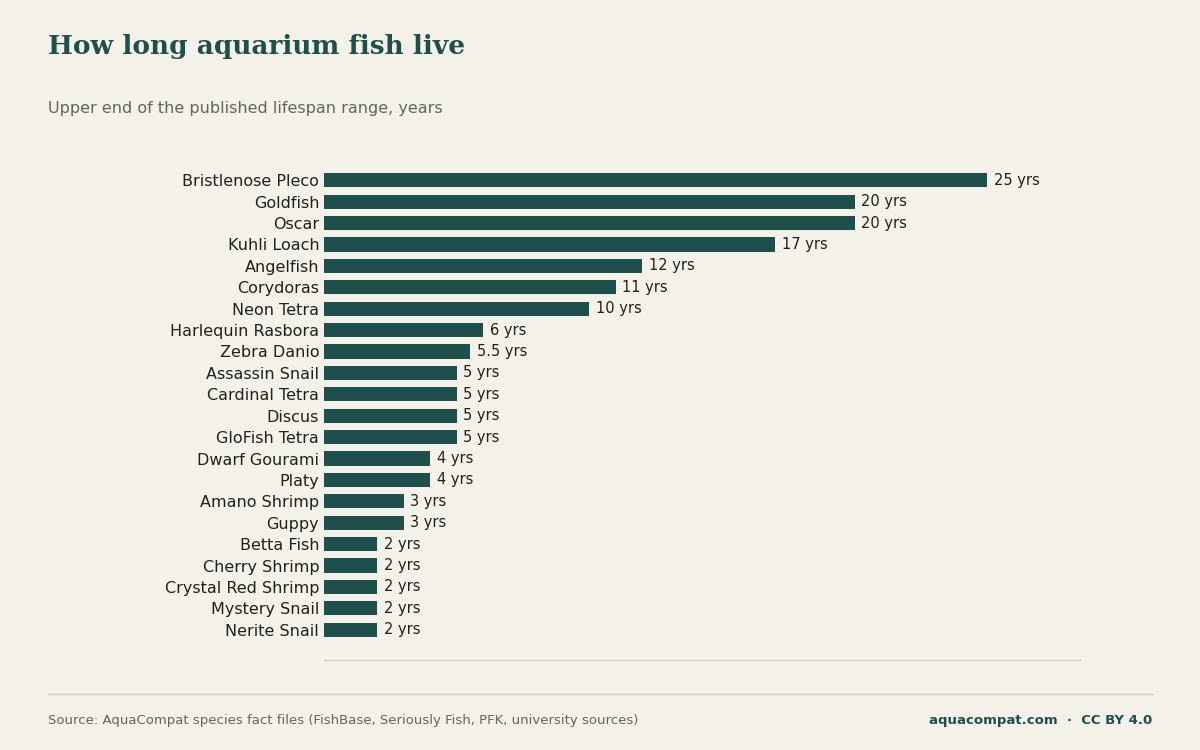
| species | scientific_name | lifespan_min_years | lifespan_max_years | evidence | sources |
|---|---|---|---|---|---|
| Bristlenose Pleco | Ancistrus sp. (3), sold as Ancistrus cf. cirrhosus | – | 25 | PFK lists Ancistrus spp. at 25 years as a longevity record. | bristlenose-pleco-s6 |
| Goldfish | Carassius auratus | 6 | 20 | OATA reports 6-8 years, up to 20+ with good water; fishkeeping.co.uk says about 20 years single-tail, about 12 fancy. | goldfish-s2, goldfish-s6 |
| Oscar | Astronotus ocellatus | 10 | 20 | Both Seriously Fish and Co-Op give a typical lifespan of 10 to 20 years. | oscar-s1, oscar-s3 |
| Kuhli Loach | Pangio kuhlii / Pangio semicincta | – | 17 | Practical Fishkeeping longevity table lists kuhli loach at 17 years, based on owner claims. | kuhli-loach-s4 |
| Angelfish | Pterophyllum scalare | 8 | 12 | Co-Op says angelfish can live up to 8-12 years. | angelfish-s3 |
| Corydoras | Corydoras spp.; reference species Corydoras aeneus, now Osteogaster aenea | – | 11 | PFK cites a bronze corydoras recorded at 11 years old. | corydoras-s6 |
| Neon Tetra | Paracheirodon innesi | – | 10 | Practical Fishkeeping longevity table lists neon tetra at 10 years, based on owner claims. | neon-tetra-s5 |
| Harlequin Rasbora | Trigonostigma heteromorpha | – | 6 | Practical Fishkeeping longevity table lists harlequin at six years, based on owner claims. | harlequin-rasbora-s5 |
| Zebra Danio | Danio rerio | 3.5 | 5.5 | FishBase: domesticated zebrafish average 3.5 years, oldest about 5.5 years. | zebra-danio-s2 |
| Assassin Snail | Anentome helena | – | 5 | Shrimp and Snail Breeder says up to 5 years in captivity. | assassin-snail-s2 |
| Cardinal Tetra | Paracheirodon axelrodi | – | 5 | Practical Fishkeeping: about a year in the wild, up to five years in captivity; its owner-claim table lists six years. | cardinal-tetra-s5, cardinal-tetra-s6 |
| Discus | Symphysodon spp. | 3 | 5 | Crampton notes captive discus typically live 3-5 years, exceptionally longer. | discus-s4 |
| GloFish Tetra | Gymnocorymbus ternetzi | 3 | 5 | Aquarium Co-Op gives approximately 3-5 years as a general GloFish average. | glofish-tetra-s3 |
| Dwarf Gourami | Trichogaster lalius | 2 | 4 | Co-Op says they live about 2-4 years with good care. | dwarf-gourami-s3 |
| Platy | Xiphophorus maculatus | 3 | 4 | Aquarium Co-Op says platies live up to 3-4 years. | platy-s3 |
| Amano Shrimp | Caridina multidentata | 2 | 3 | Shrimp Science gives a lifespan of 2-3 years. | amano-shrimp-s1 |
| Guppy | Poecilia reticulata | 2 | 3 | Aquarium Co-Op says 2-3 years at 76-78 F, about 3.5+ years at 72 F and about 18 months at 82 F. | guppy-s3 |
| Betta Fish | Betta splendens | – | 2 | FishBase gives a maximum reported age of 2 years. | betta-fish-s2 |
| Cherry Shrimp | Neocaridina davidi | 1 | 2 | Shrimp Science and Shrimp and Snail Breeder both give 1-2 years. | cherry-shrimp-s1, cherry-shrimp-s4 |
| Crystal Red Shrimp | Caridina cantonensis (aquarium 'Crystal Red' bee shrimp; trade also uses Caridina cf. cantonensis and Caridina logemanni) | 1 | 2 | Shrimp Science and Shrimp and Snail Breeder both give 1-2 years; the latter says warmer water shortens it. | crystal-red-shrimp-s1, crystal-red-shrimp-s2 |
| Mystery Snail | Pomacea diffusa | 1 | 2 | Co-Op gives an average 1-2 years depending on temperature; Applesnail.net FAQ says 12-16 months at 25C, longer when cooler. | mystery-snail-s1, mystery-snail-s6 |
| Nerite Snail | Neritina natalensis (now Vittina natalensis); hobby name covers several Neritina and related nerites | 1 | 2 | Co-Op gives about 1-2 years. | nerite-snail-s1 |
Which aquarium fish live the longest?
The longest-lived species in the dataset are the bristlenose pleco, goldfish, oscar and kuhli loach, each with a published figure of 17 years or more. The oscar's 10–20 years is a typical range given by both Seriously Fish and Aquarium Co-Op. The goldfish range combines OATA's six to eight years, which it says can pass 20 with good water, and fishkeeping.co.uk's estimate of about 20 years for single-tailed goldfish. The figures for the bristlenose pleco and the kuhli loach (up to 17 years) come from Practical Fishkeeping's table of owner-reported records.
These species are a decade-long plan, which is why the oscar tank-mate list and the goldfish tank mates guide are built around adult fish. Angelfish (8–12 years, per Aquarium Co-Op) and corydoras (a bronze corydoras recorded at 11 years, per Practical Fishkeeping) sit just below; see the angelfish compatibility list and the corydoras tank-mate guide.
Which aquarium animals have the shortest lives?
Dwarf shrimp and small snails have the shortest lives in the dataset. Shrimp Science and Shrimp and Snail Breeder give cherry shrimp and crystal red shrimp 1–2 years, and Aquarium Co-Op gives the mystery snail 1–2 years. A breeding colony of cherry shrimp and their tank mates replaces itself, so steady water matters more than the age of any one shrimp. Among snails only the assassin snail, at up to 5 years, is a longer-term addition to a snail-friendly community.
Among fish, the betta has the shortest sourced figure: FishBase reports Betta splendens living up to 2 years as a maximum, and it is the only betta lifespan source in AquaCompat's file, so it should be read as one reference value.
Which aquarium fish grow the biggest?
The oscar grows the biggest of the 29 species, reaching 14 in (35.6 cm), followed by the goldfish at 10 in (25.4 cm) and the angelfish at 6 in (15.2 cm), according to AquaCompat's dataset. Apart from those three, the discus, the kenyi and peacock cichlids, the bristlenose pleco and the molly, every species stays under four inches.
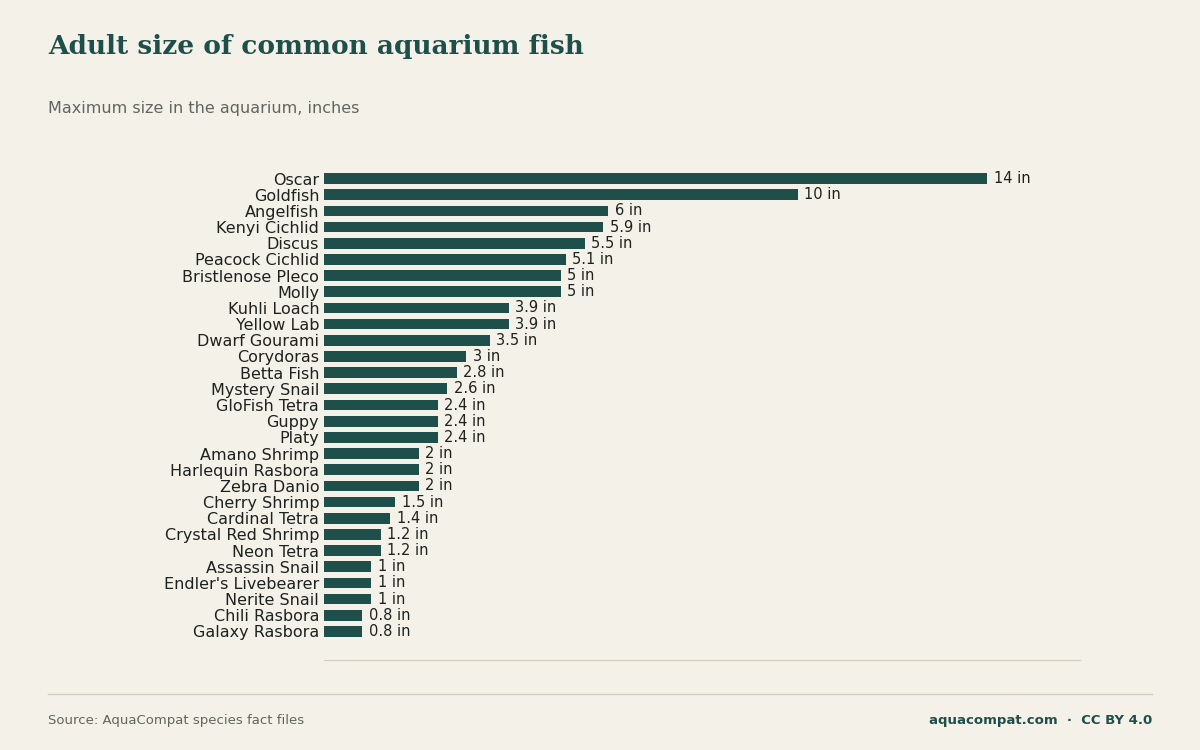
| species | scientific_name | max_size_in | evidence | sources |
|---|---|---|---|---|
| Oscar | Astronotus ocellatus | 14 | Seriously Fish 350 mm SL (14 in); FishBase max 45.7 cm TL, common 24 cm; Co-Op 10-12 in or more. | oscar-s1, oscar-s2, oscar-s3 |
| Goldfish | Carassius auratus | 10 | OATA says about 25 cm (9.8 in) in aquaria; fishkeeping.co.uk says single-tails normally 10 in, sometimes 12 in; FishBase max 48 cm TL. | goldfish-s2, goldfish-s6, goldfish-s1 |
| Angelfish | Pterophyllum scalare | 6 | Seriously Fish gives 150 mm SL and over 20 cm tall; Co-Op gives 6 in long and 8 in tall including fins. | angelfish-s1, angelfish-s3 |
| Kenyi Cichlid | Maylandia lombardoi | 5.9 | Seriously Fish 150 mm SL (about 5.9 in); FishBase 8.7 cm SL for wild fish. | kenyi-cichlid-s1, kenyi-cichlid-s2 |
| Discus | Symphysodon spp. | 5.5 | Seriously Fish 140 mm SL; FishBase 13.7 cm SL (about 5.4 in); Co-Op 5-7 in diameter in captivity. Seriously Fish 140 mm SL converts to 5.5 in. | discus-s1, discus-s2, discus-s3 |
| Peacock Cichlid | Aulonocara spp. (reference species: Aulonocara stuartgranti) | 5.1 | Seriously Fish A. stuartgranti 130 mm SL (about 5.1 in); FishBase 11.8 cm TL. | peacock-cichlid-s1, peacock-cichlid-s2 |
| Bristlenose Pleco | Ancistrus sp. (3), sold as Ancistrus cf. cirrhosus | 5.0 | PlanetCatfish and Seriously Fish give 125 mm (about 5 in) SL. | bristlenose-pleco-s1, bristlenose-pleco-s2 |
| Molly | Poecilia sphenops / Poecilia latipinna complex (hobby strains, often hybrids) | 5 | Aquarium Co-Op says up to 4-5 in (10-13 cm); Seriously Fish lists P. latipinna to 125 mm SL (4.9 in). | molly-s5, molly-s3 |
| Kuhli Loach | Pangio kuhlii / Pangio semicincta | 3.9 | Seriously Fish: 100 mm SL (3.9 in); Aquarium Co-Op 3-4 in. FishBase gives 12 cm TL for P. kuhlii. | kuhli-loach-s1, kuhli-loach-s3 |
| Yellow Lab | Labidochromis caeruleus | 3.9 | Seriously Fish 100 mm SL (3.9 in); FishBase 8.1 cm SL. Hobby sources quote larger total lengths. | yellow-lab-s1, yellow-lab-s2 |
| Dwarf Gourami | Trichogaster lalius | 3.5 | Seriously Fish 88 mm SL (about 3.5 in); FishBase 9.5 cm TL (3.7 in); Co-Op up to 3 in. | dwarf-gourami-s1, dwarf-gourami-s2, dwarf-gourami-s3 |
| Corydoras | Corydoras spp.; reference species Corydoras aeneus, now Osteogaster aenea | 3.0 | Bronze cory reaches 75 mm (3 in) SL; males smaller, to about 65 mm. | corydoras-s1, corydoras-s2, corydoras-s3 |
| Betta Fish | Betta splendens | 2.8 | Seriously Fish: 70 mm SL (about 2.8 in); FishBase: 6.5 cm TL (about 2.6 in). | betta-fish-s1, betta-fish-s2 |
| Mystery Snail | Pomacea diffusa | 2.6 | Applesnail.net gives shells 40-50 mm wide and 45-65 mm high (65 mm = 2.6 in); Co-Op says about 2 in (5 cm) across. | mystery-snail-s2, mystery-snail-s1 |
| GloFish Tetra | Gymnocorymbus ternetzi | 2.4 | Seriously Fish: 60 mm SL (2.4 in) for the black tetra. FishBase gives 7.5 cm SL. | glofish-tetra-s1 |
| Guppy | Poecilia reticulata | 2.4 | Seriously Fish lists 60 mm SL; FishBase lists females to 6.0 cm SL, males to 5.0 cm SL. 60 mm = 2.4 in. | guppy-s1, guppy-s2 |
| Platy | Xiphophorus maculatus | 2.4 | FishBase lists females to 6.0 cm TL (2.4 in) and males to 4.0 cm TL; Seriously Fish lists 50 mm SL. | platy-s2, platy-s1 |
| Amano Shrimp | Caridina multidentata | 2.0 | Grows to about 5 cm (2 in). | amano-shrimp-s1, amano-shrimp-s3, amano-shrimp-s2 |
| Harlequin Rasbora | Trigonostigma heteromorpha | 2.0 | FishBase 5.0 cm TL; Aquarium Co-Op and Practical Fishkeeping about 2 in (5 cm). Seriously Fish gives 45 mm SL. | harlequin-rasbora-s2, harlequin-rasbora-s3, harlequin-rasbora-s4 |
| Zebra Danio | Danio rerio | 2.0 | Seriously Fish: 50 mm SL (2.0 in); Aquarium Co-Op about 2-2.5 in. FishBase 3.8 cm SL. | zebra-danio-s1, zebra-danio-s3 |
| Cherry Shrimp | Neocaridina davidi | 1.5 | Females reach about 1.5 in (4 cm); males stay around 1-1.25 in. | cherry-shrimp-s2, cherry-shrimp-s4 |
| Cardinal Tetra | Paracheirodon axelrodi | 1.4 | Seriously Fish: 35 mm SL (1.4 in SL). FishBase 3.0 cm SL; Aquarium Co-Op 1.75 in. | cardinal-tetra-s1 |
| Crystal Red Shrimp | Caridina cantonensis (aquarium 'Crystal Red' bee shrimp; trade also uses Caridina cf. cantonensis and Caridina logemanni) | 1.2 | Shrimp Science 30 mm; Shrimp and Snail Breeder 2.5-3 cm. | crystal-red-shrimp-s1, crystal-red-shrimp-s2 |
| Neon Tetra | Paracheirodon innesi | 1.2 | Seriously Fish: 30 mm SL (1.2 in); FishBase: 2.5 cm SL. | neon-tetra-s1, neon-tetra-s2 |
| Assassin Snail | Anentome helena | 1.0 | Aquarium Co-Op up to 1 in (2.5 cm); Shrimp and Snail Breeder 2.5-3 cm. | assassin-snail-s1, assassin-snail-s2 |
| Endler's Livebearer | Poecilia wingei | 1.0 | Seriously Fish lists 25 mm SL (1.0 in); FishBase lists 2.0 cm SL for females. | endler-s1, endler-s2 |
| Nerite Snail | Neritina natalensis (now Vittina natalensis); hobby name covers several Neritina and related nerites | 1.0 | Zebra nerite shells reach about 2.5 cm (1 in). | nerite-snail-s3, nerite-snail-s4, nerite-snail-s2 |
| Chili Rasbora | Boraras brigittae | 0.8 | Seriously Fish 20 mm SL; Aquarium Co-Op about 3/4 in (2 cm). | chili-rasbora-s1, chili-rasbora-s3 |
| Galaxy Rasbora | Danio margaritatus | 0.8 | Seriously Fish and FishBase 21 mm SL; Aquarium Co-Op up to 1 in (2.5 cm). | galaxy-rasbora-s1, galaxy-rasbora-s2, galaxy-rasbora-s3 |
Why do size figures for the same fish disagree?
Size figures disagree mainly because sources measure different things. Seriously Fish usually quotes standard length (SL), which leaves out the tail fin, while FishBase often quotes the largest total length (TL) recorded, tail included. For the oscar, Seriously Fish gives 350 mm SL, Aquarium Co-Op 10 to 12 inches or more, and FishBase a maximum of 45.7 cm TL with a common length of 24 cm; AquaCompat's 14 in (35.6 cm) follows Seriously Fish. For goldfish, OATA gives about 25 cm in aquaria and FishBase a maximum of 48 cm TL. Height matters too: Aquarium Co-Op describes angelfish as 6 inches long but 8 inches tall including fins.
Adult size also drives compatibility. Seriously Fish and Maidenhead Aquatics say the angelfish eats neon-sized tetras, and Maidenhead says discus tank mates must not be small enough for an adult discus to swallow, a rule reflected in the discus tank-mate rankings. The species compatibility checker compares adult sizes, not shop sizes, for the same reason.
How big a tank does each species need?
Minimum tank sizes in the dataset run from 5 US gal (19 L) for cherry shrimp and single snails to 75 US gal (284 L) for one oscar. Most small schooling fish land between 10 and 20 US gallons, and the cichlids need 40 gallons or more. The table gives the basis for each figure.
- Oscar75
- Discus67
- Kenyi Cichlid55
- Peacock Cichlid55
- Angelfish53
- Goldfish48
- Yellow Lab40
- Bristlenose Pleco20
- Corydoras20
- GloFish Tetra20
- Molly20
- Zebra Danio20
- Cardinal Tetra15
- Dwarf Gourami15
- Harlequin Rasbora15
- Kuhli Loach15
- Neon Tetra15
- Platy14
- Amano Shrimp10
- Betta Fish10
- Chili Rasbora10
- Crystal Red Shrimp10
- Endler's Livebearer10
- Galaxy Rasbora10
- Guppy10
- Assassin Snail5
- Cherry Shrimp5
- Mystery Snail5
- Nerite Snail5
Minimums are AquaCompat's conversion of each source's tank footprint or volume to US gallons, as recorded in the basis column.
| species | scientific_name | min_tank_gal | basis | sources |
|---|---|---|---|---|
| Oscar | Astronotus ocellatus | 75 | Aquarium Co-Op recommends 75 gal for one oscar and 90-100 gal for two. Seriously Fish gives a 150 x 60 cm base as just enough for one adult. | oscar-s1, oscar-s3 |
| Discus | Symphysodon spp. | 67 | Seriously Fish recommends 120 x 45 x 45 cm, 255 L (about 67.4 US gal) for a few juveniles or a breeding pair. | discus-s1 |
| Kenyi Cichlid | Maylandia lombardoi | 55 | Seriously Fish base of 120 x 45 cm, about 205 L (54 US gal), rounded up to 55; Maidenhead also says at least 4 ft long. | kenyi-cichlid-s1, kenyi-cichlid-s3 |
| Peacock Cichlid | Aulonocara spp. (reference species: Aulonocara stuartgranti) | 55 | Seriously Fish base of 120 x 45 cm (listed as about 243 L) and Maidenhead's at least 4 ft long; a US 55 gal is the smallest common tank with a 4 ft (48 in) length. | peacock-cichlid-s1, peacock-cichlid-s3, peacock-cichlid-s5 |
| Angelfish | Pterophyllum scalare | 53 | Seriously Fish recommends 100 x 40 x 50 cm (200 L), which is about 52.8 US gal; rounded to 53. | angelfish-s1 |
| Goldfish | Carassius auratus | 48 | Single-tail (common, comet, shubunkin) figure from fishkeeping.co.uk: 180 L (48 US gal) for the first fish plus 55 L (about 12 US gal) per extra fish, tank at least 120 cm long. Fancy goldfish need less: 20-37 US gal for the first fish depending on source (see variants and conflicts). OATA gives 100 L (26.4 US gal) for any adult goldfish. | goldfish-s6, goldfish-s7, goldfish-s4, goldfish-s2, goldfish-s3 |
| Yellow Lab | Labidochromis caeruleus | 40 | Seriously Fish base of 90 x 45 cm, about 154 L (40.7 US gal), for a species group; Maidenhead and Practical Fishkeeping want 4 ft (120 cm) or more for a mixed mbuna tank. | yellow-lab-s1, yellow-lab-s3, yellow-lab-s4 |
| Bristlenose Pleco | Ancistrus sp. (3), sold as Ancistrus cf. cirrhosus | 20 | Co-Op recommends 20-29 gal or more for adults and a 20 gal long for breeding. | bristlenose-pleco-s4 |
| Corydoras | Corydoras spp.; reference species Corydoras aeneus, now Osteogaster aenea | 20 | Co-Op recommends 20 gal or more for most non-dwarf corys; Seriously Fish's 80 x 30 cm base works out at about 19 US gal. | corydoras-s4, corydoras-s2 |
| GloFish Tetra | Gymnocorymbus ternetzi | 20 | Seriously Fish minimum base 75 x 30 cm (about 67.5 L or 17.8 US gal at 30 cm depth); Aquarium Co-Op recommends at least 20 gal for a GloFish tetra school | glofish-tetra-s1, glofish-tetra-s3 |
| Molly | Poecilia sphenops / Poecilia latipinna complex (hobby strains, often hybrids) | 20 | Aquarium Co-Op says at least 20 gal, with 29-55 gal better for larger types. Seriously Fish base footprints: P. sphenops 90 x 30 cm (about 81 L, 21.4 US gal); P. latipinna 76 x 38 cm (about 87 L, 23 US gal). | molly-s5, molly-s1, molly-s3 |
| Zebra Danio | Danio rerio | 20 | Seriously Fish minimum base 90 x 30 cm (about 81 L or 21.4 US gal at 30 cm depth); Aquarium Co-Op recommends a 20-gallon long or longer | zebra-danio-s1, zebra-danio-s3 |
| Cardinal Tetra | Paracheirodon axelrodi | 15 | Seriously Fish minimum base 60 x 30 cm, about 54 L (14.3 US gal) at 30 cm depth, rounded up to 15; Aquarium Co-Op recommends 15-20 gal for 8-10 fish | cardinal-tetra-s1, cardinal-tetra-s3 |
| Dwarf Gourami | Trichogaster lalius | 15 | Seriously Fish: 60 x 30 x 30 cm (56 L, about 14.8 US gal) is just big enough for a pair; rounded to 15. Co-Op gives 10 gal for a single fish. | dwarf-gourami-s1, dwarf-gourami-s3 |
| Harlequin Rasbora | Trigonostigma heteromorpha | 15 | Seriously Fish minimum base 60 x 30 cm, about 54 L (14.3 US gal) at 30 cm depth, rounded up to 15; Practical Fishkeeping and FishBase also give a 60 cm tank | harlequin-rasbora-s1, harlequin-rasbora-s2, harlequin-rasbora-s4 |
| Kuhli Loach | Pangio kuhlii / Pangio semicincta | 15 | Seriously Fish minimum base 60 x 30 cm, about 54 L (14.3 US gal) at 30 cm depth, rounded up to 15; Aquarium Co-Op suggests 20 gal or more for a group | kuhli-loach-s1, kuhli-loach-s3 |
| Neon Tetra | Paracheirodon innesi | 15 | Seriously Fish minimum base 60 x 30 cm, about 54 L (14.3 US gal), rounded up to 15; FishBase also gives a 60 cm minimum aquarium length | neon-tetra-s1, neon-tetra-s2 |
| Platy | Xiphophorus maculatus | 14 | Seriously Fish base footprint of 60 x 30 cm, about 54 L (14.3 US gal). FishBase gives a 60 cm minimum tank length; Aquarium Co-Op says 10-20 gal or larger. | platy-s1, platy-s2, platy-s3 |
| Amano Shrimp | Caridina multidentata | 10 | Shrimp and Snail Breeder recommends 10 gal or more at about 1 shrimp per 2 gal; Co-Op says they suit most nano tanks with a tight lid. | amano-shrimp-s7, amano-shrimp-s2 |
| Betta Fish | Betta splendens | 10 | Seriously Fish base of 45 x 30 cm for a male or pair (about 40 L, 10.7 US gal, if 30 cm tall); Aquarium Co-Op says 5-10 gal minimum and recommends 10 gal. | betta-fish-s1, betta-fish-s4 |
| Chili Rasbora | Boraras brigittae | 10 | Seriously Fish base of 45 x 30 cm, about 41 L (about 11 US gal); Aquarium Co-Op allows 3 gal for a planted nano tank. | chili-rasbora-s1, chili-rasbora-s3 |
| Crystal Red Shrimp | Caridina cantonensis (aquarium 'Crystal Red' bee shrimp; trade also uses Caridina cf. cantonensis and Caridina logemanni) | 10 | Shrimp and Snail Breeder gives 10 gal (40 L) minimum; Shrimp Science allows 5 gal but recommends 10 gal or more for stability. | crystal-red-shrimp-s1, crystal-red-shrimp-s2 |
| Endler's Livebearer | Poecilia wingei | 10 | Seriously Fish gives 45 x 30 x 30 cm (40.5 L, 10.7 US gal). Aquarium Co-Op says 5-10 gal and advises larger because of fry output. | endler-s1, endler-s4 |
| Galaxy Rasbora | Danio margaritatus | 10 | Seriously Fish base of 45 x 30 cm, about 41 L (about 11 US gal); Aquarium Co-Op says 10 gal minimum for a small group and 20 gal or more for 10-15 fish. | galaxy-rasbora-s1, galaxy-rasbora-s3 |
| Guppy | Poecilia reticulata | 10 | Seriously Fish base footprint of 45 x 30 cm, about 41 L (10.8 US gal). FishBase gives a 60 cm minimum tank length; Aquarium Co-Op allows 5 gal for a trio but prefers 10-20 gal because of breeding. | guppy-s1, guppy-s2, guppy-s3 |
| Assassin Snail | Anentome helena | 5 | Shrimp and Snail Breeder gives 5 gal minimum and 10 gal optimal; Aquarium Co-Op says one snail can live in 2 gal or more. | assassin-snail-s1, assassin-snail-s2 |
| Cherry Shrimp | Neocaridina davidi | 5 | Smallest tank Shrimp Science and Shrimp and Snail Breeder give for a colony; 10 gal or more recommended for breeding colonies. | cherry-shrimp-s1, cherry-shrimp-s4, cherry-shrimp-s2 |
| Mystery Snail | Pomacea diffusa | 5 | Co-Op says one or two snails can live in 5 gal or more with a tight lid. | mystery-snail-s1, mystery-snail-s3 |
| Nerite Snail | Neritina natalensis (now Vittina natalensis); hobby name covers several Neritina and related nerites | 5 | Shrimp and Snail Breeder stocking guide of one snail per 5 gal (20 l). | nerite-snail-s2 |
What does a minimum tank size actually cover?
A minimum tank size covers the smallest group the source had in mind, not a full community. Seriously Fish usually gives a base footprint, such as 60 by 30 cm for the neon tetra, which AquaCompat converts at 30 cm depth and rounds up to 15 US gal (57 L). Aquarium Co-Op's 75 gallons for the oscar is for one fish, rising to 90 to 100 gallons for two.
Goldfish have the widest spread. The 48 US gal (182 L) figure is fishkeeping.co.uk's recommendation for one single-tailed goldfish, plus about 12 US gallons per extra fish; fancy goldfish are given 20 to 37 US gallons depending on the source, and OATA gives 100 litres for any adult goldfish. For bettas, Aquarium Co-Op says 5 to 10 gallons minimum and recommends 10, the figure used here.
Mixed tanks need more than the largest single minimum. The aquarium stocking calculator checks a planned group against a chosen tank, and the tank setups by size show which species fit a given volume, such as the 10-gallon community tank and the 20-gallon planted tank.
Which species have no sourced lifespan?
Of the species on this page, 7 of 29 species have no lifespan figure that AquaCompat could trace to a published source, so they are left blank rather than filled with an estimate. Their size and tank figures are sourced and appear in the tables above.
- Molly, a hybrid-rich livebearer group (see the molly care guide)
- Endler's livebearer (see the Endler's livebearer profile)
- Kenyi cichlid
- Peacock cichlid
- Yellow lab
- Chili rasbora
- Galaxy rasbora
The three Lake Malawi cichlids share one page of African cichlid tank mates. A sourced lifespan will be added to the dataset when one is found.
Why do published lifespans for the same fish vary so much?
Published lifespans vary because sources report different things: typical captive ages, single record fish, wild ages and ages at a particular water temperature.
- Records versus typical ages. Practical Fishkeeping's longevity table lists the oldest fish its readers reported, including the harlequin rasbora (up to 6 years). These are upper limits, not what most owners should expect.
- Wild versus captive. Practical Fishkeeping says cardinal tetras live about a year in the wild but up to five years in captivity.
- Average versus oldest. FishBase gives domesticated zebrafish an average of 3.5 years and an oldest of about 5.5 years.
- Temperature. Aquarium Co-Op says guppies live 2 to 3 years at 76 to 78 °F (24 to 26 °C) but about 18 months at 82 °F (28 °C). Applesnail.net gives mystery snails 12 to 16 months at 25 °C (77 °F), longer when cooler.
- Variety. Fishkeeping.co.uk puts single-tailed goldfish at about 20 years and fancy goldfish at about 12.
A common belief is that small fish are short-lived and big fish long-lived. The data do not support it as a rule: the neon tetra, at 1.2 in (3 cm), has an owner-reported record of 10 years, while captive discus typically live 3–5 years, exceptionally longer, according to a 2008 Neotropical Ichthyology paper by Crampton. Keeping water within each species' range, as set out in the aquarium temperature guide, matters more than body size.
What do lifespan and adult size mean when you buy a fish?
A juvenile oscar can grow to 14 in (35.6 cm) and live 10–20 years, a commitment to a 75 US gal (284 L) tank for over a decade. The bristlenose pleco is a gentler case: a long record age, but a modest 5 in (12.7 cm) and a 20 US gal (76 L) minimum.
Short-lived species carry a different commitment, about breeding and replacement rather than decades. Aquarium Co-Op notes that female guppies give birth about every 30 days, and the guppy community guide covers tank mates for a growing livebearer group; the best betta companions page covers the betta's shorter horizon.
Three checks are worth making before buying.
- Look up the adult size, not the shop size, of every species planned.
- Check each species' minimum tank, then run the whole group through the stocking calculator.
- Plan for the upper end of the lifespan range: a long-lived species needs a tank you expect to keep running that long.
Full care data for each animal is in the species directory.
How we built this data
AquaCompat keeps one fact file for each of the 29 species on the site. Each value in a fact file was copied from a named published source (mainly Seriously Fish, FishBase, Aquarium Co-Op, Practical Fishkeeping, Shrimp Science and OATA), with a short evidence note on what the source says. Sources were checked in October 2026. The tables on this page are exported directly from those files; no value was added for this page.
Definitions used:
- Lifespan is the minimum and maximum years a source gives. Where a source gives only a maximum or a record age, the minimum is blank.
- Adult size is a representative maximum adult length in inches, usually Seriously Fish's standard length.
- Minimum tank is the smallest tank a source recommends, converted to US gallons. Footprints are converted at the stated depth, or 30 cm when none is given, and rounded up.
AquaCompat's own calculations are limited to unit conversions and sorting. The data have clear limits.
- Most lifespan figures are expert estimates or owner reports rather than measured studies of aquarium fish.
- Several maxima are single records and overstate what most fish reach.
- Group names such as corydoras, molly and nerite snail cover several species; values follow a named reference species.
- The 29 species are popular freshwater species, not a random sample of the hobby.
The wider approach to sources and scoring is set out on the AquaCompat methodology page.
How to cite this page
Use this citation, or link to the page with the figure you use.
AquaCompat, "How Long Do Aquarium Fish Live? Lifespan, Size and Tank Data for 29 Species", updated 22 October 2026, https://aquacompat.com/data/aquarium-fish-lifespan-and-size/.
The data, tables and charts on this page are free to reuse under a Creative Commons Attribution 4.0 (CC BY 4.0) licence, provided you credit AquaCompat with a link to this page. Please also name the original source shown in each figure's evidence note.
Download the data
The CSV holds one row per species with size, lifespan, minimum tank, temperature, pH, hardness, temperament, care level and a source count. The charts are 1,200 by 750 pixel PNG images.
- Aquarium species traits, 29 species (CSV) CSV · 4 KB
- Size, lifespan, minimum tank and water parameters; blank cells where no sourced value exists.
- Chart: how long aquarium fish live PNG · 81 KB
- Upper end of the published lifespan range for 22 species.
- Chart: adult size of common aquarium fish PNG · 88 KB
- Maximum adult size in inches for 29 species.
Questions people ask
Do goldfish really live for 20 years?
Which aquarium fish is longest-lived for a small tank?
Why does this page give no lifespan for mollies?
Sources 124 documents from 18 publishers
- Applesnail.net (applesnail.net): “Apple snail FAQ”; “Pomacea diffusa”; “How to take care of apple snails”; “Quick guide”
- Aqualog (aqualog.de): “Discus (lexicon profile)”
- Aquarium Co-Op (aquariumcoop.com): “Oscar Fish Care Guide”; “Care Guide for Nerite Snails”; “Celestial Pearl Danio care guide”; “Care Guide for Amano Shrimp”; “Freshwater Angelfish Care Guide”; “Care Guide for Assassin Snails”; “Betta Fish Care Guide”; “Care Guide for Plecostomus”; “Care Guide for Cardinal Tetras”; “Care Guide for Cherry Shrimp”; “Chili Rasbora care guide”; “Care Guide for Cory Catfish”; “Discus Fish Care Guide”; “Care Guide for Dwarf Gouramis”; “Endler's Livebearer Care Guide”; “Care Guide for GloFish”; “Care Guide for Fancy Goldfish”; “Guppy Care Guide”; “Care Guide for Harlequin Rasboras and Lambchop Rasboras”; “Care Guide for Kuhli Loaches”; “Care Guide for Mollies: Feeding, Breeding, and Tank Mates”; “Care Guide for Mystery Snails”; “Care Guide for Platy Fish: Feeding, Breeding, and Tank Mates”; “Care Guide for Zebra and Leopard Danios”; “Goldfish Tank Mates”; “10 Best Top-Dwelling Fish for Your Freshwater Community Aquarium”; “What Is Neon Tetra Disease and How Can It Be Prevented?”; “Neon and Cardinal Tetras: Beginner Schooling Fish”; “Top 5 Dither Fish to Help Shy or Aggressive Fish in Freshwater Tanks”; “Betta fish tank mates”
- AquariumInfo.org (aquariuminfo.org): “Apple Snail”
- FishBase (fishbase.se): “Betta splendens, Siamese fighting fish: species summary”; “Astronotus ocellatus, Oscar: species summary”; “Danio margaritatus summary page”; “Paracheirodon innesi summary page”; “Osteogaster aenea, Bronze corydoras”; “Symphysodon aequifasciatus, Blue discus: species summary”; “Trichogaster lalius, Dwarf gourami: species summary”; “Poecilia wingei, Endlers guppy: species summary”; “Carassius auratus, Goldfish: species summary”; “Poecilia reticulata, Guppy: species summary”; “Trigonostigma heteromorpha summary page”; “Maylandia lombardoi summary page”; “Aulonocara stuartgranti summary page”; “Xiphophorus maculatus, Southern platyfish: species summary”; “Labidochromis caeruleus summary page”; “Danio rerio summary page”; “Length-weight relationships for Carassius auratus”; “Length-weight relationships for Osteogaster aenea”; “Length-weight relationships for Astronotus ocellatus”; “Pterophyllum scalare, Freshwater angelfish: species summary”; “Length-weight relationships for Pterophyllum scalare”; “Paracheirodon axelrodi summary (Bayesian length-weight estimate)”; “Length-weight relationships for Poecilia reticulata”
- fishkeeping.co.uk (fishkeeping.co.uk): “Goldfish Size, Life Expectancy and Tank Recommendations”; “Keeping Goldfish - The Right Way”
- Maidenhead Aquatics (fishkeeper.co.uk species data sheet) (fishkeeper.co.uk): “Kenyi data sheet”; “Zebra Nerite Snail”; “Hybrid Peacock (Aulonocara sp.) data sheet”; “Yellow Labidochromis data sheet”; “Siamese Fighting Fish/Betta data sheet”; “Oscar data sheet”; “Angelfish data sheet”; “Discus data sheet”; “Neon Tetra data sheet”; “Harlequin Rasbora data sheet”; “Guppy data sheet”
- Neotropical Ichthyology (Crampton 2008) (scielo.br): “Ecology and life history of an Amazon floodplain cichlid: the discus fish Symphysodon”
- Ornamental Aquatic Trade Association (OATA) (ornamentalfish.org): “How to look after goldfish in an aquarium / fish tank”; “How to look after fancy goldfish”
- PlanetCatfish (via Internet Archive snapshot, 2025) (web.archive.org): “Ancistrus sp. (3) Common Bristlenose Catfish Cat-eLog data sheet”; “Osteogaster aenea (Bronze Cory) Cat-eLog data sheet”
- Practical Fishkeeping (practicalfishkeeping.co.uk): “Amano shrimp: Spineless heroes (Nathan Hill)”; “How long will my fish live?”; “Cardinal tetra, Paracheirodon axelrodi”; “A guide to the small rasboras from the genus Trigonostigma”; “Malawi's finest: The Yellow lab, Labidochromis caeruleus”; “What water temperature do goldfish need?”; “How can I breed goldfish in my aquarium?”; “What can I keep in my hard water aquarium?”
- Practical Fishkeeping (Julian Dignall) (practicalfishkeeping.co.uk): “Focus on commonly kept Corydoras”
- Seriously Fish (seriouslyfish.com): “Astronotus ocellatus”; “Danio margaritatus (Celestial Pearl Danio)”; “Paracheirodon innesi (Neon Tetra)”; “Maylandia lombardoi”; “Poecilia sphenops”; “Aulonocara stuartgranti”; “Labidochromis caeruleus”; “Pterophyllum scalare”; “Betta splendens”; “Ancistrus sp. '3' (Common Bristlenose Catfish)”; “Paracheirodon axelrodi (Cardinal Tetra)”; “Boraras brigittae”; “Osteogaster aenea (Bronze Cory)”; “Symphysodon aequifasciatus”; “Trichogaster lalius”; “Poecilia wingei”; “Gymnocorymbus ternetzi (Black Widow Tetra)”; “Poecilia reticulata”; “Trigonostigma heteromorpha (Harlequin)”; “Pangio semicincta ('Kuhli' Loach)”; “Poecilia latipinna”; “Aulonocara baenschi”; “Xiphophorus maculatus”; “Danio rerio (Zebra Danio)”
- Shrimp and Snail Breeder (aquariumbreeder.com): “Amano Shrimp: detailed guide, care, diet and breeding”; “Assassin Snail: detailed guide, care, diet and breeding”; “Red Cherry Shrimp: detailed guide, care, diet and breeding”; “Crystal Red Shrimp: detailed guide, care, diet and breeding”; “Nerite Snails: detailed guide, care, diet and breeding”; “Cherry shrimp in a community tank: how to make it successful”
- Shrimp Science (shrimpscience.com): “Amano Shrimp”; “Red Cherry Shrimp - Care Guide”; “Crystal Red Shrimp - Care Guide”
- Tropical Fish Hobbyist Magazine (tfhmagazine.com): “Betta splendens”; “Astronotus sp.”
- UF/IFAS EDIS (ask.ifas.ufl.edu): “Evolution, Culture, and Care for Betta splendens (FA212)”
- Wikipedia (en.wikipedia.org): “Vittina natalensis”
All sources accessed . Every number on this page comes from these documents.